


 Dylan Hoback
Accu-Tube
Dylan Hoback
Accu-Tube
My Praxie analytics software transformed our operations, enabling data-driven decisions and streamlining our manufacturing process.

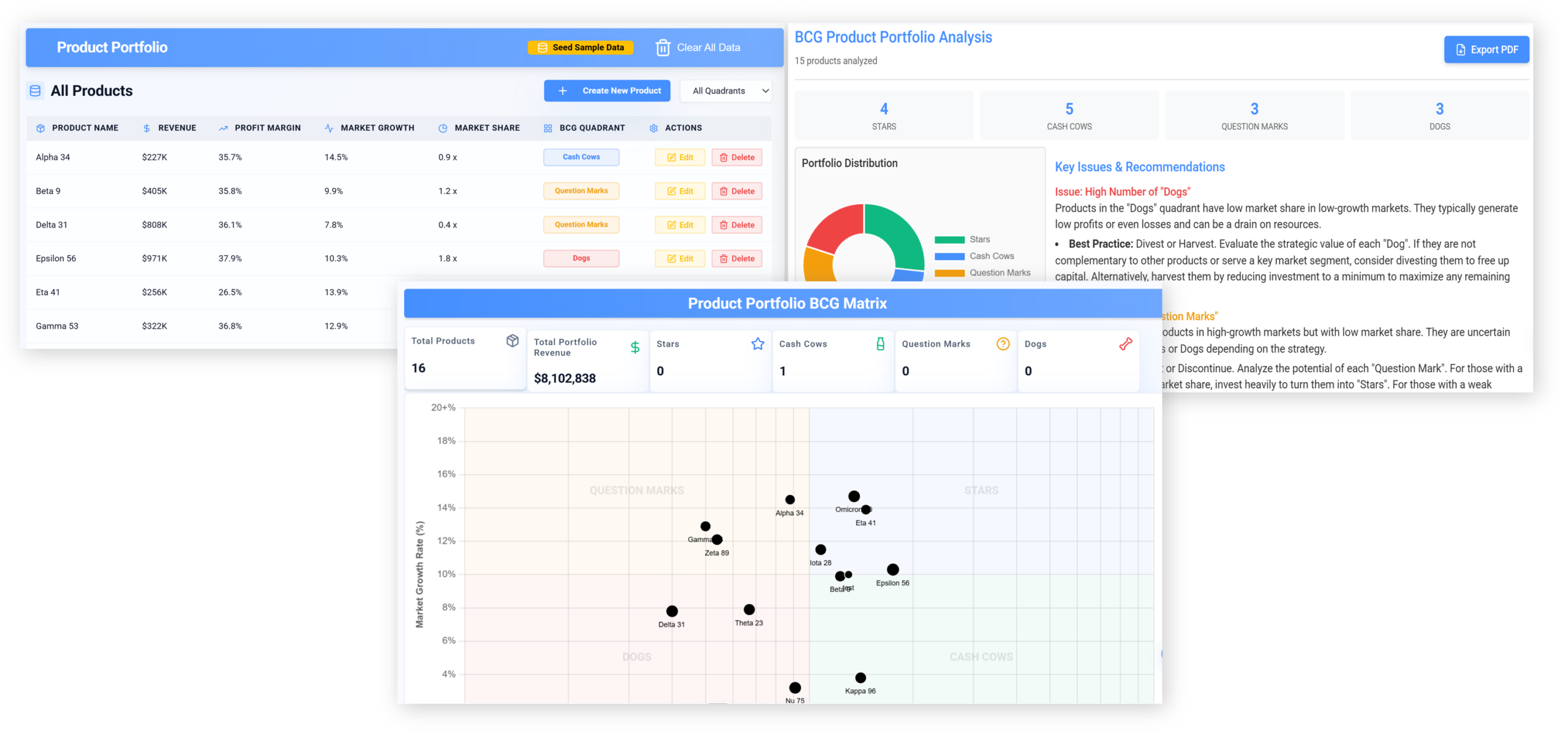
Replace static two-by-two slides with AI that keeps your portfolio positioned against live share, growth and margin data — so invest, hold and divest calls are made on what is true now.
AI portfolio strategyfor strategy and product leaders
Customer Success Stories
Dylan Hoback
Accu-Tube
“My Praxie analytics software transformed our operations, enabling data-driven decisions and streamlining our manufacturing process.
 Jason Carpenter
Environmental Pest Management
Jason Carpenter
Environmental Pest Management
“With Praxie, I found a way to take what was in documents and spreadsheets and provide my team with a visual application environment to drive our strategy with full accountability.
 Elizabeth Pridham
Perfection Fresh
Elizabeth Pridham
Perfection Fresh
“Praxie dramatically improved our process through digital transformation. We now have visibility and can drive decisions at a fraction of the time.
 Scott Russell
NUCOR Vulcraft
Scott Russell
NUCOR Vulcraft
“I would heartily recommend the Praxie team to any organization seeking to seriously undertake a lasting and successful innovation process.
 Mike Bainbridge
Dover Food Retail
Mike Bainbridge
Dover Food Retail
“Our MFG Ops application greatly improved our daily management initiatives. It is easy to see how we are doing, identify issues, and track improvements—no matter where we sit.
 Jeff Piotrowicz
ChemLink
Jeff Piotrowicz
ChemLink
“With Praxie we've created a way to report on complex projects that gives management full visibility. Executives have visibility to projects, assignments, and more at their fingertips.
 Maureen Thompson
American Nurses Association
Maureen Thompson
American Nurses Association
“Our Praxie App makes it easy to track progress on strategic objectives across the organization and includes an executive-level dashboard with real-time reports to the board on key initiatives.
 Tom Anderson
Springfield Armory
Tom Anderson
Springfield Armory
“Praxie is used every day to track and analyze every aspect of production, quality, safety, and more. We improved quality by 10%.
 Peggie Pelosi
Innovators Alliance
Peggie Pelosi
Innovators Alliance
“Almost overnight, Praxie created a customized solution for our 100 member organizations across Canada to drive strategy and innovation.
 Kate Merton
Anthem
Kate Merton
Anthem
“Praxie's innovation solution stood out from other options because it can be customized so quickly to fit our exact process requirements. Plus, it is incredibly easy to use and manage.
 Giuseppe La Casa
Atlas Copco
Giuseppe La Casa
Atlas Copco
“Scheduling used to take days; now it’s done in minutes. Praxie AI completely transformed how we do scheduling.
Dylan Hoback
Accu-Tube
“My Praxie analytics software transformed our operations, enabling data-driven decisions and streamlining our manufacturing process.
Jason Carpenter
Environmental Pest Management
“With Praxie, I found a way to take what was in documents and spreadsheets and provide my team with a visual application environment to drive our strategy with full accountability.
Elizabeth Pridham
Perfection Fresh
“Praxie dramatically improved our process through digital transformation. We now have visibility and can drive decisions at a fraction of the time.
Scott Russell
NUCOR Vulcraft
“I would heartily recommend the Praxie team to any organization seeking to seriously undertake a lasting and successful innovation process.
Mike Bainbridge
Dover Food Retail
“Our MFG Ops application greatly improved our daily management initiatives. It is easy to see how we are doing, identify issues, and track improvements—no matter where we sit.
Jeff Piotrowicz
ChemLink
“With Praxie we've created a way to report on complex projects that gives management full visibility. Executives have visibility to projects, assignments, and more at their fingertips.
Maureen Thompson
American Nurses Association
“Our Praxie App makes it easy to track progress on strategic objectives across the organization and includes an executive-level dashboard with real-time reports to the board on key initiatives.
Tom Anderson
Springfield Armory
“Praxie is used every day to track and analyze every aspect of production, quality, safety, and more. We improved quality by 10%.
Peggie Pelosi
Innovators Alliance
“Almost overnight, Praxie created a customized solution for our 100 member organizations across Canada to drive strategy and innovation.
Kate Merton
Anthem
“Praxie's innovation solution stood out from other options because it can be customized so quickly to fit our exact process requirements. Plus, it is incredibly easy to use and manage.
Giuseppe La Casa
Atlas Copco
“Scheduling used to take days; now it’s done in minutes. Praxie AI completely transformed how we do scheduling.
Trusted by Top Companies Worldwide


Placing the products on the grid was the easy part. Keeping that placement honest, as the market moves, is the job.
“Why are we still funding that one?”
“That quadrant is based on last year’s numbers.”
A slide built once a year, argued over for a day, then filed.
You do not need a better framework. You need the portfolio to reposition itself — as share, growth and margin move.
Most strategy and product leaders recognise at least four of these. If you recognise six, the rest of this page is written for you.
None of this is a framework problem. It is a freshness problem.
Is this you?
Worked example — multi-line product portfolioSeveral product lines, multiple markets, and one slide that took a month to assemble.
Share, growth and margin lived in different systems and were pulled together by hand, so the portfolio view was already out of date by the time it reached the board.
With AI-powered portfolio strategy those inputs stay connected, so position shifts as the underlying numbers shift — and an invest, hold or divest call can be made when the evidence changes, not when the calendar says so.
A slide built from last year.
A portfolio positioned on live data.
Less time collecting data and rebuilding slide decks.
Capital is directed toward higher-potential opportunities.
Teams identify stars and question marks faster.
Portfolio data refreshes from connected systems.
Resources shift away from low-return portfolio areas.
Decisions move from annual reviews to continuous action.
Which product are you least sure about keeping?
Now select a day and time below.
The objections we hear in the first 20 minutes — answered plainly.
Answer: AI makes the BCG matrix dynamic instead of static. It can analyze market growth, relative market share, revenue trends, margins, competitive signals, customer demand, and operational data to continuously update where products or business units belong across Stars, Cash Cows, Question Marks, and Dogs.
Answer: Yes. An AI-powered BCG matrix helps leadership teams identify where to invest, where to optimize, where to reposition, and where to divest. It turns portfolio analysis into a data-driven decision process instead of relying only on periodic reviews or executive judgment.
Answer: The system can use internal data such as revenue, margin, product performance, sales pipeline, customer concentration, production costs, and market segment performance, along with external signals such as market growth, competitor activity, industry trends, and demand shifts.
Answer: Yes. The AI can provide explainable recommendations by showing the drivers behind each placement, including growth rate, share position, profitability, trend direction, competitive pressure, and risk. This helps executives understand the recommendation before taking action.
Answer: Yes. Spreadsheets and slides quickly become outdated, while an AI-powered BCG matrix can stay connected to live data, update assumptions automatically, surface portfolio risks, and generate strategic recommendations that help teams act faster.
Send us your current product portfolio. We’ll show you what Praxie would surface from it — your lines, your markets, your margins.
No cost, no obligation — and you keep what we find either way.