


 Dylan Hoback
Accu-Tube
Dylan Hoback
Accu-Tube
My Praxie analytics software transformed our operations, enabling data-driven decisions and streamlining our manufacturing process.

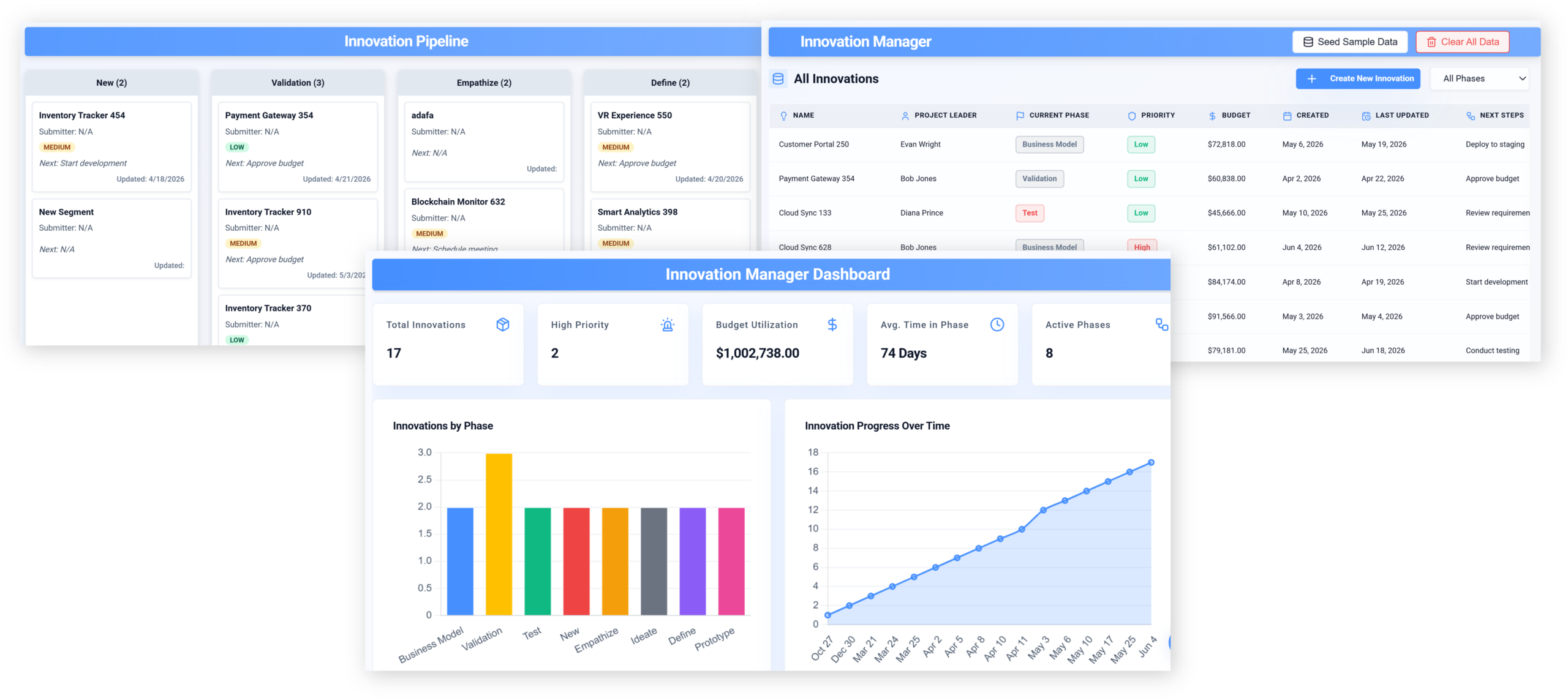
Replace spreadsheets and disconnected reviews with AI that runs your innovation process — moving ideas through stages and gates from concept to launch with clear reviews and decisions.
A super fast way to see how AI stage-gate works for your team.

Customer Success Stories
Dylan Hoback
Accu-Tube
“My Praxie analytics software transformed our operations, enabling data-driven decisions and streamlining our manufacturing process.
 Jason Carpenter
Environmental Pest Management
Jason Carpenter
Environmental Pest Management
“With Praxie, I found a way to take what was in documents and spreadsheets and provide my team with a visual application environment to drive our strategy with full accountability.
 Elizabeth Pridham
Perfection Fresh
Elizabeth Pridham
Perfection Fresh
“Praxie dramatically improved our process through digital transformation. We now have visibility and can drive decisions at a fraction of the time.
 Scott Russell
NUCOR Vulcraft
Scott Russell
NUCOR Vulcraft
“I would heartily recommend the Praxie team to any organization seeking to seriously undertake a lasting and successful innovation process.
 Mike Bainbridge
Dover Food Retail
Mike Bainbridge
Dover Food Retail
“Our MFG Ops application greatly improved our daily management initiatives. It is easy to see how we are doing, identify issues, and track improvements—no matter where we sit.
 Jeff Piotrowicz
ChemLink
Jeff Piotrowicz
ChemLink
“With Praxie we've created a way to report on complex projects that gives management full visibility. Executives have visibility to projects, assignments, and more at their fingertips.
 Maureen Thompson
American Nurses Association
Maureen Thompson
American Nurses Association
“Our Praxie App makes it easy to track progress on strategic objectives across the organization and includes an executive-level dashboard with real-time reports to the board on key initiatives.
 Tom Anderson
Springfield Armory
Tom Anderson
Springfield Armory
“Praxie is used every day to track and analyze every aspect of production, quality, safety, and more. We improved quality by 10%.
 Peggie Pelosi
Innovators Alliance
Peggie Pelosi
Innovators Alliance
“Almost overnight, Praxie created a customized solution for our 100 member organizations across Canada to drive strategy and innovation.
 Kate Merton
Anthem
Kate Merton
Anthem
“Praxie's innovation solution stood out from other options because it can be customized so quickly to fit our exact process requirements. Plus, it is incredibly easy to use and manage.
Dylan Hoback
Accu-Tube
“My Praxie analytics software transformed our operations, enabling data-driven decisions and streamlining our manufacturing process.
Jason Carpenter
Environmental Pest Management
“With Praxie, I found a way to take what was in documents and spreadsheets and provide my team with a visual application environment to drive our strategy with full accountability.
Elizabeth Pridham
Perfection Fresh
“Praxie dramatically improved our process through digital transformation. We now have visibility and can drive decisions at a fraction of the time.
Scott Russell
NUCOR Vulcraft
“I would heartily recommend the Praxie team to any organization seeking to seriously undertake a lasting and successful innovation process.
Mike Bainbridge
Dover Food Retail
“Our MFG Ops application greatly improved our daily management initiatives. It is easy to see how we are doing, identify issues, and track improvements—no matter where we sit.
Jeff Piotrowicz
ChemLink
“With Praxie we've created a way to report on complex projects that gives management full visibility. Executives have visibility to projects, assignments, and more at their fingertips.
Maureen Thompson
American Nurses Association
“Our Praxie App makes it easy to track progress on strategic objectives across the organization and includes an executive-level dashboard with real-time reports to the board on key initiatives.
Tom Anderson
Springfield Armory
“Praxie is used every day to track and analyze every aspect of production, quality, safety, and more. We improved quality by 10%.
Peggie Pelosi
Innovators Alliance
“Almost overnight, Praxie created a customized solution for our 100 member organizations across Canada to drive strategy and innovation.
Kate Merton
Anthem
“Praxie's innovation solution stood out from other options because it can be customized so quickly to fit our exact process requirements. Plus, it is incredibly easy to use and manage.


Innovation Management Is Complex - AI Can Help
Stop managing ideas, experiments, business cases, approvals, portfolios, and launch plans across disconnected spreadsheets, slide decks, email threads, and meeting notes. Praxie’s AI-powered innovation management workspace helps teams capture opportunities, evaluate concepts, prioritize investments, accelerate experiments, and turn the best ideas into measurable business impact.
Innovation is not just a suggestion box. It is a dynamic portfolio of ideas, evidence, decisions, tradeoffs, and execution work.
Instead of a feature dump, Praxie organizes innovation management capabilities around the real work leaders, product teams, engineers, and operators need to accomplish to turn ideas into measurable business results.
Bring employee ideas, customer feedback, market signals, product requests, and operational opportunities into one searchable innovation pipeline.
Use AI to evaluate ideas against strategic goals, customer impact, financial potential, feasibility, risk, and resource constraints.
Turn selected ideas into structured projects, experiments, pilots, and action plans with owners, milestones, tasks, and measurable hypotheses.
Measure pilot results, capture lessons learned, standardize winning practices, and expand proven innovations across teams, regions, or sites.
A simple view of the innovation management landscape — and why Praxie helps teams capture better ideas, prioritize smarter investments, and turn innovation into measurable business results.
Global Steel & Building Products Manufacturer
A global manufacturer of steel and steel building products partnered with Praxie to digitize and manage its full innovation pipeline, from frontline ideas and strategic opportunities to executive portfolio reviews and new business model experiments.
Leadership can now see ideas, concepts, experiments, owners, and status in one innovation workspace.
Unified portfolio viewAI-assisted scoring helps teams evaluate feasibility, value, risk, investment needs, and strategic fit.
Better investment decisionsStage gates, reviews, action items, and decision history are standardized across teams and regions.
Repeatable operating modelFrontline, engineering, commercial, and leadership teams can submit and refine opportunities faster.
Opportunity maps, scorecards, and AI summaries make it easier to fund the best concepts.
Stage-gate workflows, decision logs, and action tracking keep innovation teams moving.
Praxie helped us turn innovation management into a repeatable, visible, AI-powered operating system for growth.
Clear answers to the most common questions companies ask when moving from scattered ideas, spreadsheets, and stage-gate meetings to an AI-powered innovation pipeline.
Answer: AI helps teams capture ideas, evaluate opportunities, prioritize projects, and surface insights from across the business. It supports better decision-making by making recommendations explainable, traceable, and connected to business goals, so leaders stay in control.
Answer: Yes. AI-powered innovation management connects idea intake, scoring, business cases, stage-gate reviews, experiments, project plans, approvals, and performance tracking in one system. Teams can see what is moving, what is stuck, and which initiatives have the highest potential impact.
Answer: The AI can evaluate ideas against strategic fit, market potential, customer value, feasibility, cost, risk, sustainability, and expected return. Instead of relying only on subjective opinions or manual scoring, teams get a more consistent way to compare opportunities.
Answer: Yes. AI can summarize ideas, draft business cases, identify duplicate submissions, prepare review materials, generate project updates, flag missing information, and recommend next steps. This reduces administrative work so teams can spend more time advancing high-value innovations.
Answer: Yes. Spreadsheets and generic project tools usually track activity, but they do not intelligently connect ideas, strategy, financial impact, resource constraints, risks, and outcomes. AI-powered innovation management creates a live, searchable, and decision-ready view of the full innovation portfolio.