


 Dylan Hoback
Accu-Tube
Dylan Hoback
Accu-Tube
My Praxie analytics software transformed our operations, enabling data-driven decisions and streamlining our manufacturing process.

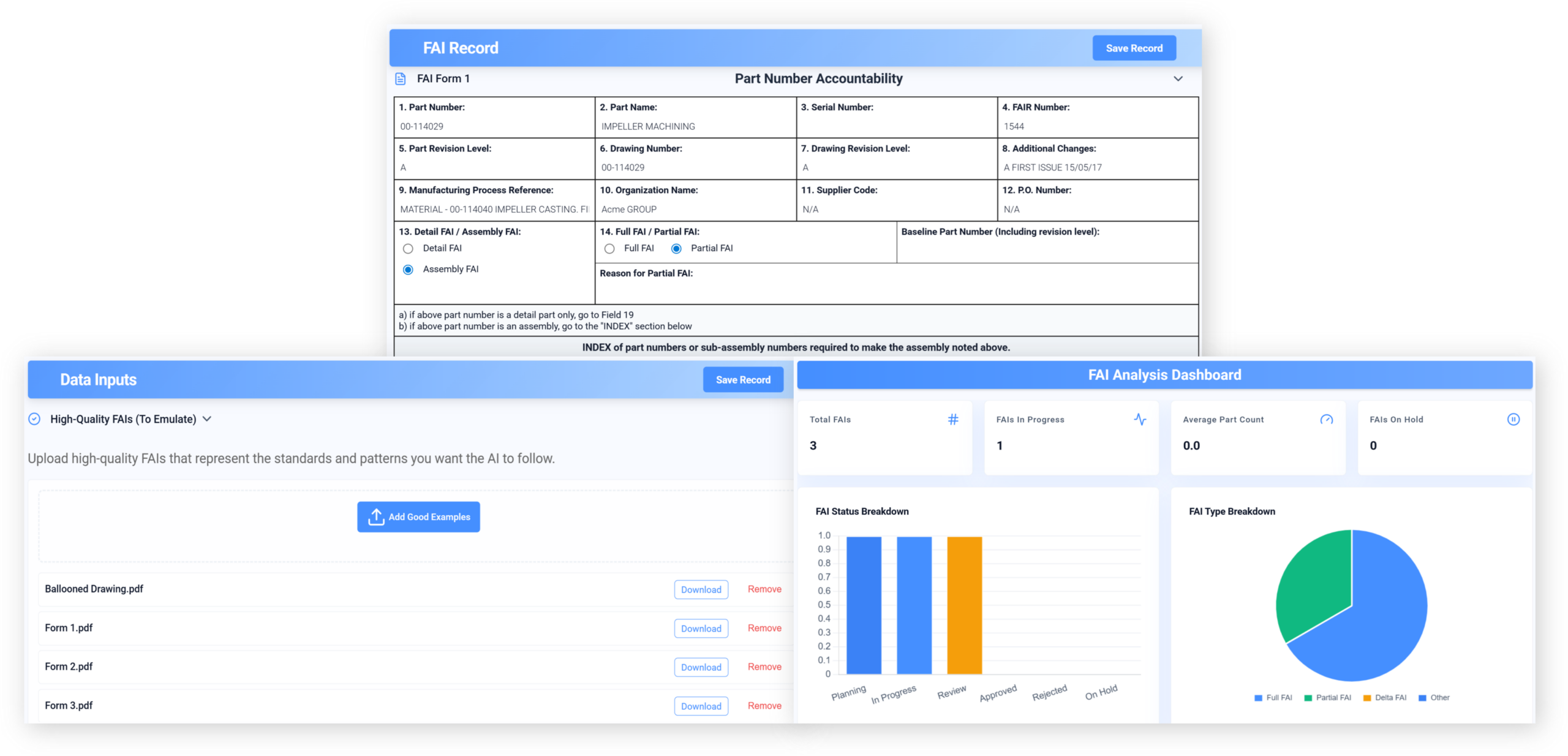
Replace manual ballooning, spreadsheets, and scattered inspection documents with AI that builds the inspection plan, maps characteristics to measurement results, resolves nonconformances, and assembles a submission-ready FAI package.
A super fast way to see how AI first article inspection works for your team.

Customer Success Stories
Dylan Hoback
Accu-Tube
“My Praxie analytics software transformed our operations, enabling data-driven decisions and streamlining our manufacturing process.
 Jason Carpenter
Environmental Pest Management
Jason Carpenter
Environmental Pest Management
“With Praxie, I found a way to take what was in documents and spreadsheets and provide my team with a visual application environment to drive our strategy with full accountability.
 Elizabeth Pridham
Perfection Fresh
Elizabeth Pridham
Perfection Fresh
“Praxie dramatically improved our process through digital transformation. We now have visibility and can drive decisions at a fraction of the time.
 Scott Russell
NUCOR Vulcraft
Scott Russell
NUCOR Vulcraft
“I would heartily recommend the Praxie team to any organization seeking to seriously undertake a lasting and successful innovation process.
 Mike Bainbridge
Dover Food Retail
Mike Bainbridge
Dover Food Retail
“Our MFG Ops application greatly improved our daily management initiatives. It is easy to see how we are doing, identify issues, and track improvements—no matter where we sit.
 Jeff Piotrowicz
ChemLink
Jeff Piotrowicz
ChemLink
“With Praxie we've created a way to report on complex projects that gives management full visibility. Executives have visibility to projects, assignments, and more at their fingertips.
 Maureen Thompson
American Nurses Association
Maureen Thompson
American Nurses Association
“Our Praxie App makes it easy to track progress on strategic objectives across the organization and includes an executive-level dashboard with real-time reports to the board on key initiatives.
 Tom Anderson
Springfield Armory
Tom Anderson
Springfield Armory
“Praxie is used every day to track and analyze every aspect of production, quality, safety, and more. We improved quality by 10%.
 Peggie Pelosi
Innovators Alliance
Peggie Pelosi
Innovators Alliance
“Almost overnight, Praxie created a customized solution for our 100 member organizations across Canada to drive strategy and innovation.
 Kate Merton
Anthem
Kate Merton
Anthem
“Praxie's innovation solution stood out from other options because it can be customized so quickly to fit our exact process requirements. Plus, it is incredibly easy to use and manage.
Dylan Hoback
Accu-Tube
“My Praxie analytics software transformed our operations, enabling data-driven decisions and streamlining our manufacturing process.
Jason Carpenter
Environmental Pest Management
“With Praxie, I found a way to take what was in documents and spreadsheets and provide my team with a visual application environment to drive our strategy with full accountability.
Elizabeth Pridham
Perfection Fresh
“Praxie dramatically improved our process through digital transformation. We now have visibility and can drive decisions at a fraction of the time.
Scott Russell
NUCOR Vulcraft
“I would heartily recommend the Praxie team to any organization seeking to seriously undertake a lasting and successful innovation process.
Mike Bainbridge
Dover Food Retail
“Our MFG Ops application greatly improved our daily management initiatives. It is easy to see how we are doing, identify issues, and track improvements—no matter where we sit.
Jeff Piotrowicz
ChemLink
“With Praxie we've created a way to report on complex projects that gives management full visibility. Executives have visibility to projects, assignments, and more at their fingertips.
Maureen Thompson
American Nurses Association
“Our Praxie App makes it easy to track progress on strategic objectives across the organization and includes an executive-level dashboard with real-time reports to the board on key initiatives.
Tom Anderson
Springfield Armory
“Praxie is used every day to track and analyze every aspect of production, quality, safety, and more. We improved quality by 10%.
Peggie Pelosi
Innovators Alliance
“Almost overnight, Praxie created a customized solution for our 100 member organizations across Canada to drive strategy and innovation.
Kate Merton
Anthem
“Praxie's innovation solution stood out from other options because it can be customized so quickly to fit our exact process requirements. Plus, it is incredibly easy to use and manage.


First Article Inspection Is Complex - AI Can Help
Stop chasing first articles with spreadsheets, marked-up PDFs, and tribal knowledge. Praxie’s AI-powered first article inspection brings drawings, ballooned characteristics, inspection plans, measurement results, certifications, nonconformances, and approval status into one secure workspace so teams can plan smarter, submit faster, and qualify new parts with confidence.
First article inspection is not just a form. It is a constantly changing system where drawing revisions, characteristics, measurement capability, suppliers, and customer approval deadlines all compete for attention.
Instead of a feature dump, Praxie organizes first article inspection capabilities around the real work quality leaders, FAI coordinators, inspectors, and supplier quality engineers need to accomplish every day.
Unify drawings, ballooned characteristics, measurement results, and supplier documentation to see which parts need attention.
Use AI to rank characteristics and open issues by risk, criticality, backlog impact, and likely effect on approval and quality.
Coordinate inspectors, gauges, procedures, and inspection tasks so first articles get verified faster and with fewer delays.
Turn inspection history, root-cause insights, and recurring defects into better inspection plans and continuous improvement.
A simplified view of how manufacturers move from manual ballooning and spreadsheet-based FAI tracking to connected AI first article inspection that improves approval rates, reduces cost, and gets new parts into production faster.
Catch issues earlier and reduce failed submissions.
Cut delays from drawing to measurement to approval.
Keep inspection records complete and on schedule.
Reduce rework, scrap, and repeat defects.
Connect inspection plans with every drawing requirement.
Get new parts approved and into production faster.
A simple view of the first article inspection landscape — and why Praxie delivers more predictive insight, faster inspection execution, and smarter quality documentation for manufacturers.
Clear answers to the most common questions manufacturers ask when moving from manual ballooning, spreadsheets, and disconnected inspection documents to intelligent, AI-powered first article inspection.
Answer: The AI automates data extraction, validation, and analysis across drawings, inspection results, and compliance documentation. It can balloon drawings, map characteristics to measurement results, and detect missing or inconsistent data. Recommendations are explainable, so quality teams can see why a characteristic needs attention and stay in control of every inspection decision.
Answer: A substantial amount. Traditional FAI preparation requires hours of manual drawing ballooning, spreadsheet entry, and document verification. AI generates inspection characteristics, organizes measurement results, and assembles compliant reports in minutes rather than hours — so teams spend their time resolving issues instead of compiling paperwork.
Answer: The system automatically flags out-of-spec conditions, detects tolerance risks, and routes issues through structured workflows for engineering and quality review. That enables faster root-cause analysis, coordinated corrective actions, and clear documentation of deviations or approvals before production proceeds.
Answer: Yes. By identifying dimensional issues, documentation gaps, and process inconsistencies early, AI-supported FAI resolves problems during initial production rather than during full-scale manufacturing. That improves first-pass yield, reduces scrap and rework, and accelerates production readiness across parts, lines, plants, or suppliers.
Answer: Traditional FAI processes rely on manual data entry, disconnected documents, and static spreadsheets that store data but never interpret it. AI-powered first article inspection connects drawings, measurements, supplier documentation, and compliance requirements into one intelligent workflow so teams can predict issues, optimize inspection plans, and continuously improve quality.