


 Dylan Hoback
Accu-Tube
Dylan Hoback
Accu-Tube
My Praxie analytics software transformed our operations, enabling data-driven decisions and streamlining our manufacturing process.

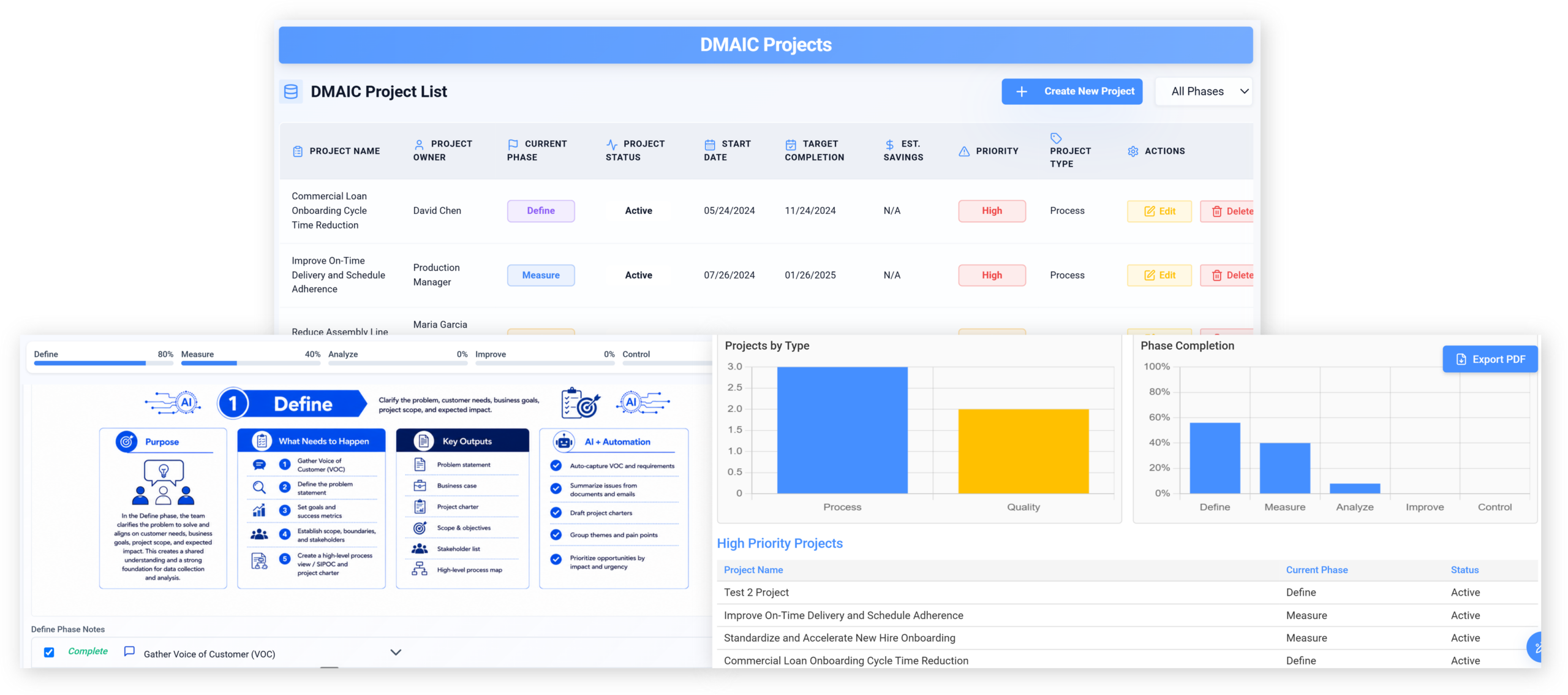
Replace DMAIC tollgate decks with AI that moves projects through the phases — pulling the data for Measure, testing the hypotheses in Analyse, and verifying the gain in Control.
AI DMAIC projects managerfor Six Sigma and CI leaders
Customer Success Stories
Dylan Hoback
Accu-Tube
“My Praxie analytics software transformed our operations, enabling data-driven decisions and streamlining our manufacturing process.
 Jason Carpenter
Environmental Pest Management
Jason Carpenter
Environmental Pest Management
“With Praxie, I found a way to take what was in documents and spreadsheets and provide my team with a visual application environment to drive our strategy with full accountability.
 Elizabeth Pridham
Perfection Fresh
Elizabeth Pridham
Perfection Fresh
“Praxie dramatically improved our process through digital transformation. We now have visibility and can drive decisions at a fraction of the time.
 Scott Russell
NUCOR Vulcraft
Scott Russell
NUCOR Vulcraft
“I would heartily recommend the Praxie team to any organization seeking to seriously undertake a lasting and successful innovation process.
 Mike Bainbridge
Dover Food Retail
Mike Bainbridge
Dover Food Retail
“Our MFG Ops application greatly improved our daily management initiatives. It is easy to see how we are doing, identify issues, and track improvements—no matter where we sit.
 Jeff Piotrowicz
ChemLink
Jeff Piotrowicz
ChemLink
“With Praxie we've created a way to report on complex projects that gives management full visibility. Executives have visibility to projects, assignments, and more at their fingertips.
 Maureen Thompson
American Nurses Association
Maureen Thompson
American Nurses Association
“Our Praxie App makes it easy to track progress on strategic objectives across the organization and includes an executive-level dashboard with real-time reports to the board on key initiatives.
 Tom Anderson
Springfield Armory
Tom Anderson
Springfield Armory
“Praxie is used every day to track and analyze every aspect of production, quality, safety, and more. We improved quality by 10%.
 Peggie Pelosi
Innovators Alliance
Peggie Pelosi
Innovators Alliance
“Almost overnight, Praxie created a customized solution for our 100 member organizations across Canada to drive strategy and innovation.
 Kate Merton
Anthem
Kate Merton
Anthem
“Praxie's innovation solution stood out from other options because it can be customized so quickly to fit our exact process requirements. Plus, it is incredibly easy to use and manage.
Dylan Hoback
Accu-Tube
“My Praxie analytics software transformed our operations, enabling data-driven decisions and streamlining our manufacturing process.
Jason Carpenter
Environmental Pest Management
“With Praxie, I found a way to take what was in documents and spreadsheets and provide my team with a visual application environment to drive our strategy with full accountability.
Elizabeth Pridham
Perfection Fresh
“Praxie dramatically improved our process through digital transformation. We now have visibility and can drive decisions at a fraction of the time.
Scott Russell
NUCOR Vulcraft
“I would heartily recommend the Praxie team to any organization seeking to seriously undertake a lasting and successful innovation process.
Mike Bainbridge
Dover Food Retail
“Our MFG Ops application greatly improved our daily management initiatives. It is easy to see how we are doing, identify issues, and track improvements—no matter where we sit.
Jeff Piotrowicz
ChemLink
“With Praxie we've created a way to report on complex projects that gives management full visibility. Executives have visibility to projects, assignments, and more at their fingertips.
Maureen Thompson
American Nurses Association
“Our Praxie App makes it easy to track progress on strategic objectives across the organization and includes an executive-level dashboard with real-time reports to the board on key initiatives.
Tom Anderson
Springfield Armory
“Praxie is used every day to track and analyze every aspect of production, quality, safety, and more. We improved quality by 10%.
Peggie Pelosi
Innovators Alliance
“Almost overnight, Praxie created a customized solution for our 100 member organizations across Canada to drive strategy and innovation.
Kate Merton
Anthem
“Praxie's innovation solution stood out from other options because it can be customized so quickly to fit our exact process requirements. Plus, it is incredibly easy to use and manage.


Chartering the project was the easy part. Getting it through Measure, while everyone has a day job, is the job.
“What has the programme actually delivered this year?”
“I am still waiting for someone to pull the data.”
Twenty open charters, four tollgates held, and one completed project.
You do not need more projects. You need the ones you have to keep moving — and prove the gain at the end.
Most Six Sigma and CI leaders recognise at least four of these. If you recognise six, the rest of this page is written for you.
None of this is a methodology problem. It is a momentum problem.
Is this you?
Worked example — multi-site Six Sigma programmeTwenty open charters, a handful of belts, and data that had to be requested from someone else every time.
Because each phase depended on manual data pulls and scheduled tollgates, projects aged between reviews — and the programme's results were whatever could be claimed at year end.
With the data connected and phases tracked, Measure stops being a waiting game, Control gains are verified against real numbers, and programme-level results become something you can actually show.
A deck and an apology.
A project that has actually moved.
Less time building templates, updates, and tollgate reports.
AI connects signals across data, notes, defects, and process history.
Faster containment, corrective action, and defect reduction.
AI summaries and dashboards replace copy-paste project updates.
Owners, alerts, audits, and evidence stay connected after closeout.
Teams close more projects with measurable financial impact.
Which DMAIC project has been stuck the longest, and in which phase?
Now select a day and time below.
The objections we hear in the first 20 minutes — answered plainly.
Answer: AI helps teams move faster through Define, Measure, Analyze, Improve, and Control by organizing project inputs, surfacing trends, recommending next steps, and keeping improvement work connected to measurable business outcomes.
Answer: Yes. Instead of managing charters, data, analysis, action plans, and control plans across disconnected files, the software keeps everything in one workflow so project teams, sponsors, and leaders can see progress in real time.
Answer: The AI can review process data, notes, defects, downtime, quality issues, and historical project information to identify patterns, suggest likely causes, and guide teams through tools like 5 Whys, fishbone diagrams, Pareto analysis, and hypothesis testing.
Answer: Yes. AI-powered guidance helps team members understand what to do next, what data is needed, which improvement tools to use, and how to document findings without requiring everyone to be a Six Sigma expert.
Answer: The Control phase becomes easier because the system tracks KPIs, monitors process changes, flags performance drift, and keeps owners accountable for control plans, follow-up actions, and long-term results.
Send us one of your stalled DMAIC projects. We’ll show you what Praxie would surface — your baseline, your data, your gain.
No cost, no obligation — and you keep what we find either way.