


 Dylan Hoback
Accu-Tube
Dylan Hoback
Accu-Tube
My Praxie analytics software transformed our operations, enabling data-driven decisions and streamlining our manufacturing process.

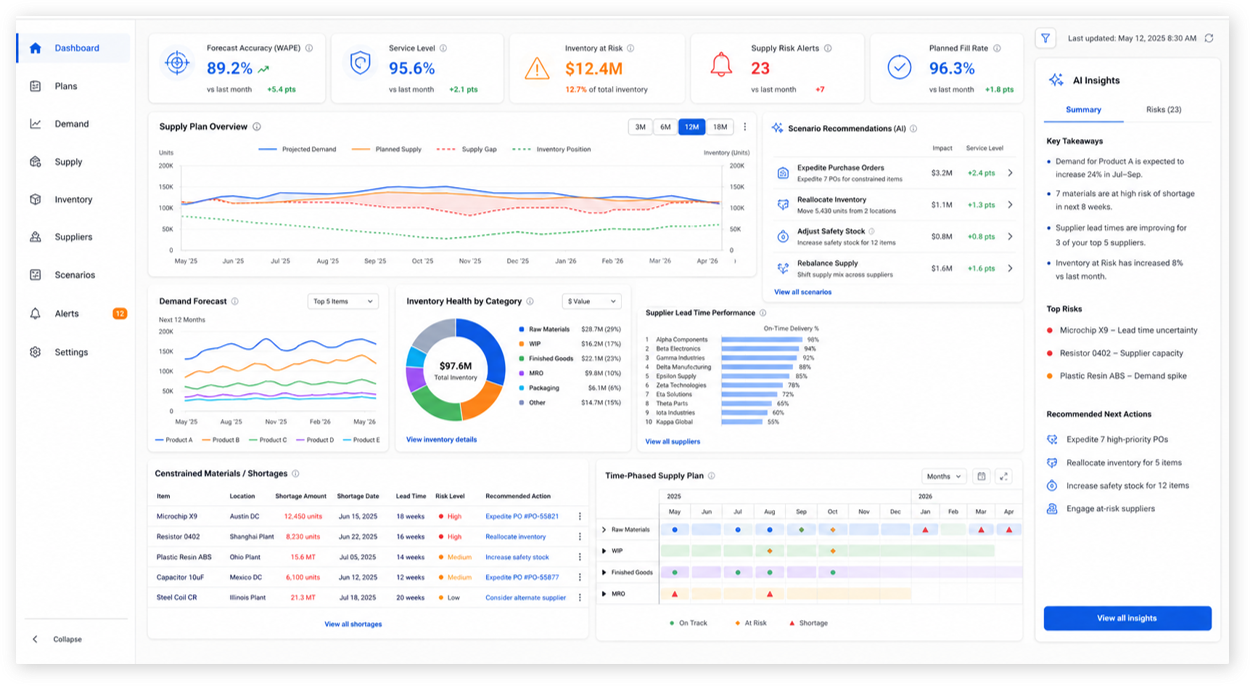
Replace static spreadsheets, disconnected ERP and MRP reports, and reactive shortage meetings with AI that senses supply-demand gaps, prioritizes the right actions, and keeps your plan balanced in real time.
A super fast way to see how AI supply planning works for your team.

Customer Success Stories
Dylan Hoback
Accu-Tube
“My Praxie analytics software transformed our operations, enabling data-driven decisions and streamlining our manufacturing process.
 Jason Carpenter
Environmental Pest Management
Jason Carpenter
Environmental Pest Management
“With Praxie, I found a way to take what was in documents and spreadsheets and provide my team with a visual application environment to drive our strategy with full accountability.
 Elizabeth Pridham
Perfection Fresh
Elizabeth Pridham
Perfection Fresh
“Praxie dramatically improved our process through digital transformation. We now have visibility and can drive decisions at a fraction of the time.
 Scott Russell
NUCOR Vulcraft
Scott Russell
NUCOR Vulcraft
“I would heartily recommend the Praxie team to any organization seeking to seriously undertake a lasting and successful innovation process.
 Mike Bainbridge
Dover Food Retail
Mike Bainbridge
Dover Food Retail
“Our MFG Ops application greatly improved our daily management initiatives. It is easy to see how we are doing, identify issues, and track improvements—no matter where we sit.
 Jeff Piotrowicz
ChemLink
Jeff Piotrowicz
ChemLink
“With Praxie we've created a way to report on complex projects that gives management full visibility. Executives have visibility to projects, assignments, and more at their fingertips.
 Maureen Thompson
American Nurses Association
Maureen Thompson
American Nurses Association
“Our Praxie App makes it easy to track progress on strategic objectives across the organization and includes an executive-level dashboard with real-time reports to the board on key initiatives.
 Tom Anderson
Springfield Armory
Tom Anderson
Springfield Armory
“Praxie is used every day to track and analyze every aspect of production, quality, safety, and more. We improved quality by 10%.
 Peggie Pelosi
Innovators Alliance
Peggie Pelosi
Innovators Alliance
“Almost overnight, Praxie created a customized solution for our 100 member organizations across Canada to drive strategy and innovation.
 Kate Merton
Anthem
Kate Merton
Anthem
“Praxie's innovation solution stood out from other options because it can be customized so quickly to fit our exact process requirements. Plus, it is incredibly easy to use and manage.
Dylan Hoback
Accu-Tube
“My Praxie analytics software transformed our operations, enabling data-driven decisions and streamlining our manufacturing process.
Jason Carpenter
Environmental Pest Management
“With Praxie, I found a way to take what was in documents and spreadsheets and provide my team with a visual application environment to drive our strategy with full accountability.
Elizabeth Pridham
Perfection Fresh
“Praxie dramatically improved our process through digital transformation. We now have visibility and can drive decisions at a fraction of the time.
Scott Russell
NUCOR Vulcraft
“I would heartily recommend the Praxie team to any organization seeking to seriously undertake a lasting and successful innovation process.
Mike Bainbridge
Dover Food Retail
“Our MFG Ops application greatly improved our daily management initiatives. It is easy to see how we are doing, identify issues, and track improvements—no matter where we sit.
Jeff Piotrowicz
ChemLink
“With Praxie we've created a way to report on complex projects that gives management full visibility. Executives have visibility to projects, assignments, and more at their fingertips.
Maureen Thompson
American Nurses Association
“Our Praxie App makes it easy to track progress on strategic objectives across the organization and includes an executive-level dashboard with real-time reports to the board on key initiatives.
Tom Anderson
Springfield Armory
“Praxie is used every day to track and analyze every aspect of production, quality, safety, and more. We improved quality by 10%.
Peggie Pelosi
Innovators Alliance
“Almost overnight, Praxie created a customized solution for our 100 member organizations across Canada to drive strategy and innovation.
Kate Merton
Anthem
“Praxie's innovation solution stood out from other options because it can be customized so quickly to fit our exact process requirements. Plus, it is incredibly easy to use and manage.


Supply Planning Is Complex - AI Can Help
Stop relying on static spreadsheets, disconnected ERP reports, and planning meetings that chase supply issues after they happen. Praxie’s AI-powered supply planning connects demand signals, inventory, suppliers, capacity, lead times, purchase orders, production constraints, shortages, and replenishment assumptions in one secure, shared workspace. With AI-driven supply recommendations, exception alerts, and scenario planning, teams can balance service levels, inventory, and capacity faster.
Supply planning is not a single inventory calculation. It is a living system where demand, materials, suppliers, lead times, production capacity, purchase orders, inventory, and risk signals constantly change.
A simplified view of how manufacturers move from spreadsheet-heavy, ERP-driven, reactive supply planning to AI-powered supply planning that connects demand, inventory, suppliers, capacity, purchase orders, and exceptions into one intelligent planning workspace.
Fewer manual reconciliations, follow-ups, and spreadsheet updates.
Supply risks are detected earlier before customers are impacted.
Less excess, obsolete, stranded, and poorly positioned inventory.
Material constraints are identified before they disrupt production.
Fewer emergency buys, premium freight events, and supplier fire drills.
Teams compare supplier, inventory, and capacity options faster.
A simple view of the supply planning landscape — and why Praxie helps manufacturers move beyond spreadsheets, static ERP reports, and point tools to connected, AI-powered supply planning.
Clear answers to the most common questions manufacturers ask when moving from spreadsheets, static ERP/MRP reports, and reactive shortage meetings to connected AI-powered supply planning.
Answer: The AI supports planner judgment by connecting demand signals, inventory, suppliers, lead times, purchase orders, BOM requirements, capacity, and shortage risks. Recommendations are explainable, so planners can see why an action is suggested and remain in control of final decisions.
Answer: AI-powered supply planning reduces the repetitive work of reconciling ERP exports, inventory reports, supplier updates, purchase orders, and shortage lists. Teams spend less time chasing data and more time acting on the highest-priority supply risks.
Answer: The system updates the supply picture and highlights what changed, which orders or materials are affected, and what actions are available. It can recommend options such as expediting, reallocating inventory, adjusting replenishment, using alternate parts, or changing supplier priorities.
Answer: Yes. The AI continuously monitors supply constraints, supplier commitments, inventory exposure, purchase order status, and material availability to flag shortage risks before they disrupt production or customer commitments.
Answer: Yes. AI-powered supply planning helps teams see where inventory is too low, too high, or poorly positioned. It can recommend supply actions that balance service levels, working capital, supplier risk, and production feasibility instead of optimizing one metric in isolation.
Answer: AI-powered supply planning does not replace core systems. It acts as an intelligent planning layer that connects data from ERP, MRP, MES, purchasing systems, inventory records, supplier updates, and spreadsheets, then turns that data into exceptions, scenarios, recommended actions, and workflow follow-up.
Answer: Yes. Traditional systems are often strong at transactions and planning logic, but they can be rigid, slow to interpret, and disconnected from real-time exception management. Point AI tools may help with a narrow task, but Praxie’s approach connects supply context, AI recommendations, dashboards, alerts, scenarios, and workflows in one planning workspace.