


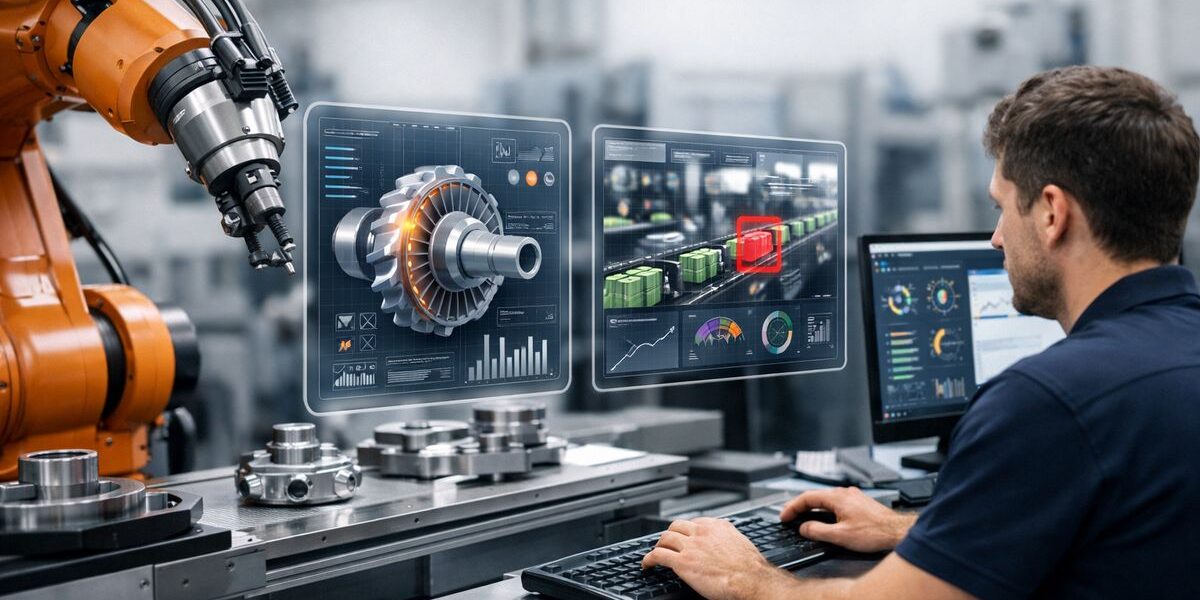
Manufacturing process improvement is the work of fixing what keeps slowing your plant down: waste, defects, waiting, messy handoffs, and surprise downtime. Once AI enters the floor, that job does not change, but your ability to see patterns gets a lot better. If your team keeps having the same Monday morning conversation about the same production problem, this is where AI starts to matter.
What Manufacturing Process Improvement Means When AI Enters the Floor
In plain English, manufacturing process improvement means making your operation run better with less friction. That could mean shorter cycle times, fewer defects, less scrap, smoother changeovers, or fewer moments where one area finishes work and the next area is not ready for it.
AI fits into that picture as a helper, not a replacement for lean basics. If your standards are weak, your scheduling is chaotic, or your process changes from shift to shift, AI will not magically clean that up. What it can do is spot patterns in production data faster than manual review, then surface issues while you still have time to act.
The simple way to think about AI in a plant
The easiest way to think about AI is this: software that learns from your production data and notices things your team would probably miss, especially over time. It can flag unusual behavior, predict likely failures, and suggest where to look next.
Picture an extra set of eyes on the line that never gets tired at 2:13 a.m. That is the useful version of AI in manufacturing. Not science fiction, just pattern recognition applied to real plant problems.
The Problems AI Helps You Solve First
AI is most useful when attached to a real process problem, not a big innovation pitch. The best AI projects start with one annoying bottleneck that keeps costing you time or money. That is the right scale.
Bottlenecks that slow output
Bottlenecks are not always obvious. A machine may not be fully down, but it may still be dragging output because cycle times drift, materials arrive unevenly, or operators keep waiting on the same handoff. AI can scan machine data, queue times, and line performance to show where work is piling up and where flow keeps breaking.
That matters because small delays stack up fast. By the time a missed shipment shows up on a dashboard, the problem has usually been growing for days.
Quality issues and repeat defects
If defects keep coming back, AI can help connect the dots earlier. It can review inspection images, sensor readings, quality logs, and even operator notes to find patterns behind repeat failures.
The point is not just sorting bad parts at the end. The point is catching root causes sooner, before one bad setting or one unstable condition turns into a full batch of rework.
Unplanned downtime and maintenance surprises
Predictive maintenance sounds technical, but the idea is simple. AI watches for unusual patterns in vibration, temperature, pressure, or run time that often show up before equipment fails.
That gives you a chance to fix equipment on your schedule instead of during a scramble. There is a big difference between a planned repair during a scheduled stop and a line sitting dead halfway through a shift.
Scrap, rework, and material waste
Some scrap looks random until you line up the details. AI can connect process settings, room conditions, machine behavior, and operator actions to show why waste keeps appearing in the same product family or the same shift.
That is especially useful when everyone has a theory but nobody has proof. AI gives you something better than guesses.
Scheduling and changeover delays
Scheduling problems often hide in plain sight. Too much waiting between jobs, poor sequencing, and messy setups can eat throughput without adding a single minute of actual production value.
AI can help plan job order more intelligently and highlight setup patterns that waste time. Sometimes the fastest capacity increase comes from better sequencing, not new equipment.
Inventory imbalances and shortages
You know the pain: too much of one part, not enough of the one part that stops the whole line. AI can improve forecasting and replenishment by looking at demand patterns, supplier timing, and production history together.
That does not mean perfect inventory. It means fewer dumb shortages and fewer shelves full of the wrong stuff.
The All-in-One AI Platform for Orchestrating Business Operations
 Instantly create & manage your process Use AI to save time and move faster Connect your company’s data & business systems
Where AI Fits With Proven Manufacturing Process Improvement Methods
AI works best when it supports methods you already know: lean, Six Sigma, Kaizen, 5 Whys, OEE, and value stream mapping. It does not replace these tools. It makes weak spots easier to see and easier to measure.
AI plus lean manufacturing and waste reduction
Lean focuses on waste, waiting, extra motion, overproduction, and the rest of the usual troublemakers. AI helps by turning messy shop floor data into usable patterns, so waste is not just something you feel, it is something you can point to.
That is the trick. Once waste becomes visible, it gets easier to fix.
AI plus Six Sigma, OEE, and root-cause work
Six Sigma aims to reduce variation. OEE, which stands for overall equipment effectiveness, tracks availability, performance, and quality in one simple measure. AI strengthens both by spotting variation trends, hidden losses, and likely causes faster than manual review alone.
It also helps with root-cause work. Instead of chasing the loudest theory in the room, you get a clearer view of what changed first.
What Data AI Usually Needs to Be Useful
AI works best when connected to signals your plant already produces. You do not need a futuristic setup to begin.
Common inputs: machines, sensors, quality logs, ERP, and operator notes
Useful inputs often include PLC data, MES records, ERP history, maintenance logs, inspection images, and typed or handwritten shift notes. Even imperfect data can be enough if one problem is clearly defined.
That is good news, because most plants already have more data than expected. It is just scattered.
The catch: bad data creates bad recommendations
Here is the catch: AI learns from what you feed it. If naming is inconsistent, downtime reasons are vague, or operators use workarounds that never get documented, the output will be messy too.
It works a lot like training a new hire. If the process is unclear, the result will be unclear.
How to Choose the Right AI Use Case for Your Plant
A good starting point is not the fanciest use case. It is the one that hurts often enough to matter and shows up clearly enough to measure.
Start with one expensive, recurring problem
Pick something that causes pain every week: repeat scrap, unstable cycle time, chronic downtime, or inspection delays. If it already shows up in daily production meetings, it is probably a good candidate.
One problem is enough. Honestly, that is better than trying to boil the ocean.
Pick a process with measurable before-and-after results
You need a baseline. Downtime hours, scrap rate, first-pass yield, changeover time, any of those can work. If you cannot tell whether the result improved, the project will feel like a science fair display instead of an operational win.
Common Misconceptions About AI in Manufacturing Process Improvement
A lot of hesitation around AI comes from bad assumptions, not bad fit.
AI does not need to replace your team
AI is most useful when it helps operators, engineers, planners, and maintenance staff make faster decisions. Floor judgment still matters. Actually, it matters more when better signals are available.
AI is not only for giant factories
You do not need a massive facility to get value. One machine cell, one defect category, or one maintenance issue can be enough to justify the effort.
AI will not fix a broken process by itself
This part is blunt because it needs to be. If your setup process is chaotic, AI will show the chaos faster. It will not create standards, ownership, or follow-through for you.
What a Good First Win Looks Like
A good first win is boring in the best way. It solves a real problem, saves time, and makes the next project easier to approve.
Example: catching a repeat downtime pattern before it turns into a lost shift
Picture a packaging cell in Ohio that keeps having short stoppages every Monday morning. AI connects those stoppages with rising motor temperature and a pattern of overloads after weekend startup. Instead of waiting for a full breakdown, your maintenance team schedules a fix before the next shift gets wrecked.
That kind of win builds trust fast: fewer surprises, cleaner planning, steadier output.
Questions You May Still Have Before You Try It
Results can come quickly for use cases like anomaly detection or inspection support, especially if the data already exists. Bigger planning and scheduling projects usually take longer because more systems are involved.
Perfect data is not required. Consistent enough data is. If you can track one recurring problem reliably, you can usually start learning from it.
Try one thing this week: pull the last 30 days of data for one recurring production problem and check whether the same pattern keeps showing up by machine, shift, or SKU. That is often the moment AI stops feeling abstract and starts looking useful.
The All-in-One AI Platform for Orchestrating Business Operations
Instantly create & manage your process Use AI to save time and move faster Connect your company’s data & business systems
