


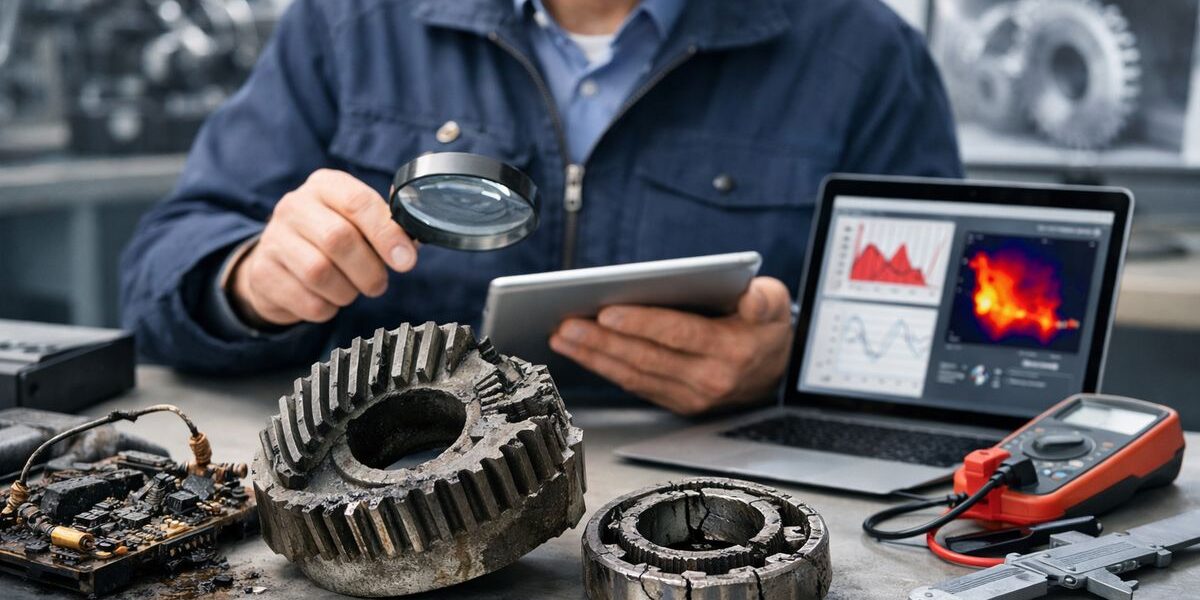
Equipment failure analysis is the process of figuring out why a machine, part, or system stopped doing its job. That matters because replacing the broken thing is easy, but stopping the same failure from showing up again on your line at 2:13 a.m. is where the real value is.
What Equipment Failure Analysis Actually Means
In plain English, equipment failure analysis is detective work for machines. You look past the obvious breakdown and trace the chain of events that caused it. If a gearbox locks up, the goal is not just to swap the gearbox and restart production. The goal is to understand why it locked up in the first place.
That sounds simple, but here’s the thing: most plants are good at restoring operation fast and less good at learning from the failure. Production pressure pushes you toward the quick fix. Failure analysis pushes you toward the right fix.
For manufacturers interested in AI, this distinction matters a lot. AI can help you find patterns in breakdowns, but only if you treat failures as signals to study, not random bad luck.
What Usually Causes Equipment to Fail
Most equipment failures fall into a handful of familiar buckets. Wear and tear is the obvious one. Bearings, seals, belts, and couplings all age, and at some point parts simply reach the end of useful life.
Poor lubrication is another repeat offender. Too little grease, the wrong oil, or contaminated lubricant can quietly destroy rotating equipment. Misalignment does the same thing in a more mechanical way. If shafts, pulleys, or motors are slightly off, vibration and heat build up until something gives.
Contamination is a bigger deal than many plants admit. Dust, moisture, metal particles, or product residue can get into places where they do real damage. Overload also shows up often, especially when equipment runs beyond intended speed, weight, temperature, or duty cycle.
Then there’s the human side. Operator error can trigger failures, but blaming people too fast usually misses the bigger issue. Weak maintenance routines, poor inspection habits, bad replacement parts, and design flaws often set the stage long before the moment of breakdown.
The difference between the symptom and the root cause
A burnt motor, cracked seal, or seized bearing is usually the symptom. The root cause is the reason that symptom happened.
Think of it like smoke in a kitchen. If you only deal with the smoke, you open a window and move on. If you deal with the fire, you stop the problem from coming back. Equipment failures work the same way. A snapped belt may be what you see. Improper tension, pulley misalignment, and missed inspections may be what actually caused it.
The All-in-One AI Platform for Orchestrating Business Operations
 Instantly create & manage your process Use AI to save time and move faster Connect your company’s data & business systems
How Equipment Failure Analysis Works Step by Step
The process is more approachable than it sounds. You document what happened, gather evidence, inspect the failed part, review how the machine was running, identify likely causes, confirm the real cause, and then decide what to change.
The trick is to slow down just enough to preserve the clues. Good analysis is not academic paperwork. It is a structured way to avoid repeating expensive mistakes.
Start with what happened before touching anything
Start with the timeline. What happened right before the failure? What alarms came first? Was the machine running hotter than normal? Did anybody hear a squeal, notice vibration, or see product buildup near the drive?
Capture the maintenance history too. If a coupling was adjusted last Thursday in Bay 4, that detail matters. So do load conditions, speed changes, and recent part swaps. Once a failed component gets tossed into a scrap bin and the line gets cleaned up, a lot of useful evidence disappears with it.
Separate immediate cause, contributing factors, and root cause
This is where failure analysis gets better than basic troubleshooting. The immediate cause is what failed in the moment. The contributing factors are the conditions that helped it fail. The root cause is the deeper system issue that allowed those conditions to exist.
For example, the belt snapped. That is the immediate cause. Tension drifted out of spec, which contributed. The inspection routine never checked belt tension after changeovers, which is the root cause. Different layers, different fixes.
Where AI Fits Into Equipment Failure Analysis
AI fits best when you already have a repeatable way to capture failure data. That is the direct truth. It is not a magic fix for maintenance chaos.
When your plant records sensor readings, work orders, downtime events, operator notes, and recurring faults in a usable way, AI can spot patterns faster than manual review alone. It can connect things that are easy to miss across months of data and dozens of assets.
What AI can help you notice faster
AI is useful for anomaly detection, which simply means spotting behavior that does not match a machine’s normal pattern. It can flag unusual vibration, rising temperature, odd power draw, or combinations of conditions that tend to happen before failure.
It can also match failure patterns across similar assets, help prioritize maintenance based on likely risk, and uncover hidden links between operating conditions and breakdowns. Maybe motors only fail during high-humidity shifts, or only after a certain product changeover. Manual review can miss that. AI usually won’t.
The catch: AI can’t fix a messy process
If failure reports say things like “machine broke” or “motor bad,” AI has very little to work with. If sensors drift, timestamps are wrong, and nobody records what changed after a repair, the output will be just as messy as the input.
In other words, AI can sort messy information faster, but it cannot turn bad habits into good analysis. Clean process first, smarter pattern detection second.
Common Mistakes That Make Failure Analysis Useless
The biggest mistake is stopping at the first obvious answer. A failed bearing is not an explanation. It is a starting point.
Another common mess is blaming operators without evidence. Sometimes human error is involved. But often the real problem is unclear procedures, poor training, weak inspection routines, or a machine setup that invites mistakes. Skipping documentation is another way to waste a failure. So is replacing parts without inspecting them.
The last mistake is forgetting to check whether the fix worked. If the same asset fails again three weeks later, your corrective action was not corrective.
What Good Failure Analysis Looks Like in Practice
Picture a packaging line that keeps losing a conveyor motor. On the surface, it looks like a motor problem, so the motor gets replaced again and again.
A better analysis finds product dust getting into the housing, slight shaft misalignment raising load, and missed inspections after sanitation shifts. Suddenly the problem looks different. The fix is not “buy better motors.” The fix is sealing against contamination, correcting alignment, and tightening the inspection routine after washdown. That changes the system, not just the part.
How to Start Using Equipment Failure Analysis in Your Plant
Start small. Pick one repeat failure that keeps costing you time, money, or sleep. Standardize what gets recorded every time it happens: timeline, alarms, operating conditions, maintenance history, and what the failed part actually looked like.
Save failed parts when possible. Review the same few cause questions every time. Then, once that process is consistent, bring AI into the picture to help spot patterns across events.
That’s the best place to begin: not with every asset in the plant, just with one repeat offender you’re tired of seeing.
The All-in-One AI Platform for Orchestrating Business Operations
Instantly create & manage your process Use AI to save time and move faster Connect your company’s data & business systems
