


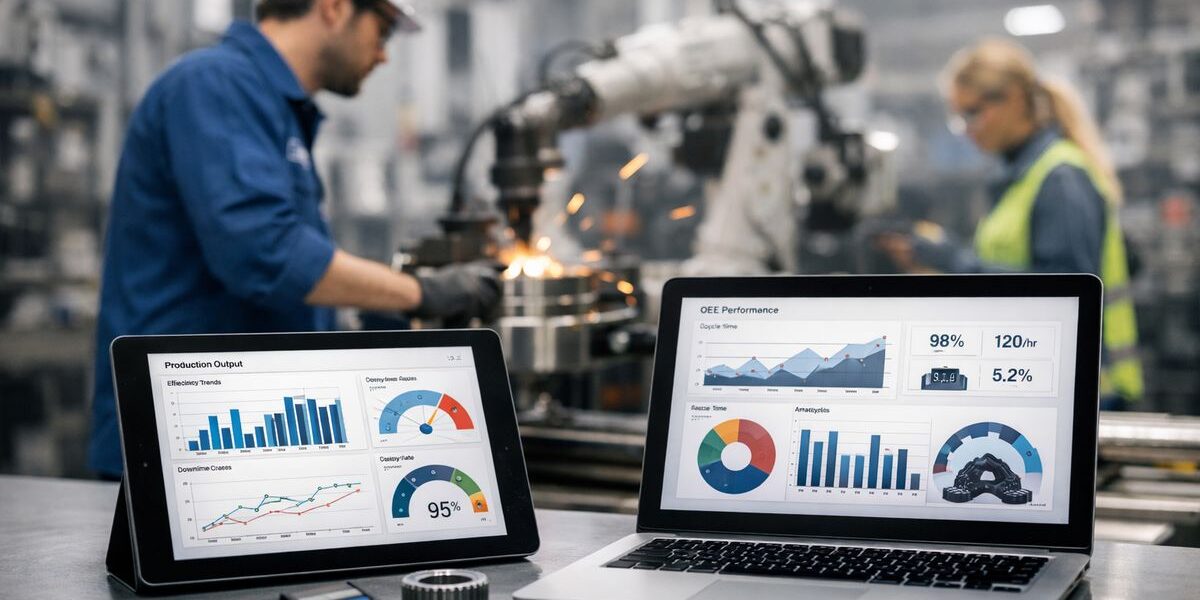
Manufacturing performance metrics are the numbers that show what in your operation is actually helping, slowing, wasting, or improving output. If you want to bring AI into manufacturing, this is where the real work starts, because AI is only useful when your data tells a clear story instead of dumping a pile of disconnected numbers on your desk at 4:17 p.m.
What Manufacturing Performance Metrics Actually Are
At the simplest level, manufacturing performance metrics measure how your process is performing. Think production speed, machine uptime, product quality, delivery reliability, and cost. They turn gut feelings into something you can track, compare, and fix.
Here’s the thing: a metric is just a measurement. A KPI, or key performance indicator, is the small set of metrics that matters most right now. Every KPI is a metric, but not every metric deserves daily attention. If your team tracks 40 numbers and acts on none of them, you do not have visibility. You have clutter.
Metrics vs. KPIs: What’s Worth Watching Closely
A simple way to think about it: metrics tell you what’s happening, KPIs tell you what matters most right now.
That difference matters even more once AI enters the picture. AI works best when your priority signals are clear. If your systems are feeding it dozens of reports with no clear hierarchy, the output gets noisy fast. Clean priorities lead to better alerts, better predictions, and fewer false alarms.
The Core Manufacturing Performance Metrics That Reveal What’s Working
Some metrics show up in almost every solid manufacturing dashboard for a reason. They reveal where output is smooth, where it stalls, and where hidden losses keep creeping in.
Efficiency and output metrics
OEE, or overall equipment effectiveness, rolls availability, performance, and quality into one view. It tells you how much of your planned production time is truly productive. If OEE drops, something is getting in the way, usually downtime, slow cycles, or defects.
Throughput shows how much product you finish in a given period. Cycle time measures how long it takes to complete one unit or batch. Capacity utilization shows how much of your available production capacity you are actually using. Downtime tracks when production stops, and for how long.
These numbers get useful when you stop treating them like averages and start looking for patterns. If downtime spikes every Tuesday at 2:00 p.m. on one line, that is not bad luck. That is a fix waiting to happen. AI can spot those patterns faster than a spreadsheet, especially when machine logs, shift data, and maintenance records all connect.
Quality and delivery metrics
High output means very little if rework and late shipments keep eating the gains.
First pass yield tells you how much product gets through the process correctly the first time. Scrap rate shows how much material gets wasted. Defect rate tells you how often quality issues appear. On-time delivery measures whether orders arrive when promised, while schedule attainment shows how closely production matches the plan.
These metrics answer a blunt question: is your output actually usable, and is it arriving when it should? A line can look productive on paper while quality problems quietly drain margin in the background. That is why quality and delivery metrics belong right next to output metrics, not in a separate report nobody checks.
Cost and flow metrics
Cost per unit tells you what each finished item really costs to produce. Inventory turns show how quickly inventory moves through the business. Work-in-process, or WIP, measures items stuck between starting and finishing. Lead time tracks how long it takes from order to delivery.
This is where hidden drag shows up. If work keeps piling up between steps, your process is telling you something even before margins tighten. Too much WIP usually means a bottleneck, uneven scheduling, or poor handoffs. AI can help here too, especially by flagging slow-moving inventory, predicting shortages, or spotting where lead time keeps stretching.
The All-in-One AI Platform for Orchestrating Business Operations
 Instantly create & manage your process Use AI to save time and move faster Connect your company’s data & business systems
How to Choose the Right Metrics Instead of Tracking Everything
You do not need a giant dashboard. You need a useful one.
Match each metric to a real business question
Start with the biggest headache in front of you. Missed ship dates? Look at on-time delivery, schedule attainment, and lead time. Rising scrap? Focus on first pass yield, defect rate, and scrap rate. Machine stoppages? Watch downtime, cycle time, and OEE.
The trick is to choose metrics the same way you check dashboard lights before a long drive. You do not stare at every possible signal. You watch the ones tied to the failure you most want to avoid.
Build a short scorecard your team can actually use
A good scorecard usually includes a handful of metrics across production, quality, delivery, and cost. Short is better. If a metric never leads to a decision, it is probably clutter.
That also makes you more AI-ready. Cleaner inputs lead to better forecasting, stronger anomaly detection, and more useful recommendations. AI does not need more noise. It needs sharper signals.
Where AI Fits Into Manufacturing Performance Metrics
AI does not replace your metrics. It makes them more useful.
What AI can uncover that basic reporting misses
Basic reporting tells you what happened. AI can help show what is starting to happen, and what is likely to happen next. That includes anomaly detection, predictive maintenance, demand forecasting, quality trend detection, and production scheduling support.
The catch is that AI shines when patterns span multiple signals. A machine slowdown, a creeping defect rate, and longer changeovers may look unrelated in separate reports. Put them together, and AI can flag the connection before it turns into a Friday-night fire drill.
The data setup you need before AI helps
Messy data gives you messy outputs. That part is not exciting, but it is real.
You need consistent metric definitions, reliable machine and production data, solid timestamps, and one source of truth where possible. Do not try to digitize everything at once. Clean up a few high-value data streams first, especially around downtime, quality, and production timing. That is usually enough to get useful early results.
Common Mistakes That Make Manufacturing Metrics Less Useful
Bad metrics do not just waste time. They create false confidence.
Tracking too many metrics, too often
A wall of charts can hide the one number that actually needs attention. Too much reporting creates noise, and noise makes action slower.
Using lagging metrics without leading indicators
Lagging metrics show what already happened, like late orders or scrap last month. Leading indicators hint at what is about to go wrong, like rising downtime trends or inconsistent changeover times. You need both.
Ignoring context behind the number
One number alone can mislead you. Higher output can still hide lower quality, more overtime, or rising scrap. Pair metrics so the picture gets clearer, not prettier.
A Simple Way to Start Using Manufacturing Performance Metrics Better
You do not need a full transformation to make this useful.
Start with one line, one problem, and three metrics
Pick one production line or process. Name the biggest pain point. Then track three connected metrics for a few weeks. If late orders are the problem, watch cycle time, downtime, and on-time delivery together.
That is enough to start seeing patterns, and enough for AI tools to begin finding relationships worth acting on.
What “working” should look like over time
Working does not mean collecting more numbers. It means fewer surprises, faster fixes, steadier output, and better decisions.
Start small. Build one scorecard that answers one real problem. Once your numbers start telling a clear story, AI has something useful to work with, and so do you.
The All-in-One AI Platform for Orchestrating Business Operations
Instantly create & manage your process Use AI to save time and move faster Connect your company’s data & business systems
