


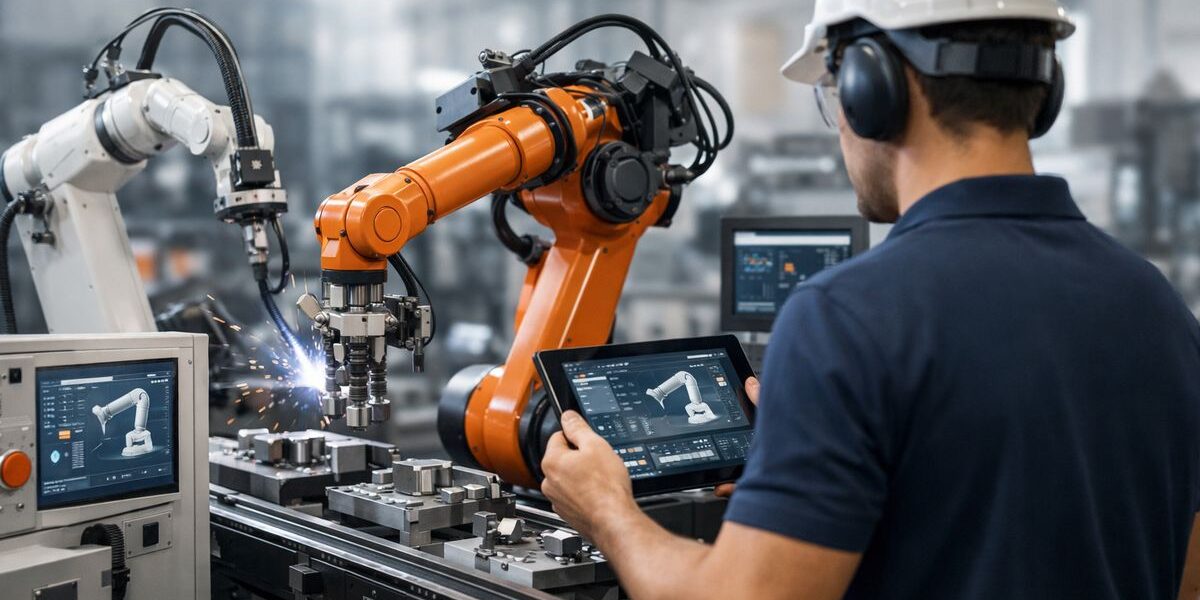
You can buy sensors, software, and AI models, then still end up with the same production headache in a shinier package. That is the real starting point for manufacturing process automation: not the tool, but the work itself. In plain English, manufacturing process automation means using software, machines, controls, sensors, and AI to handle repeatable production tasks with less manual intervention, more consistency, and better visibility into what is happening on the floor.
Early in the process, it helps to know where this guide is going. You will get a clear definition of manufacturing process automation, see where AI actually fits, learn which processes are worth automating first, and walk through a practical implementation plan that makes sense for both operations and IT.
Why manufacturing process automation starts with better work
A lot of automation projects go sideways for the same reason: the team automates rework, unclear approvals, bad data entry, or handoffs nobody fully understands. Then everyone wonders why the system is fragile, expensive, and oddly unpopular with the people who have to use it.
Better work design comes before better automation. That is not theory. It is the difference between speeding up a strong process and speeding up confusion.
If your line relies on tribal knowledge, meaning the unwritten stuff that only two experienced operators really know, automation will expose that weakness fast. If steps change by shift, if downtime codes mean different things to different people, or if quality checks live on paper and in someone’s head, AI will not magically sort it out. It will inherit the mess.
This guide is built for manufacturing and IT managers trying to bring AI into real production environments, not slide decks. The goal is simple: fix the work, then automate what deserves it.
What manufacturing process automation actually means
Manufacturing process automation is the use of connected tools to run repeatable production activities with less manual effort and more control. That can include machine controls, software workflows, robotic movement, data collection, inspection systems, and AI-based decision support.
The scope is narrower than “automate the whole factory,” and that distinction matters. Most companies do not jump from mostly manual operations to a lights-out facility. They improve one process, then another, then connect those gains into something bigger.
Process automation vs. factory automation
Process automation focuses on a specific workflow or production step. Think line-side inspection, automated data capture from a press, or digital routing of quality holds. Factory automation is broader. It covers how an entire facility coordinates machines, materials, systems, and production flow.
PLCs, or programmable logic controllers, run machine-level control. SCADA systems help monitor and supervise equipment. MES sits closer to production execution, tracking what is being made and how it is performing. ERP handles business planning, orders, and inventory at a higher level. Robotics can automate movement or repetitive actions. AI can sit on top of all of this, improving decisions rather than replacing the whole stack.
Where AI fits into the picture
AI is not the whole automation system. It is a layer that helps the system notice patterns, predict outcomes, or make recommendations faster than a person scanning spreadsheets and dashboards.
In manufacturing, that usually shows up in a few practical ways. AI can spot visual defects in high-speed inspection, flag unusual machine behavior before failure, improve scheduling based on live constraints, and help tune processes when too many variables are moving at once. It can also support operators with clearer instructions, which is why teams working on standardization often get value from turning know-how into guided digital steps before they chase bigger AI projects.
Start by fixing the work before you automate it
Here’s the thing: automation needs something stable to hold onto. If the underlying work is inconsistent, your automation will be brittle from day one.
Picture paving a shortcut across a clean path versus paving a maze. In the first case, you make travel faster. In the second, you lock in confusion and make it harder to change later. Manufacturing works the same way.
Bad inputs, unclear ownership, inconsistent timing, and undocumented exceptions all raise the cost of automation. They also make every change harder. A system that works only when Maria is on first shift and one specific machine is behaving is not automated in any meaningful sense. It is just dependent in a new way.
Find the repeatable work that already behaves well
The best first automation candidates are boring, and that is a compliment. You want tasks that are high-volume, rules-based, and predictable, with clear inputs and outputs. Stable processes pay you back faster because they do not require the system to guess what should happen next.
That might be a repeat inspection step, a handoff between a machine and an MES transaction, automated line-side data capture, or a standard assembly sequence that rarely changes. If a process already performs well on its best days and follows a known pattern, automation can make that good behavior show up more often.
For teams trying to tighten standard work before automating it, capturing repeatable tasks on video and turning them into usable steps often exposes what is actually consistent and what only seems consistent from a distance.
Spot the friction that will break automation
The catch is that weak points hide in the details. Manual rekeying of job data. Different names for the same defect code. Frequent machine stops that no one categorizes the same way. Workflows full of exceptions, meaning cases that do not follow the normal path and need special handling.
Exception handling matters because it is where many projects quietly fail. The normal flow is easy to automate. The strange-but-common cases are what break trust. If operators have to keep bypassing the system to get work done, the automation is not helping.
Disconnected systems are another common problem. One machine generates useful data, but it never reaches the MES. The ERP has order changes, but the floor learns about them late. A quality database exists, but it cannot talk to production records. Automation across weak connections tends to turn into manual babysitting.
Standardize before you scale
Consistency is what gives automation something solid to grab onto. That means standard work, clear naming conventions, reliable data capture, documented decision rules, and agreed ownership for process performance.
This does not need to become a giant documentation project. Start with the work that repeats most often and causes the most pain when it goes wrong. Write down the normal path. Define the exceptions. Agree on the labels. Make sure the same event means the same thing across shifts.
If your systems are already starting to sprawl, it helps to sort out what to check before connecting production tools and business systems so you are not layering automation on top of mismatched definitions and brittle handoffs.
The All-in-One AI Platform for Orchestrating Business Operations
 Instantly create & manage your process Use AI to save time and move faster Connect your company’s data & business systems
The main types of manufacturing automation to know
Most automation discussions get messy because people use one term to describe ten different things. A cleaner way to think about it is by asking what problem the tool is solving, where it sits in the stack, and how much change the process can tolerate.
Fixed, programmable, and flexible automation
Fixed automation is built for high-volume, repetitive production. It is fast and efficient, but not great when products or routings change often. Think dedicated equipment designed to do the same job all day.
Programmable automation fits batch production better. You can reconfigure it for different runs, though changeovers still take effort. It works well when product variation is real, but not constant.
Flexible automation handles faster changeovers and mixed production environments better. It is more adaptable, often more software-driven, and useful when you need to shift among products without rebuilding the line every time.
Software, robotics, and control systems
PLCs handle machine logic. SCADA helps operators and engineers monitor equipment status and process conditions. MES connects production activity to execution data, while ERP integrations link manufacturing to planning, orders, and inventory.
Robots handle repetitive physical tasks like welding, pick-and-place, palletizing, or packaging. Cobots, or collaborative robots, are designed to work more closely with people in shared spaces. Machine vision adds automated seeing, which matters for inspection, guidance, and verification. Workflow automation software handles digital approvals, alerts, routing, and documentation around the production process.
The right choice depends on the bottleneck. If your problem is physical repetition, robotics may help. If it is missing visibility, better software and data capture may do more. If operators are improvising because instructions are unclear, software that keeps work instructions current and usable on the floor can be a smarter first move than adding more hardware.
AI-enabled automation tools
AI works best when the process is already measurable. It can improve forecasting, visual inspection, predictive maintenance, process tuning, and operator support, but only if the system can feed it clean, consistent signals.
That is why flashy demos can mislead teams. A model that detects defects beautifully in a lab still needs stable lighting, labeled examples, and a clear downstream action in the real plant. AI is powerful, but it is not magic glue for a process nobody has defined.
Where automation delivers the biggest gains in manufacturing
The biggest wins usually show up where managers feel pain every day: delays, rework, downtime, inventory surprises, and too much dependence on manual follow-up.
Production and assembly
On the line, automation helps most when repetitive work is slowing throughput or creating variation. Automated assembly steps, coordinated machine timing, digital work instructions, and better line balancing can reduce cycle time and cut bottlenecks that ripple across the shift.
This is also where AI can support operators rather than replace them. For mixed-model production, guided execution helps people perform the right task in the right order without relying on memory. Honestly, I have seen one unclear assembly step cause more wasted time than a whole week of dashboard meetings.
Quality control and inspection
Quality is a natural fit because inspection is repetitive, time-sensitive, and often easy to define once standards are clear. Automated inspection systems and machine vision can detect defects, check dimensions, verify presence or placement, and support statistical process control. SPC just means tracking process variation over time so you can spot drift before it becomes scrap.
AI earns its keep here when defects are subtle, patterns are hard for people to see consistently, or line speed leaves very little time for judgment. Better traceability is another big win. When a defect shows up, you want to know what batch, machine state, material lot, and operator context went with it.
Maintenance and production monitoring
Condition monitoring and predictive maintenance can reduce unplanned downtime if the signals are meaningful. Sensors, machine data, and alerting logic help teams see wear, heat, vibration, or performance changes before they become breakdowns.
OEE, or overall equipment effectiveness, is a simple way to combine availability, performance, and quality into one view of how well equipment is actually producing. Used well, it helps teams focus. Used badly, it becomes a number everyone argues about. The point is not the score. The point is catching losses early enough to fix them.
Material handling, inventory, and logistics
A lot of hidden delay lives between processes. Conveyors, AGVs or AMRs, pick-and-place systems, automated warehouse feeds, and better inventory visibility can smooth the flow of materials so production does not stall waiting for the obvious thing that should have been there already.
This is often less glamorous than robotics on the line, but it matters just as much. If parts, finished goods, and replenishment signals move slowly or inconsistently, the rest of your automation spends half its life waiting.
The real benefits of manufacturing process automation
The usual benefits list is accurate, but it gets more useful when you describe what those gains look like on Tuesday afternoon, not in a board deck.
Faster throughput with fewer manual slowdowns
Automation removes waiting, repeated handoffs, and the little clerical jobs that quietly clog the day. Data gets captured once instead of typed three times. Machines do not sit idle while someone walks paperwork across the building. Alerts reach the right person without a game of telephone.
Better quality and less rework
Standardized execution cuts variation. Automated checks catch problems earlier, before bad parts multiply downstream. That means less scrap, fewer surprises at final inspection, and fewer root-cause hunts that start with “it only happens sometimes.”
Lower risk, safer operations, and more resilient staffing
Some work is repetitive, physically rough, or simply hazardous. Automation can move people away from those tasks while making output less dependent on a handful of veterans who know every workaround. That matters even more when hiring is tough and turnover is real.
Better decisions from better data
Once processes are instrumented and standardized, the data gets more useful. Root-cause analysis is faster because you are not piecing together five partial records. AI models perform better because the inputs are cleaner. Supervisors can act on current conditions instead of yesterday’s manual report.
A practical step-by-step plan to implement automation
You do not need a giant transformation program to start. You need a disciplined first move.
1. Assess your current process
Map the workflow as it actually runs, not as the SOP claims it runs. Document cycle times, delays, rework points, downtime patterns, and where data is missing or unreliable. If the process changes by shift, capture that too.
2. Set clear goals that matter on the floor
Choose outcomes that operators and supervisors would notice: lower scrap, better uptime, faster changeovers, fewer manual entries, or less waiting between steps. Vague goals create vague projects, and vague projects rarely survive contact with production reality.
3. Choose the right automation opportunity first
Prioritize based on business impact, process stability, technical feasibility, and likely payback. Start where the work is mature enough to support automation. Not every painful process is the right first project. Sometimes the noisiest problem needs basic discipline before it needs technology.
4. Build the data and systems foundation
Decide what data matters, where it comes from, who owns it, and how systems will exchange it. Machines, sensors, MES, ERP, and analytics tools need shared definitions, not just connectors. If you plan to add AI later, this foundation matters even more.
5. Pilot, measure, and adjust
Run a contained pilot with baseline metrics, exception tracking, and direct operator feedback. Keep the scope small enough to learn quickly without disrupting the whole plant. The pilot should test the process, the data, and the human workflow, not just the software.
6. Roll out in stages and train the people who use it
Rollout works better in waves than in one big switch. Give each role clear instructions, support channels, and realistic training tied to daily work. Teams usually do better when floor-level training is built around the actual jobs people perform instead of generic system demos.
7. Monitor, maintain, and improve
Automation is not set-and-forget. Performance drifts. Sensors fail. Labels change. Operators find edge cases nobody planned for. Review results regularly, maintain the tools, update the logic, and keep improving the process around the system.
Common mistakes that make automation projects stall
Most failed projects are not mysterious. The warning signs show up early.
Automating a broken process
If the workflow is messy, automation will just make the mess happen faster. You may get speed, but you will not get control.
Chasing flashy AI without usable data
AI cannot rescue poor signal quality, inconsistent labels, or missing history. That is the plain truth. If the data is weak, the model will be weak, and the project will turn into a debate about trust instead of a tool people rely on.
Ignoring operators and frontline knowledge
The people doing the work know where the process bends, where the exceptions happen, and which steps are only “standard” on paper. Leave them out, and you build a brittle system that looks good in review meetings and falls apart on second shift.
Trying to do too much at once
Too many integrations, too many goals, too many stakeholders, no clear pilot path. That combination stalls projects fast. Smaller, sharper projects usually win because they create proof, trust, and momentum.
How to decide if your plant is ready for AI-driven automation
Readiness is less about ambition and more about discipline. You are ready when the process is stable enough to describe clearly, measurable enough to monitor, and important enough to justify the effort.
Signs you are ready
The strongest signs are repeatable workflows, stable demand patterns, defined quality criteria, usable machine and process data, and leadership support across operations and IT. You do not need perfection. You need enough consistency that the system can tell normal from abnormal.
Signs you should fix the basics first
If workarounds are undocumented, exceptions happen constantly, systems barely connect, and nobody owns process performance, slow down. Fix naming, standards, handoffs, and data capture first. The boring groundwork is what makes the smart stuff work.
What the future of manufacturing process automation looks like
The next wave is not just more automation. It is better orchestration. Systems will get better at adapting to change, coordinating across tools, and supporting people in the moment rather than dumping information on them after the fact.
You will also see AI become more useful as a layer inside daily operations: better scheduling recommendations, stronger visual inspection, smarter maintenance triggers, and more context-aware operator guidance. But the pattern will stay the same. Companies that win will not be the ones that bought the flashiest tools. They will be the ones that made their work clear enough for those tools to help.
Try one process this week
Pick one production workflow that causes the same headache every week. Map the handoffs, write down the normal path, and note exactly where the work breaks before you talk about tools.
Do that this week, then share back what you found. That one exercise will tell you more about your automation future than another vendor demo ever will.
The All-in-One AI Platform for Orchestrating Business Operations
Instantly create & manage your process Use AI to save time and move faster Connect your company’s data & business systems
