


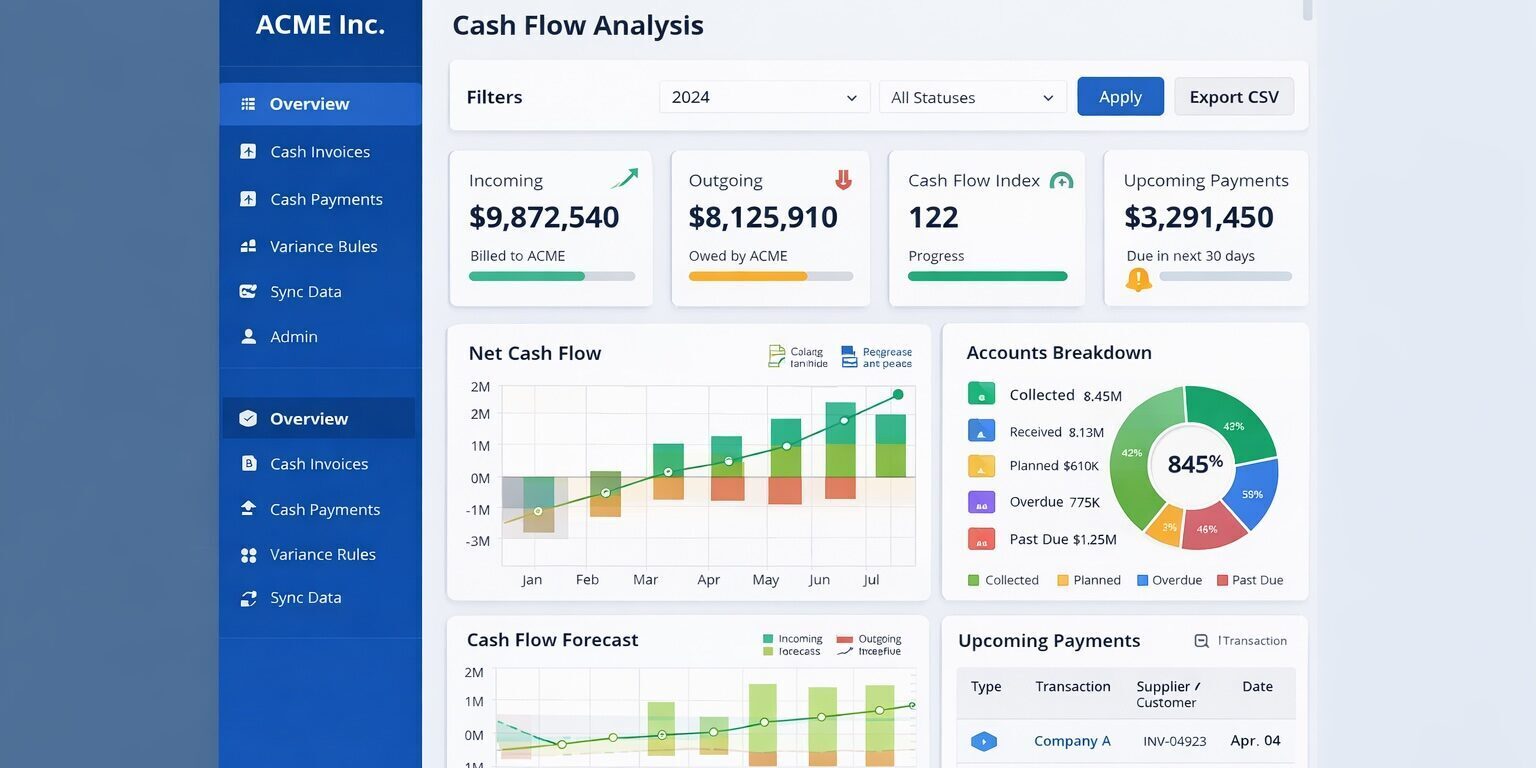
You know the importance of cash flow inside out. Yet, it’s not always easy to track how each purchase order affects your company’s bottom line or where potential leaks in your spending might arise. A real-time spend tracking dashboard changes this conversation completely, allowing you to see each dollar commitment, how it’s progressing through your purchasing process, and how those expenses stack up over time.
A tool like Praxie’s Cash Flow Analysis app goes even further by linking open purchase orders, goods received, and spend trends, then placing all that information right at your fingertips. This visibility not only helps you check today’s available funds but also forecast future commitments more effectively. Through dynamic filters, progress indicators, and monthly or yearly comparisons, you can spot cash flow risks, identify supplier performance challenges, and adapt your strategy in time to avoid bottlenecks.
Recognize the need for real-time data
A lot can happen in a single day or even an hour in your finance world. You might approve a new purchase order or receive an unexpected invoice from a supplier. When these moments aren’t captured quickly, your picture of cash flow becomes obsolete. By the time you see your weekly or monthly report, critical opportunities to rein in costs or dispute charges may have slipped by. That’s where a real-time spend tracking dashboard becomes your ally. It gathers purchase order updates, invoice status changes, and goods receipt records in near-instantaneous fashion, so your data is always reflective of your current situation.
The alternative is juggling multiple spreadsheets, which is time-consuming and prone to human error. Even if you meticulously record updates, you risk a lag that prevents you from making quick, informed decisions. You might allocate funds you don’t have or fail to place a purchase order when you do have enough capital, simply because your records haven’t caught up. When you unlock real-time visibility, you cut down these gaps, reduce confusion, and empower your team with prompt, evidence-based insights.
In many finance departments, discussions about real-time data focus on broad analytics without pinning down exactly how that immediacy leads to everyday savings or improved supplier relations. But the benefits are concrete. You can avoid late fees because you’ll know precisely when a payment is due. You can take advantage of early payment discounts because you’ll catch opportunities in the moment rather than after the fact. Real-time data, in other words, isn’t just a buzzword—it’s a practical safeguard and a strategic advantage you can’t afford to ignore.
Link purchase orders and goods
As soon as purchase orders are issued, you introduce a set of expectations on your cash flow. Connecting these POs to the actual goods received ensures you match those expectations with reality. If your ordered items arrive on schedule and match the original invoice, your financial state remains predictable. However, short shipments, late deliveries, or partial orders can throw this predictability off. By having your real-time spend tracking dashboard draw a direct line from the initial PO to the subsequent delivery, you get the full story on whether costs align with what you anticipated.
You also enhance accountability when you link purchase orders and goods. In many companies, a single purchase order can spawn multiple shipments or partial deliveries over time. Without a consolidated view, it’s tough to know whether you’ve fully accounted for all the items you ordered or been billed incorrectly. A dynamic dashboard helps you see each stage, from the initial order to the final shipment, highlighting any discrepancies that need your attention. It also shows when you’ve received items but haven’t yet been billed—an important piece of the puzzle for forecasting upcoming cash outlays.
This linkage is a backbone for accurate financial planning. It’s easy to assume you’re only spending what appears on incoming invoices, yet incomplete deliveries or overlooked partial shipments can hide costs. By uniting POs with goods received data and your spend trend analysis, you create a seamless lineage between what you requested, what you actually got, and how much it impacted your overall spending. With this level of transparency, you can plan upcoming payments more precisely and avoid last-minute budget surprises.
The All-in-One AI Platform for Orchestrating Business Operations
 Instantly create & manage your process Use AI to save time and move faster Connect your company’s data & business systems
Use filters to track spending
A robust dashboard isn’t just a stream of numbers—it’s an interactive tool that lets you slice and dice your data in the way that makes the most sense for your team. Filters are your best friend here. You can organize your information by supplier, purchase category, date range, or even payment status. This flexibility goes beyond offering a basic overview. It ensures that you can see exactly which areas may be draining funds, where your payment delays occur, and how different segments of your purchasing process impact your liquidity.
If you’re curious why a certain item consistently runs over budget, it might be because a supplier’s costs went up or because shipping fees fluctuate more than you realized. When you filter by supplier, you can track exactly how prices have changed and whether you need to negotiate better terms or explore alternatives. Similarly, date filters help you see at a glance whether you’re experiencing seasonal spikes in spending, which can prompt a conversation about adjusting your procurement schedule.
At first, you might not think these filters offer much more than convenience, but they’re essential for turning raw data into actionable insights. Rather than rummaging through a giant spreadsheet for hours on end, you quickly drill down to the information you need most. You might focus on new orders placed this month, items received last week, or costs associated with a specific department. By restricting your view to the relevant data, you make faster decisions and catch anomalies before they spiral into bigger issues.
Compare month-over-month trends
Even the most detailed snapshot of your finances today won’t give you the full tactical edge if you don’t compare it to the past. Month-over-month metrics reveal whether your purchasing behaviors, costs, or payment timelines are improving or deteriorating. A real-time spend tracking dashboard that includes historical comparisons acts like a color-coded map. You see exactly where you’ve progressed—maybe you’ve spent less on one category this month compared to last—and where you’re slipping, such as a spike in expedited shipping charges.
This kind of trend analysis is vital for your budgeting process. You can’t set realistic spending targets if you don’t know how your expenditures behave over time. Maybe your supply chain is impacted by the holiday rush in December. Or perhaps you see a recurring lull in late summer. By detecting these patterns, you can allocate resources more accurately, adjust your reorder points, or coordinate with suppliers to lock in better terms during slower periods.
Month-over-month comparisons also help you understand the ripple effects of business decisions. If you launched a new product line, how did that change your material costs? If you shifted to a new supplier last quarter, did your monthly spending decrease or did it introduce new overhead costs? By looking at these trends, you confirm whether each strategic move actually delivers the desired financial result. That evidence becomes crucial when you’re deciding whether to invest more in a particular initiative or pivot to a different strategy entirely.
Spot risks and performance issues
When you see a sudden jump in costs or a disruptive dip in delivery timeliness, you might have a problem with supplier performance, fluctuating prices, or even internal inefficiencies. A real-time spend tracking dashboard pinpoints these issues fast, saving you from major headaches down the line. You’ll notice if a supplier consistently misses deadlines or if a category of goods routinely goes over budget despite your expectations. These red flags are your cue to investigate further, renegotiate contracts, or consider adopting a supplier risk management software approach to reduce vulnerabilities.
Catching problems early gives you more negotiating power. If a supplier’s late deliveries are hurting your production schedule, you have documented evidence right there in your dashboard. This proof-based argument puts you in a stronger position to request concessions, ask for expedited shipping, or transition to a more reliable vendor. Conversely, if you discover that over-ordering certain materials is a recurring issue, you can address it internally. Maybe employees aren’t checking stock levels before reordering, or maybe forecasts are too high. Either way, you have the data to drive meaningful changes.
The same goes for unbalanced payment terms or unexpectedly high fees. When your dashboard highlights a spike in ancillary charges—like overnight shipping or rush fees—take it as a sign that processes need refinement. Do you need a better lead time with a key supplier? Should you store more strategic inventory so you’re not forced into last-minute orders? Without a centralized, real-time view, you might only realize these flaws when they’ve already made a dent in your financial performance.
Focus on early action
Spotting a problem is only half the battle. Acting early is what saves you from last-minute cash shortages or supplier disruptions. When your real-time spend tracking dashboard highlights a significant pending payment, you can quickly assess whether you need to transfer funds, expedite an invoice approval, or negotiate a temporary adjustment with the supplier. This agility reduces the odds of missed deadlines, late fees, or an awkward situation where you’re juggling multiple high-dollar obligations with insufficient coverage.
One of the key advantages of early action is it fosters better relationships with your suppliers. If you see you’ll need more goods earlier than expected, you have time to engage your supplier and collaboratively plan shipment dates. This proactive approach often leads to lower costs because you can coordinate deliveries, avoid expedited freight, and demonstrate reliability. Suppliers appreciate that you’re managing your orders responsibly, and in turn, they may be more willing to accommodate special requests or favorable pricing.
Early action also helps you pivot when you realize some items are about to exceed your forecast. Instead of waiting for the invoice to arrive and scrambling for leftover budget, you can decide whether to move funds from another category, request a short extension, or place the order in a different month to keep your overall budget balanced. Prompt responses like these aren’t just good crisis management. They elevate your reputation within and beyond your team, as you’ll be seen as someone who anticipates challenges before they become emergencies.
Build a stronger dashboard
A real-time spend tracking dashboard works best when it’s customized to fit your unique processes. Your business might prioritize shipping cost data over payment terms, or you might want to integrate a forecasting module that projects future spend based on historical trends. As you begin building out or refining your dashboard, think about your biggest financial pain points, the data points you need to watch closely, and the most useful ways to visualize that information.
Below is a quick example of how you might organize core metrics in your dashboard:
| Metric | What it shows | Why it matters |
|---|---|---|
| Open Purchase Orders | Current orders not yet fulfilled | Helps you forecast cash outflows |
| Goods Received (In Transit) | Pending items or in-route orders | Alerts you to partial or delayed items |
| Spend by Category | Breakdown of spend across areas | Reveals high or unexpected expenses |
| Supplier On-Time Rate | Supplier delivery performance | Identifies potential disruptions |
When you design your layout, aim for a clear, clutter-free interface that tells a story at a glance. For instance, a color-coded progress bar could indicate which purchase orders are fully delivered, partially delivered, or overdue. A pie chart might show which three suppliers account for the bulk of your spending. If you can absorb these updates in seconds rather than minutes, you’ll be more inclined to check the dashboard regularly, and your decision-making will be all the sharper for it.
Always consider who else is using the dashboard. If your colleagues in purchasing, accounting, or operations also rely on the data, build in consistent naming conventions, status updates, and definitions of key metrics. That clarity prevents misinterpretation. Everyone is on the same page, so you don’t need to spend valuable time explaining or double-checking data. Ultimately, a strong dashboard doesn’t just display figures. It arms you and your team with the insights you need to make better calls, faster.
Keep teams aligned
Creating the perfect real-time spend tracking dashboard is only truly effective if all relevant departments use it consistently. Sometimes finance teams live in their own silos, working off separate systems or sets of priorities. Aligning your purchasing, finance, and even operational teams around the same data ensures everyone sees the bigger picture. You’ll reduce duplicate tasks, minimize conflicting orders, and eliminate repeated requests to suppliers for the same items.
It’s helpful to schedule regular check-ins, whether weekly or monthly, where you review the dashboard’s insights together. Encourage open conversations about where performance is shining or slipping. This approach prevents finger-pointing and focuses attention on problem-solving. If, for example, you notice a certain category’s spend jumped 20% this month, the team can lean into discovering the root cause. Maybe materials cost more than usual, or maybe you received a surge of last-minute orders.
Also, make the dashboard your single source of truth. Instead of referencing outdated spreadsheets in different emails, direct everyone to the dashboard for real-time figures. That consistency curbs confusion and fosters a culture that values up-to-date information. When the entire team is working off the same data set, it’s easier to propose solutions, assign tasks, and set realistic timelines for improvements. You move forward as a cohesive unit, rather than tackling problems piecemeal.
Refine your ongoing approach
As your operations evolve, so should your real-time spend tracking dashboard. Companies grow, suppliers change, and economic climates shift. The dashboard you set up today might need tweaks in six months to account for new product lines, additional vendor relationships, or expansions into different regions. Take time every quarter or so to review what the dashboard is telling you. If the metrics you prioritized last quarter aren’t critical anymore, replace them with new indicators.
A major advantage of a flexible system like Praxie’s Cash Flow Analysis app is that you can adapt reports, filters, and displays as your priorities shift. You may find, for instance, that you need more detailed supplier scorecards to capture on-time delivery performance or to factor in quality metrics that feed into your total cost. Or perhaps you want to compare your monthly spend to your budget forecast in real time, so you immediately see any deviations. Keep experimenting with new data visualizations and progress indicators until you feel you’ve covered the points your organization cares about most.
Above all, treat your dashboard as a living tool. Encourage your team to suggest improvements or call out areas where deeper analysis would be beneficial. If someone spots a rising trend in shipping costs, you might add a small block on your dashboard devoted to carrier fees. If managers want more frequent updates on purchase orders, you could set up alerts or more prominent notifications. Constant refinement keeps your processes fresh and helps you stay a step ahead of surprises, which is especially important for maintaining stable working capital.
Conclusion
Mastering your organization’s cash exposure is an ongoing journey—one that becomes significantly smoother when you can see the road ahead in real time. By combining open purchase orders, goods received data, and spend trends into a single, clear dashboard, you’re giving yourself and your team the chance to act fast and respond before cash flow issues take root. With thoughtful filters and monthly comparisons, you also maintain the context you need to make the best decisions for your operational health and your bottom line.
The ultimate goal is to spend more time optimizing your working capital strategy and less time hunting down missing numbers or re-checking outdated spreadsheets. A real-time spend tracking dashboard does the heavy lifting by organizing and visualizing your data as it happens. So each day, you’re confidently steering your finances, relying on a full picture that makes sense at a glance. It’s a practical path to stronger cash control, smoother supplier relationships, and a finance operation that stays ready for whatever comes next.
The All-in-One AI Platform for Orchestrating Business Operations
Instantly create & manage your process Use AI to save time and move faster Connect your company’s data & business systems
