


Total Productive Maintenance (TPM) is a well-established methodology aimed at maximizing the effectiveness of manufacturing equipment by integrating maintenance activities into daily operations. It is built upon eight foundational pillars, including autonomous maintenance, planned maintenance, and quality maintenance, among others. While TPM is widely adopted across various industries, its implementation in regulated sectors—such as pharmaceuticals, food and beverage, and medical devices—presents unique challenges and requirements.
Regulated industries operate under stringent compliance frameworks, such as Good Manufacturing Practices (GMP), U.S. Food and Drug Administration (FDA) regulations, International Organization for Standardization (ISO) standards, and Hazard Analysis and Critical Control Points (HACCP). These frameworks demand rigorous documentation, validation, and risk management practices, which must be seamlessly integrated into TPM efforts.
This article explores how TPM aligns with regulatory requirements, the adaptations needed for compliance, and best practices for implementing TPM in highly regulated environments.
The Eight Pillars of TPM in Regulated Industries
The standard TPM framework consists of eight pillars designed to improve equipment reliability, efficiency, and productivity. In regulated industries, these pillars require enhanced focus on compliance, documentation, and validation.
1. Autonomous Maintenance (Jishu Hozen)
Autonomous Maintenance empowers operators to take responsibility for routine maintenance tasks, such as cleaning, lubricating, and inspecting equipment. In regulated industries, this practice must be documented meticulously to ensure compliance with GMP and FDA standards.
- Compliance Considerations: Operators must follow Standard Operating Procedures (SOPs) for cleaning and maintenance.
- Documentation Requirements: Maintenance logs must be kept in compliance with data integrity regulations, such as FDA 21 CFR Part 11 for electronic records.
- Risk Management: Operators should be trained to identify and report potential contamination risks in pharmaceutical and food manufacturing.
2. Planned Maintenance
Planned maintenance focuses on preventing equipment breakdowns through scheduled servicing and part replacements. In regulated industries, planned maintenance is critical to maintaining equipment qualification and process validation.
- Compliance Considerations: Maintenance schedules must align with equipment validation protocols and regulatory guidelines.
- Documentation Requirements: Maintenance activities must be recorded in a validated Computerized Maintenance Management System (CMMS).
- Risk Management: Failure Mode and Effects Analysis (FMEA) can be used to assess risks associated with equipment failures.
3. Quality Maintenance
Quality Maintenance ensures that equipment operates within predefined quality parameters to prevent defects and deviations. In regulated industries, this aligns closely with Process Validation and Quality Control measures.
- Compliance Considerations: Equipment must be validated and regularly calibrated according to regulatory requirements.
- Documentation Requirements: Every calibration and quality check must be documented to meet FDA and ISO standards.
- Risk Management: Root Cause Analysis (RCA) should be conducted for any equipment-related deviations affecting product quality.
4. Focused Improvement (Kobetsu Kaizen)
Focused Improvement aims to identify and eliminate losses by continuously improving processes. In regulated industries, improvement initiatives must be carefully evaluated for their impact on compliance and product safety.
- Compliance Considerations: Any changes to maintenance processes must be reviewed under Change Control procedures.
- Documentation Requirements: Improvement initiatives should be recorded, with justifications provided for any process modifications.
- Risk Management: Regulatory impact assessments should be conducted before implementing process changes.
5. Early Equipment Management
Early Equipment Management ensures that new equipment is designed and installed with maintenance and reliability in mind. In regulated industries, this pillar is crucial for meeting equipment qualification requirements.
- Compliance Considerations: New equipment must undergo Installation Qualification (IQ), Operational Qualification (OQ), and Performance Qualification (PQ).
- Documentation Requirements: Design Qualification (DQ) documentation should be prepared to ensure compliance.
- Risk Management: Equipment selection must consider contamination risks and compliance with hygiene standards.
6. Education and Training
Training is essential to ensure that employees understand and adhere to maintenance procedures. In regulated industries, training programs must include compliance topics such as GMP, Good Documentation Practices (GDP), and regulatory reporting.
- Compliance Considerations: Employees must be trained on regulatory requirements relevant to maintenance activities.
- Documentation Requirements: Training records must be maintained and periodically reviewed.
- Risk Management: Competency assessments should be conducted to ensure that employees can perform maintenance tasks correctly.
7. Safety, Health, and Environment (SHE)
The SHE pillar focuses on creating a safe and compliant working environment. In regulated industries, SHE initiatives must align with workplace safety regulations and environmental sustainability guidelines.
- Compliance Considerations: Equipment safety features must comply with OSHA, FDA, and ISO safety regulations.
- Documentation Requirements: Incident reports and safety audits must be recorded for compliance purposes.
- Risk Management: Hazard assessments should be conducted to identify potential contamination or safety risks.
8. TPM in Administration
Administrative functions play a crucial role in supporting maintenance activities through proper documentation, compliance monitoring, and regulatory reporting.
- Compliance Considerations: Administrative processes must support GMP and regulatory audits.
- Documentation Requirements: Compliance reports and audit trails must be maintained for regulatory review.
- Risk Management: Data integrity controls should be implemented to prevent unauthorized changes to maintenance records.
Digitize your manufacturing process 10x faster at one-tenth the cost
 Instantly create & manage your process Use AI to save time and move faster Connect your company’s data & business systems
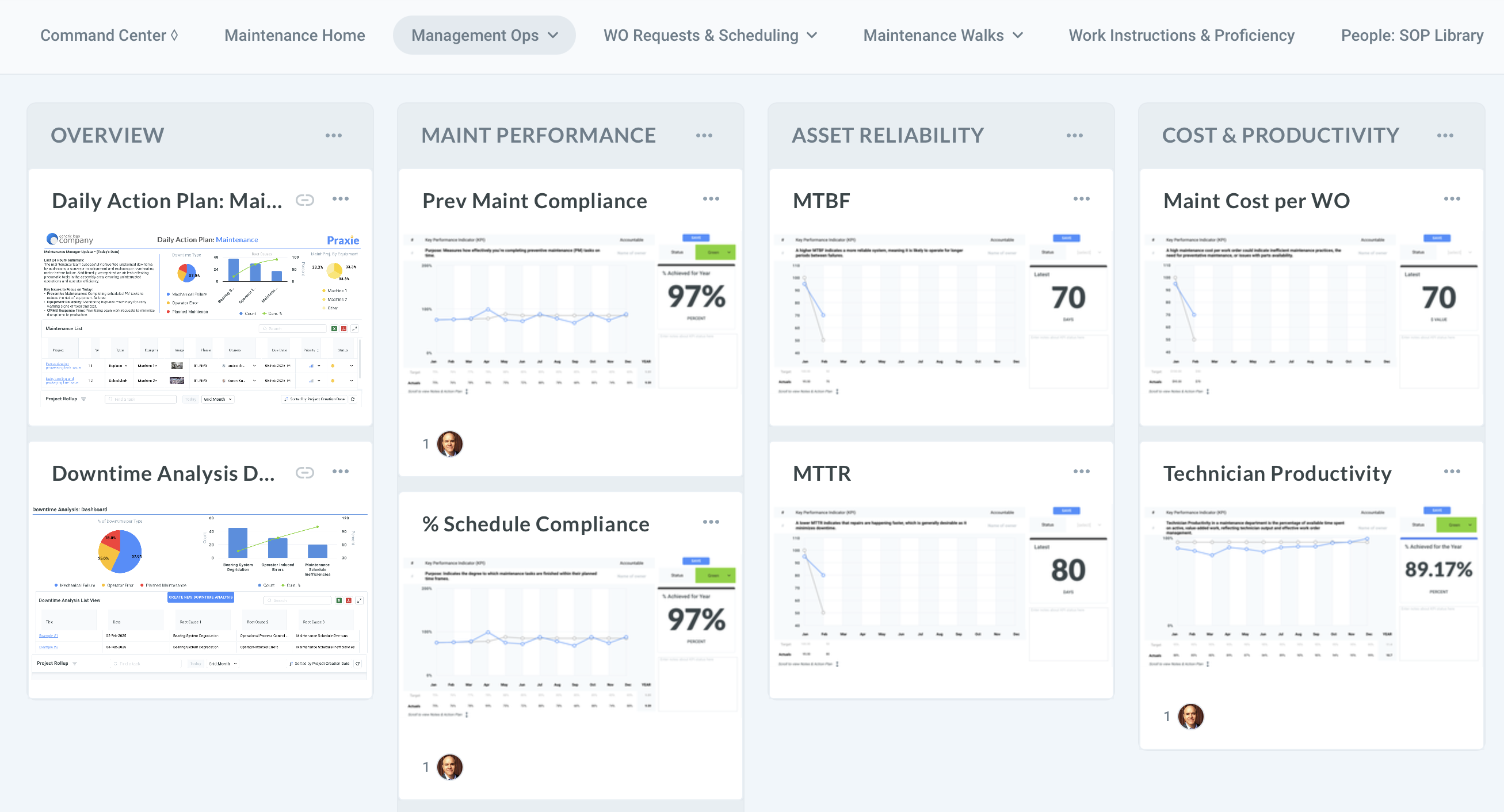
Praxie’s Total Productive Maintenance App
Regulatory Frameworks Impacting TPM
1. Good Manufacturing Practices (GMP)
GMP regulations require that maintenance activities ensure product safety, consistency, and quality. This includes:
- Maintaining clean and validated equipment.
- Ensuring traceability of maintenance activities.
- Implementing preventive maintenance to avoid contamination risks.
2. FDA Regulations (21 CFR Part 11, 210, 211)
The U.S. FDA mandates strict controls over maintenance processes, including:
- Electronic record-keeping under 21 CFR Part 11.
- Equipment maintenance and validation under 21 CFR Part 210 and 211.
- Investigation of maintenance-related deviations.
3. ISO Standards (ISO 9001, ISO 13485, ISO 22000)
- ISO 9001: Requires a structured maintenance management system for quality control.
- ISO 13485: Applies to medical device manufacturing, emphasizing equipment validation.
- ISO 22000: Ensures food safety through preventive maintenance programs.
4. HACCP (Hazard Analysis and Critical Control Points)
For the food and beverage industry, HACCP requires maintenance activities to prevent contamination risks by:
- •Regularly servicing and sanitizing processing equipment.
- •Implementing risk-based preventive controls for equipment failures.
- •Documenting maintenance as part of food safety compliance.
Best Practices for Implementing TPM in Regulated Industries
1. Integrate TPM with Regulatory Compliance Systems
- Use a CMMS to automate maintenance scheduling and record-keeping.
- Align TPM activities with regulatory audits to ensure compliance readiness.
2. Implement Robust Documentation and Data Integrity Controls
- Use electronic logs that comply with FDA 21 CFR Part 11.
- Maintain thorough documentation for all maintenance activities, including deviations.
3. Conduct Regular Validation and Risk Assessments
- Perform IQ, OQ, and PQ for all critical equipment.
- Use FMEA to evaluate risks associated with equipment failures.
4. Enhance Training Programs
- Provide mandatory compliance training for all maintenance personnel.
- Conduct periodic refresher courses on GMP, ISO, and HACCP requirements.
5. Foster a Culture of Continuous Improvement
- Use TPM metrics (e.g., Overall Equipment Effectiveness – OEE) to drive improvements.
- Encourage cross-functional teams to collaborate on maintenance enhancements.
Implementing TPM in regulated industries requires a tailored approach that prioritizes compliance, documentation, and risk management. By integrating TPM with regulatory frameworks such as GMP, FDA regulations, ISO standards, and HACCP, organizations can enhance equipment reliability while ensuring product quality and safety.
A well-executed TPM strategy not only minimizes downtime and defects but also strengthens regulatory compliance, ensuring that manufacturers remain audit-ready and competitive in their respective industries. By leveraging technology, training, and risk-based methodologies, organizations can fully realize the benefits of TPM while maintaining the highest standards of quality and safety.
Digitize your manufacturing process 10x faster at one-tenth the cost
Instantly create & manage your process Use AI to save time and move faster Connect your company’s data & business systems