


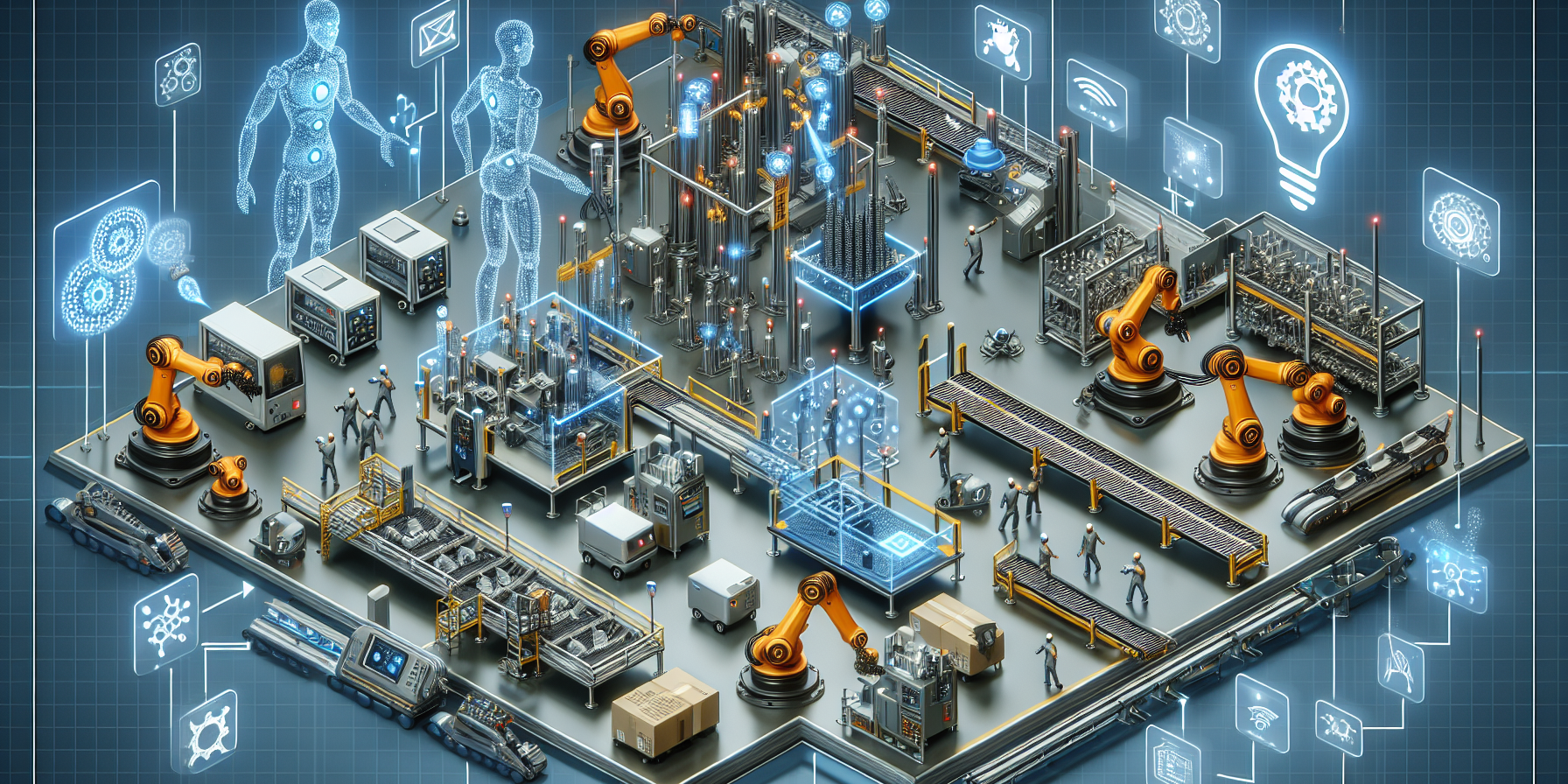
AI in Manufacturing
Overview of AI Applications in Manufacturing
Artificial intelligence is revolutionizing the manufacturing industry by offering a variety of applications that enhance efficiency, productivity, and quality. AI applications in manufacturing encompass several areas, including predictive maintenance, process optimization, quality control, and supply chain management. With AI-driven technology, manufacturing plants can now predict equipment failures before they occur, optimize production schedules, and ensure product quality at every stage of the production process.
Key AI Applications:
- Predictive Maintenance: Uses machine learning to forecast equipment failures.
- Process Optimization: Enhances production efficiency through real-time data analysis.
- Quality Control: Inspects products automatically using computer vision.
- Supply Chain Management: Optimizes inventory and logistics with AI-driven insights.
Benefits of Incorporating AI in Manufacturing Processes
Incorporating AI into manufacturing processes offers several compelling benefits, from improved operational efficiency to enhanced product quality. AI enables manufacturers to achieve higher throughput, reduce downtime, and minimize waste. It also enhances decision-making capabilities by providing real-time insights and predictive analytics.
Key Benefits:
- Increased Efficiency: AI algorithms streamline operations, reducing bottlenecks and enhancing workflow.
- Cost Savings: Predictive maintenance prevents costly breakdowns, leading to substantial savings.
- Improved Quality: Automated quality control ensures products meet high standards consistently.
- Better Decision-Making: AI provides data-driven insights, enhancing strategic planning.
| AI Application | Benefits |
|---|---|
| Predictive Maintenance | Reduced downtime, cost savings |
| Process Optimization | Increased efficiency, less waste |
| Quality Control | Improved product quality |
| Supply Chain Management | Better inventory control |
AI in manufacturing not only addresses current inefficiencies but also paves the way for more advanced manufacturing strategies. By leveraging AI technologies, manufacturers can implement concepts like the theory of constraints in manufacturing and explore ai-assisted production planning for future-ready operations. For more insights on AI’s transformative impact, visit our article on ai-assisted manufacturing strategies.
AI-Assisted Theory of Constraints
The integration of AI into manufacturing processes has revolutionized how constraints are identified and managed. One significant area of impact is the Theory of Constraints (TOC), a methodology that prioritizes the most critical bottleneck in a process to improve overall efficiency.
Understanding Theory of Constraints in Manufacturing
The Theory of Constraints is a management philosophy aimed at identifying the most significant limiting factor (constraint) in a manufacturing process and systematically improving it. The idea is that a single constraint often determines the throughput of an entire system. By focusing on this constraint, plant managers can significantly enhance productivity and efficiency.
- Identify the Constraint: Determine the most significant bottleneck affecting production.
- Exploit the Constraint: Make quick improvements to get more output from the constrained process without major investments.
- Subordinate Everything Else: Align the whole manufacturing process to support the improved performance of the constraint.
- Elevate the Constraint: Make necessary investments to eliminate the constraint.
- Repeat the Process: Continuously identify and process the next constraint.
Understanding and implementing TOC can significantly streamline manufacturing operations. For more insights on this theory, read our article on theory of constraints in manufacturing.
How AI Enhances Theory of Constraints Implementation
AI plays a crucial role in enhancing the implementation of TOC by providing real-time data analytics, predictive insights, and automated decision-making. Here’s how AI can transform each step of the TOC process:
Identifying Constraints:
AI algorithms can analyze vast amounts of production data in real-time to identify bottlenecks more efficiently than traditional methods. Machine learning models can predict potential constraints before they become problematic.
Exploiting Constraints:
AI-driven predictive maintenance tools can ensure that machinery involved in the constraint operates at optimal levels. For example, sensors and IoT devices can monitor equipment health, forecasting failures, and enabling timely interventions.
| Method | Traditional TOC | AI-Enhanced TOC |
|---|---|---|
| Identification | Manual data analysis | Real-time data analytics |
| Exploitation | Basic improvements | Predictive maintenance |
Subordinating Processes:
AI systems can optimize the entire manufacturing workflow to support the key constraint. This ensures that every part of the process is synchronized, reducing delays and enhancing productivity. For more information, visit our article on ai-driven manufacturing resource allocation.
Elevating Constraints:
AI provides actionable insights on where to invest resources to eliminate constraints effectively. Through AI-assisted simulation models, plant managers can visualize the impact of changes before they are implemented, reducing the risk of investment.
Repeating the Process:
Continual monitoring by AI systems ensures that new constraints are quickly identified and addressed, fostering a culture of continuous improvement. Check our resource on ai-driven manufacturing decision-making for more details.
AI technologies automate and optimize the TOC steps, enabling quicker and more precise decision-making for manufacturing managers. Integrating AI not only makes the TOC process more efficient but also significantly enhances overall manufacturing productivity. Learn more about the benefits in our article on ai-assisted theory of constraints.
Real-World AI Applications
Predictive Maintenance and Machine Health Monitoring
Predictive maintenance is one of the most impactful AI applications in manufacturing, allowing companies to foresee equipment failures before they occur. By leveraging machine learning algorithms and IoT devices, manufacturing plants can gather real-time data from machinery to predict when maintenance should be performed.
This proactive approach reduces downtime and extends the lifespan of equipment, resulting in increased productivity and cost savings. Critical machine data such as vibration, temperature, and sensor readings are analyzed continuously to detect anomalies.
| Data Metric | Description |
|---|---|
| Vibration | Measures oscillations in equipment |
| Temperature | Monitors heat levels in machinery |
| Sensor Readings | Tracks performance metrics |
AI-assisted predictive maintenance not only identifies potential issues but also recommends corrective actions. This ensures that maintenance activities are carried out efficiently, minimizing disruptions to the production process.
Process Optimization and Quality Control
AI applications in manufacturing also significantly enhance process optimization and quality control. AI algorithms can analyze large datasets to uncover patterns and insights that human operators might miss. By adjusting parameters and optimizing workflows, AI can improve overall process efficiency.
Implementing AI for quality control involves real-time monitoring of production to ensure that products meet specified standards. Machine vision systems equipped with deep learning algorithms can inspect and identify defects with greater accuracy and speed than traditional methods.
| Quality Metric | AI Performance |
|---|---|
| Defect Detection Rate | 99% accuracy |
| Inspection Speed | 200 parts/minute |
In addition, AI-driven process optimization can automate adjustments in production lines to adapt to real-time conditions, reducing waste and enhancing the consistency of output. For an in-depth look at how AI can streamline manufacturing operations, explore our article on ai-assisted production planning.
By utilizing AI for process optimization and quality control, manufacturing plants can achieve superior efficiency and reliability, leading to higher customer satisfaction and competitive advantage.
Digitize your manufacturing process 10x faster at one-tenth the cost
 Instantly create & manage your process Use AI to save time and move faster Connect your company’s data & business systems
Implementing AI Solutions
Steps to Integrate AI into Manufacturing Operations
Implementing AI applications in manufacturing requires strategic planning and a structured approach. Here are the key steps to successfully incorporate AI into manufacturing processes:
- Identify Specific Needs: Assess the current manufacturing processes to determine where AI can add value. This includes areas like predictive maintenance, quality control, and process optimization.
- Define Objectives: Establish clear goals for AI integration, such as reducing downtime, increasing throughput, or enhancing product quality.
- Data Collection: Gather and organize historical and real-time data from various sources within the manufacturing plant.
- Choose Appropriate AI Technologies: Select the right AI tools and technologies that align with the defined objectives. This could involve machine learning algorithms, computer vision, or natural language processing.
- Pilot Testing: Start with a pilot project to test the AI applications in a controlled environment. This helps in understanding the potential challenges and benefits.
- Training and Development: Train the workforce to use AI tools effectively. This includes training plant managers, engineers, and IT staff.
- Implementation: Gradually integrate AI solutions across the manufacturing operations, ensuring minimal disruption.
- Monitoring and Evaluation: Continuously monitor the performance of AI applications and make necessary adjustments.
For a deeper dive into integrating AI, explore our article on ai-assisted manufacturing strategies.
Challenges and Considerations for AI Adoption
Adopting AI in manufacturing comes with its set of challenges and considerations. Understanding these can help in devising effective implementation strategies:
- Data Quality and Integration: Ensuring high-quality data and integrating it across various systems can be complex. Poor data quality can lead to inaccurate AI predictions.
- Cost Considerations: AI implementation can be costly, involving expenses related to technology, infrastructure, and training. Careful budget planning is crucial.
- Technological Complexity: The complexity of AI technologies may require specialized skills and expertise. Hiring or training personnel to manage AI tools can be challenging.
- Change Management: Employee resistance to change can hinder AI adoption. Effective change management strategies are needed to ensure smooth transition.
- Regulatory Compliance: Ensure that the implementation of AI adheres to industry regulations and standards.
- Scalability: The chosen AI solutions should be scalable to accommodate future growth in manufacturing operations.
| Challenge | Consideration |
|---|---|
| Data Quality and Integration | Implement robust data governance and ensure seamless integration across systems |
| Cost Considerations | Plan for upfront and ongoing costs, and evaluate ROI |
| Technological Complexity | Invest in training and development, or hire experts |
| Change Management | Develop strategies for effective change management and employee engagement |
| Regulatory Compliance | Stay updated with industry regulations and ensure AI solutions comply |
| Scalability | Choose scalable AI solutions to accommodate future expansion |
Addressing these challenges strategically can lead to the successful adoption of AI in manufacturing. For further insights on overcoming production constraints with AI, visit ai solutions for production constraints.
Implementing AI into manufacturing processes also calls for aligning operations with ai-assisted theory of constraints to maximize efficiency and effectiveness in production planning and resource allocation. Explore more on ai-assisted production planning to understand how AI can transform manufacturing operations.
Digitize your manufacturing process 10x faster at one-tenth the cost
Instantly create & manage your process Use AI to save time and move faster Connect your company’s data & business systems
