


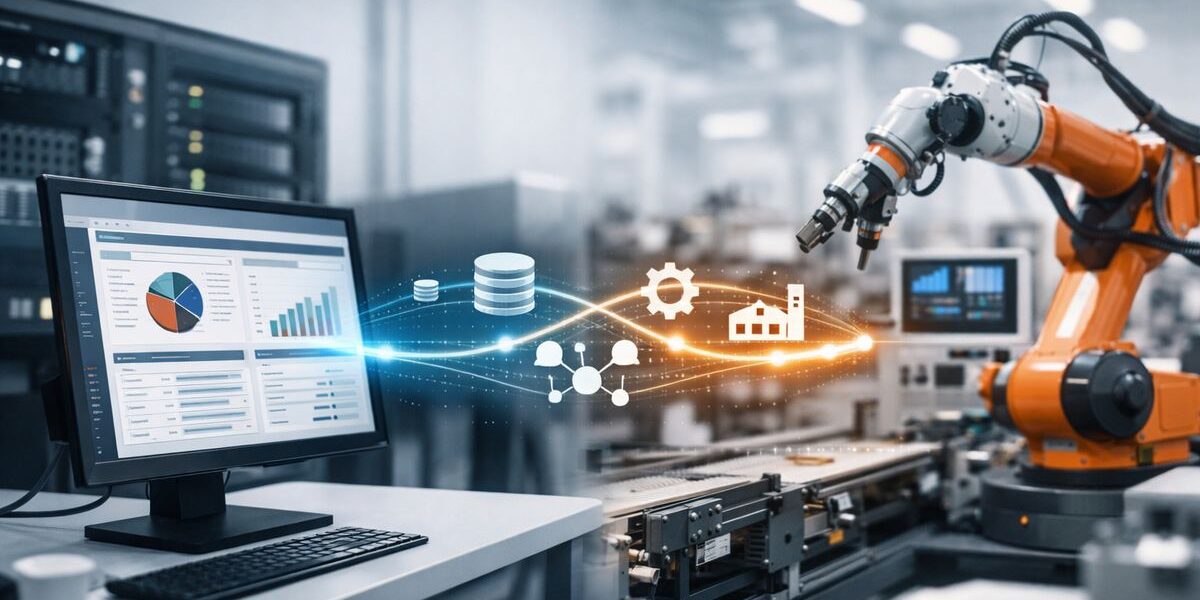
ERP MES integration is the live connection between your business system and your plant system, so production data moves automatically instead of getting retyped, delayed, or lost. If finance sees one version of production, the plant sees another, and somebody ends up checking a spreadsheet at 6:12 a.m., this is the gap you are dealing with. Once you understand how the connection works, it gets much easier to see why it matters so much for AI, planning, and day-to-day control.
What ERP and MES integration actually means
ERP, or enterprise resource planning, is the system that runs business operations like orders, inventory, purchasing, and finance. MES, or manufacturing execution system, is the system that runs and tracks production on the floor in real time.
ERP MES integration connects those systems so information flows back and forth without manual handoffs. Your ERP can send the plan, and your MES can send back what actually happened. That sounds simple, but the payoff is huge. Instead of chasing stale reports, you get a cleaner view of what is happening across the business and the plant.
ERP vs. MES: the simple difference
The simplest way to think about it is this: ERP plans and records the business, MES executes and monitors the work.
A maps app is a useful analogy. ERP is the route your app suggests before you leave the driveway. MES is the real trip, including traffic, road work, missed turns, and the exact time you arrive. You need both. The planned route matters, but the real-world conditions matter just as much.
Why these systems often drift apart
This split usually happens for a normal reason. Your ERP often came from business needs like finance, procurement, and order management. Your MES often grew from plant needs like machine tracking, labor reporting, quality checks, and throughput.
Over time, those systems start speaking slightly different languages. Part numbers get formatted differently. Timing rules differ. One system updates once an hour, the other updates every few seconds. The disconnect is common, but handoff friction shows up fast once schedules tighten or quality issues hit.
Why connecting plant systems matters more than ever
When ERP and MES do not talk cleanly, every schedule change, material shortage, quality hold, or labor update travels slower than it should. That delay costs money.
Here’s the thing: integration is not an IT nice-to-have. It is the backbone for reliable decisions. If your goal includes AI, automation, or even just better reporting, disconnected systems will keep dragging you backward.
The cost of disconnected data
The problems are rarely dramatic at first. A supervisor updates production counts in one system, then someone else retypes them later. Inventory says material is available, but the floor already consumed it. Customer service gives an order update based on yesterday’s report. Finance closes the month with extra reconciliation because production reporting landed late.
Those small misses add up to bigger executive headaches: missed margins, poor delivery commitments, weak traceability, and too much time spent arguing over whose report is right.
Why AI depends on connected ERP and MES data
AI needs connected data more than clever models. Forecasting, anomaly detection, predictive maintenance, scheduling optimization, and copilots all depend on clean signals from both business systems and plant systems.
Trusted data means data you do not have to argue about in meetings. If your ERP says one thing, your MES says another, and your teams maintain side spreadsheets to fill the gap, AI will not fix that. It will just process the confusion faster.
What data usually moves between ERP and MES
A lot of writing on this topic stays abstract. In practice, integration is about specific information moving at the right time between systems.
From ERP to MES
ERP usually sends the production intent. That includes work orders, bills of materials, routings, item masters, customer priorities, planned quantities, due dates, and inventory availability.
This is the business saying, “Here is what needs to be made, how it should be made, and when it matters.” Without that connection, the floor often works from partial instructions or outdated priorities.
From MES to ERP
MES sends back the production reality. That includes production counts, scrap, labor time, machine status, material consumption, downtime, quality results, and order completion.
That return flow matters just as much as the plan itself. Your ERP should not only know what was supposed to happen. It should know what actually happened, how long it took, what material got consumed, and where performance drifted.
Where other systems often join the picture
ERP and MES are the core pair, but your environment usually includes a few more systems around the edges. PLM handles product data. QMS handles quality records. CMMS handles maintenance events. WMS tracks warehouse movements. Machine and IIoT signals add equipment-level data from the floor.
Once those systems connect sensibly, your records stop living in isolated pockets. You start getting one operational story instead of five fragments.
The biggest benefits you can expect from ERP MES integration
The value is not just cleaner interfaces. It shows up in better decisions, faster response, tighter control, and a much stronger base for automation.
Better scheduling and faster shop-floor response
Integrated systems help your schedule react to real conditions. If a machine goes down, material runs short, a rush order shows up, or labor shifts mid-day, updates move faster between planning and execution.
That means your plan gets closer to reality. Not perfect, because manufacturing is never perfect, but much closer. And that alone can save a lot of scrambling.
More accurate inventory, costing, and financial visibility
When actual production consumption and completion flow back into ERP quickly, inventory records improve. Work-in-progress becomes easier to see. Product costing gets less theoretical and more grounded in actual labor, scrap, and material use.
For finance, this matters during month-end close and margin analysis. Fewer surprises. Less cleanup. Better confidence in the numbers.
Stronger quality and traceability
Connected records make lot tracking, genealogy, and nonconformance reporting much easier to manage. If a defect appears, you can trace what material went into the order, what machine ran it, what conditions existed, and where else that batch traveled.
That is a big deal in regulated and complex manufacturing. Faster root-cause analysis is not just convenient. It can protect customer relationships, compliance, and brand reputation.
A cleaner base for AI and advanced analytics
AI works best when your operational history is connected and timely. Integrated ERP and MES data supports better demand-to-production alignment, predictive maintenance, scrap reduction, and automated exception alerts.
The direct claim is simple: AI cannot fix data handoffs you never connected. If your foundation is messy, your results will be too.
Common integration approaches and how to choose
The technical side sounds intimidating until you strip away the jargon. Most ERP MES integrations fall into a few familiar patterns.
API-based integration
APIs are structured ways for software systems to exchange data directly. If your ERP and MES both support strong APIs, this approach can give you speed, flexibility, and near real-time updates.
The catch is that APIs are not magic. You still need solid data mapping, governance, security, and testing. Fast integration with sloppy definitions just creates fast confusion.
Connectors, middleware, and integration platforms
Connectors and middleware act like an adapter layer between systems. Instead of custom-building every connection, you use tools designed to help different applications exchange data more consistently.
This can speed up implementation, especially if your systems are common platforms with prebuilt connectors available. But it also adds another layer to manage, monitor, and maintain. Sometimes that tradeoff is worth it. Sometimes it becomes one more system in the middle of the problem.
File-based and manual workflows
Older environments often start with CSV imports, batch uploads, or semi-manual workflows. That can be a practical first step, especially if one system is limited or heavily customized.
But there are real limits. File-based workflows introduce latency, increase error risk, and do not scale well once update frequency rises. Good enough for a first move, not ideal as your long-term backbone.
The All-in-One AI Platform for Orchestrating Business Operations
 Instantly create & manage your process Use AI to save time and move faster Connect your company’s data & business systems
What usually gets in the way
The hardest part is rarely the connection itself. It is the mess hiding behind the connection.
Mismatched master data
Integration breaks down when your systems disagree about what a part, operation, or unit of measure even is. Item codes, routing versions, naming conventions, and plant-specific workarounds can quietly wreck a project.
Before systems can exchange data well, they need shared definitions. Otherwise, you are connecting confusion to confusion.
Too much customization and unclear ownership
Years of tweaks inside ERP and MES can make integrations brittle. A custom field added for one plant, a workaround built for one team, a reporting rule nobody fully remembers, it all piles up.
Ownership matters just as much. Somebody needs to own data definitions, exception handling, and process changes. Without that, the integration slowly turns into a patchwork nobody trusts.
Real-time expectations vs. practical needs
Not every signal needs second-by-second sync. Machine alarms might. Financial summaries probably do not.
The trick is matching timing to business impact. If you try to make everything real time, you can overengineer the project and spend money where it does not help. Smart integration is selective.
How to roll out ERP MES integration without making a mess
A calm rollout usually beats a grand transformation plan.
Start with one workflow that hurts the most
Pick one narrow, high-value workflow first. Work order release to MES is a strong candidate. Production reporting back to ERP is another. Material consumption updates are often worth it too.
One painful workflow gives you a clear business case, visible wins, and fewer moving parts. Boiling the ocean sounds ambitious, but it usually slows everything down.
Set the rules for data before the plumbing
Before building interfaces, set the rules. Who owns item data? When does an event count as complete? How do exceptions get handled? What naming standards apply across plants and systems?
Good integration is as much process design as software work. If the rules are fuzzy, the interfaces will be too.
Measure success in plant and business terms
Success should show up in schedule adherence, reporting latency, inventory accuracy, scrap visibility, order status accuracy, and close-cycle improvement.
Those are the outcomes that matter. An interface that technically works but does not improve decisions is just a cleaner pipe.
Questions leaders usually ask before moving forward
Do you need to replace ERP or MES to integrate them?
Usually, no. In many environments, the smarter move is connecting your current systems first, then modernizing pieces over time. Replacement can come later if needed, but integration does not have to wait for a full platform overhaul.
Which should lead the project: IT or operations?
Neither side can do it alone. IT handles architecture, security, data flow, and integration design. Operations defines what must happen on the floor, where the delays hurt, and which data actually matters.
If one side drives without the other, the result usually looks good on paper and weak in practice.
What is the best first step if AI is part of the goal?
Start with a data flow audit between ERP and MES. Track what enters, what leaves, where delays happen, and which decisions suffer because of those delays.
Then try one simple exercise: map a single work order from planning to completion and notice where the handoffs break. That one walkthrough often shows you more than a month of status meetings.
The All-in-One AI Platform for Orchestrating Business Operations
Instantly create & manage your process Use AI to save time and move faster Connect your company’s data & business systems
