


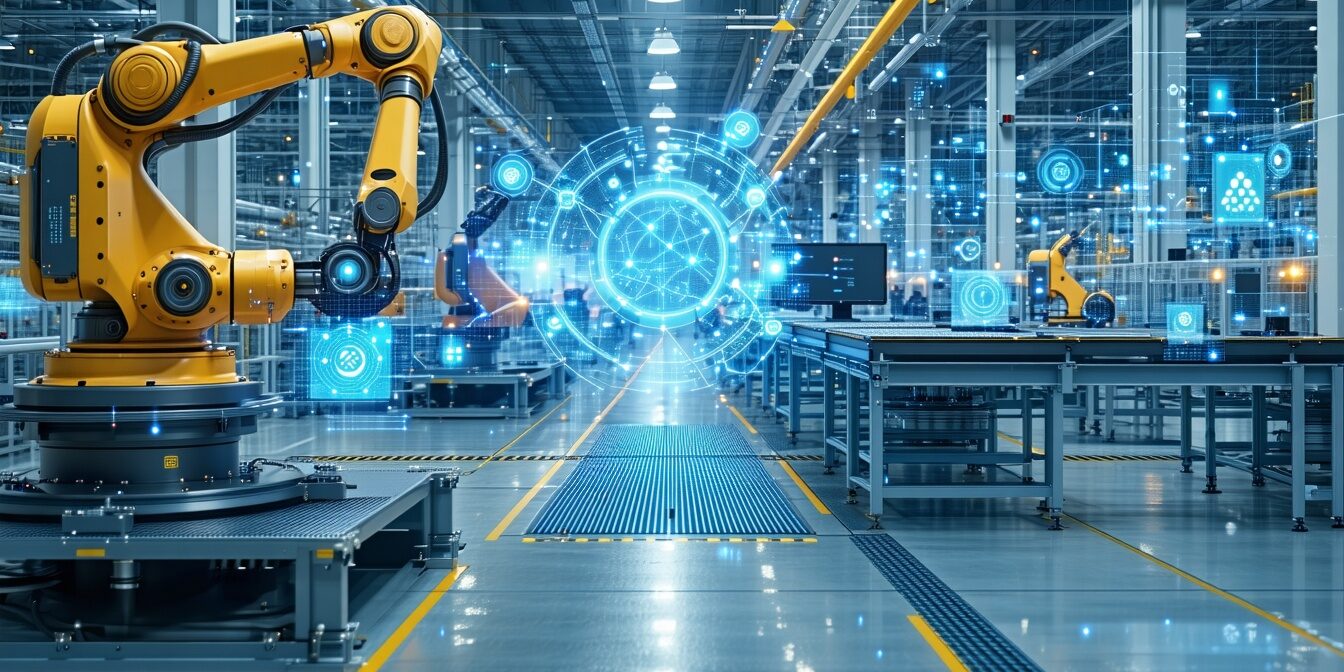
The Rise of AI in Manufacturing
Automation Technology Investments
Industries are making significant investments in automation technology, with 20% of organizations committing $1-5 million to adopt cutting-edge technologies (FlowForma). This surge in investments showcases the rapid growth of AI automation, parallel to the advancements seen during the industrial revolution.
The table below illustrates the investment distribution:
| Investment Range | Percentage of Organizations |
|---|---|
| \$1-5 Million | 20% |
| Less than \$1 Million | 50% |
| More than \$5 Million | 30% |
AI Integration Across Industries
AI automation is being integrated across several sectors, including healthcare, manufacturing, and finance. This integration leverages machine learning (ML), natural language processing (NLP), and predictive analytics to streamline repetitive tasks and minimize human intervention. However, certain tasks still require human approval to ensure quality and accuracy.
In manufacturing, machine learning enhances operations by identifying hidden issues, supporting predictive maintenance, streamlining processes, and optimizing the supply chain. These improvements result in cost reduction and greater efficiency.
AI’s role in Computerized Maintenance Management Systems (CMMS) is particularly beneficial for industries with heavy machinery, such as manufacturing, healthcare, oil and gas, and transportation. AI in CMMS helps prevent unnecessary downtime and reduce costs by optimizing equipment maintenance schedules (LLumin).
Despite the benefits, AI algorithms face challenges like overfitting, where models become too tailored to training data, leading to inaccurate predictions on new data. Nonetheless, the global machine learning market is projected to grow from USD 79.29 billion in 2024 to over USD 500 billion by 2030, driven by a compound annual growth rate of 36%.
For more on integrating AI into manufacturing, visit our pages on intelligent automation in manufacturing, ai-powered manufacturing processes, and Praxie’s multiagent ai orchestration.
Applications of AI in Manufacturing
Exploring the diverse applications of artificial intelligence in manufacturing reveals significant advancements that benefit various industries. These applications demonstrate the transformative potential of AI in improving efficiency, safety, and overall productivity.
Healthcare Automation
In healthcare, AI automation alleviates administrative burdens and streamlines core processes. Automated systems handle tasks such as managing patient details, administrative processes, and documenting operation notes. This automation fosters unified communication across departments and allows healthcare professionals to focus more on patient care.
| Task | Automation Benefits |
|---|---|
| Administrative Processes | Reduces paperwork and manual entry |
| Patient Details Management | Ensures accurate and updated patient records |
| Operation Notes | Saves time for doctors and clinicians |
For more insights into how AI impacts healthcare, check out our article on healthcare automation in manufacturing.
Construction Efficiency
AI automation enhances efficiency in the construction sector by optimizing resource allocation, managing workflows, predicting project timelines, and analyzing real-time site footage for risk identification. These applications improve site management and safety, contributing to timely project completion and cost control.
| Application | Benefits |
|---|---|
| Resource Allocation | Optimizes the use of labor and materials |
| Workflow Management | Streamlines processes and improves coordination |
| Timeline Predictions | Enhances project scheduling and on-time delivery |
| Real-Time Site Analysis | Identifies risks, improving site safety |
For more strategies on integrating AI into construction, visit our article on digital transformation in manufacturing.
Smart Manufacturing Processes
In the manufacturing sector, AI-driven smart processes are revolutionizing traditional workflows. AI automates compliance management, purchase orders, and inventory tracking, effectively addressing challenges such as labor shortages, supply chain disruptions, and rising costs (FlowForma).
| Process | Advantages |
|---|---|
| Compliance Management | Ensures adherence to regulations |
| Purchase Orders | Automates order processing, reducing errors |
| Inventory Tracking | Maintains efficient stock levels and reduces shortages |
Manufacturers can leverage AI to enhance productivity and efficiency. For further information on smart manufacturing, explore our article on AI-powered manufacturing processes.
These applications of AI in healthcare, construction, and manufacturing highlight the broad scope of benefits provided by intelligent automation. By incorporating AI solutions, industries can achieve higher levels of efficiency, safety, and overall performance. For comprehensive solutions in AI orchestration for manufacturing, visit Praxie’s multiage AI orchestration.
The All-in-One AI Platform for Orchestrating Business Operations
 Instantly create & manage your process Use AI to save time and move faster Connect your company’s data & business systems
Machine Learning in Predictive Maintenance
Machine learning plays a pivotal role in the realm of predictive maintenance in industrial automation, offering numerous advantages. By leveraging AI technologies, industries can achieve higher efficiency and cost savings while maintaining equipment performance. Here’s a comprehensive look at how machine learning drives predictive maintenance.
Equipment Performance Monitoring
Predictive maintenance relies heavily on the real-time monitoring of equipment performance. Using sensors to gather data such as vibration, temperature, and noise levels, machine learning analyzes this data to detect patterns and anomalies (LLumin). This proactive approach helps in addressing potential issues before they escalate into significant problems.
| Parameter | Monitoring Tool | Impact on Equipment |
|---|---|---|
| Vibration | Accelerometers | Predicts mechanical wear |
| Temperature | Thermal sensors | Identifies overheating |
| Noise Level | Acoustic sensors | Detects abnormal sounds |
To learn more about how digital tools revolutionize manufacturing, visit our article on digital transformation in manufacturing.
Cost Savings and Efficiency Benefits
Unplanned downtime in the manufacturing sector can cost businesses up to $50 billion annually. Machine learning helps mitigate these costs by effectively utilizing resources and minimizing unexpected shutdowns. Predictive maintenance reduces downtime, increases equipment longevity, and optimizes the overall production process.
| Benefit | Effect on Business |
|---|---|
| Reduced Downtime | Lowers operational costs |
| Proactive Repairs | Extends equipment lifespan |
| Efficient Resource Use | Enhanced production efficiency |
For insights into how AI enhances manufacturing, explore our section on benefits of AI in manufacturing.
Implementing Predictive Maintenance
Implementing predictive maintenance involves deploying machine learning models to predict equipment failures and suggest necessary actions (Control Engineering). This is particularly beneficial in industrial settings where even a minor glitch can lead to costly interruptions. By identifying when machines may fail, maintenance teams can schedule timely repairs or part replacements, thereby reducing unplanned downtimes.
The global market for machine learning is expanding rapidly, projected to reach USD 79.29 billion by 2024 and over USD 500 billion by 2030 (Onix Systems). This significant growth underscores the importance and potential of machine learning in industrial automation.
| Step | Action | Outcome |
|---|---|---|
| Data Collection | Installing sensors | Real-time data monitoring |
| Data Analysis | Using AI algorithms | Pattern recognition |
| Maintenance Planning | Scheduling repairs | Reduced downtime |
For more information on intelligent industries, visit intelligent automation in manufacturing and AI orchestration for manufacturing.
Machine learning’s integration in predictive maintenance represents a pivotal advancement in industrial automation. By enhancing equipment performance monitoring, minimizing costs, and streamlining implementation processes, industries can leverage machine learning to achieve superior operational efficiency and reliability. For further readings on advanced AI technologies, explore Praxie’s multiage AI orchestration.
Advancements in Industrial Automation
Role of AI in Production Optimization
Artificial Intelligence (AI) is transforming industrial manufacturing by helping optimize production lines, manage timely maintenance interventions, handle new materials, and even build smarter factories. Utilizing data to optimize workflows within facilities ensures increased efficiency, reduced downtime, and better resource management. For more information, you can explore our detailed insights on benefits of AI in manufacturing.
| Key Benefits | Details |
|---|---|
| Optimized Workflows | AI algorithms streamline the production process. |
| Timely Maintenance | Predictive maintenance prevents unexpected equipment failures. |
| Material Handling | AI systems adapt to new materials quickly. |
| Smarter Factories | Increased factory automation and intelligence. |
Self-Learning Industrial Robots
Self-learning industrial robots are being integrated into manufacturing processes to increase flexibility and efficiency. These robots use machine learning techniques coupled with computer vision and sensor technologies to achieve autonomous production and incident predictability (Avnet Silica). Self-learning robots eliminate the need for lengthy programming processes, allowing them to autonomously adjust tasks based on error detection and changing production conditions. This flexibility is particularly beneficial for small-batch production and personalized product manufacturing in the upcoming decade.
| Feature | Benefit |
|---|---|
| Autonomous Adjustment | Robots adapt tasks without reprogramming. |
| Error Detection | Identifies and corrects production errors. |
| Flexible Deployment | Suitable for various applications. |
| Small-Batch Production | Ideal for personalized manufacturing needs. |
More details can be found in our section on AI-powered manufacturing processes.
Real-Time Data Analysis with Edge Computing
Combining edge computing with intelligent sensors in manufacturing enables real-time data analysis, providing results in milliseconds or microseconds. This quick decision-making process is more efficient compared to cloud-based analysis, significantly benefiting a wide range of autonomous systems. Edge computing ensures that self-learning algorithms can rapidly respond to changes in production conditions, leading to improved operational efficiency.
| Aspect | Advantage |
|---|---|
| Real-Time Analysis | Immediate insights from data. |
| Intelligent Sensors | Enhanced accuracy and reliability. |
| Quick Decision-Making | Faster response times. |
| Autonomous Systems | Better autonomy in operations. |
For comprehensive details on integrating AI and edge computing, check our resource on AI-driven intelligent automation.
Edge computing, self-learning robots, and AI-driven production optimization are all part of Praxie’s comprehensive multiage AI orchestration solutions for intelligent automation in manufacturing. By leveraging these advanced technologies, IT managers, plant managers, and engineers can significantly enhance their manufacturing processes.
The All-in-One AI Platform for Orchestrating Business Operations
Instantly create & manage your process Use AI to save time and move faster Connect your company’s data & business systems