


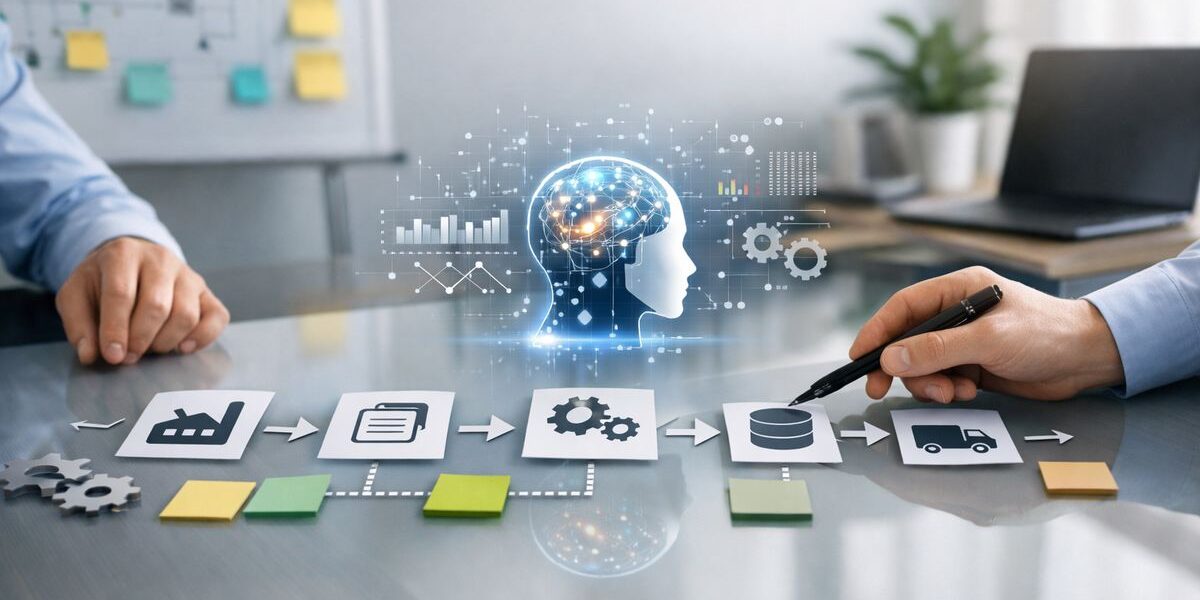
AI value stream mapping is a way to see how work, data, decisions, and handoffs actually move through your business, with AI helping spot delays and waste faster than a manual map can. If your teams keep saying “we’re busy” but results still arrive late, this is the missing picture, because speed means nothing when flow is broken.
What AI value stream mapping is
AI value stream mapping starts with a simple idea: value only counts when it moves all the way from request to result. In a factory, that might mean from customer order to shipped product. In IT, it might mean from business request to working software in production. The map shows every step in between, including the ugly parts people usually leave out, like waiting, rework, approval loops, and handoffs that eat half the timeline.
Classic value stream mapping came from lean manufacturing. You draw the steps, mark how long work spends being touched versus sitting still, and use that picture to remove waste. Value stream management is broader. It is the ongoing discipline of measuring, improving, and governing flow over time, rather than running a one-time mapping exercise and putting the poster on a wall.
AI value stream mapping sits between those ideas and modern operating reality. It uses the structure of value stream mapping, the continuity of value stream management, and AI-assisted analysis to make sense of fast-changing, cross-system work. That matters because your process no longer lives in one room, one team, or one spreadsheet.
How it builds on traditional value stream mapping
Traditional value stream mapping works well when a process is visible and stable. You can stand by a line, trace the steps, talk to the people doing the work, and sketch the current state. That approach still matters. Honestly, it matters more than some software vendors admit, because if you do not understand the work, no dashboard will save you.
But the environment changed. Manufacturing now depends on planning tools, machine signals, supplier data, quality systems, and service tickets. Software delivery moves through backlog tools, code repositories, testing pipelines, security gates, cloud platforms, and incident systems. Even service operations have become a web of workflows instead of a neat sequence. A static map built in a workshop on Tuesday can already be wrong by Friday afternoon.
AI value stream mapping keeps the lean goal, which is improving flow to the customer, but updates the method for processes that shift constantly. Instead of relying only on interviews and sticky notes, it pulls from systems that record what actually happened. That is the big leap.
What “AI” is actually doing in the map
The term can sound bigger than it is, so it helps to make it concrete. AI is not “drawing the map” in some magical way. AI is helping gather signals, connect patterns, summarize what matters, predict where delays are likely, and suggest where to look first.
Machine learning, which means software finding patterns from past data, can detect recurring bottlenecks, unusual variation, or conditions that tend to lead to rework or delay. Generative AI can summarize a messy process trail in plain English, explain why a queue keeps building, or turn system records into a usable narrative. Pattern detection can surface issues no one notices because each team sees only one slice of the timeline.
Think of it like traffic navigation. The road map already exists. AI is the live layer that says where congestion keeps forming, what route is slowing down, and what will probably happen in the next 20 minutes if nothing changes.
Why it matters right now
Here’s the thing: most organizations do not have a shortage of data. You have too many dashboards, too many point tools, and too many meetings where every function shows a different version of reality. One team says output is fine, another says response time is collapsing, and leadership gets stuck reconciling metrics instead of fixing flow.
AI value stream mapping matters because it shifts the conversation from local activity to end-to-end movement. That is a much more honest view of performance. You stop asking whether teams are busy and start asking whether value is moving.
Speed alone is useless if flow is broken. A plant can run one station at full utilization and still miss shipments because material waits between stages. An engineering team can ship code quickly and still frustrate the business because approvals, testing, and support issues choke the path to production. Without a shared map, every team improves its own island and the full stream still stalls.
Why manufacturing and IT teams are both feeling the pain
Manufacturing and IT used to feel like separate universes. Not anymore. Production relies on software, planning systems, networked equipment, supplier integrations, and service workflows. IT now supports not just office systems but plant operations, automation, cybersecurity, quality, and uptime. That means delays often sit in the seams.
Operations may see machine downtime but not the service ticket backlog behind the fix. Engineering may see code throughput but not the downstream release approvals that keep changes idle. Supply chain may see late inbound material but not the scheduling logic that amplifies the disruption. Security may see policy exceptions but not how those exceptions slow customer delivery.
When every function sees only its own screen, blind spots multiply. Duplicate work follows. Decisions get slower because each meeting begins with “that’s not what your numbers show.” AI value stream mapping creates one view of the stream across those silos, which is often the first time the whole story becomes visible.
Why old mapping methods break down in fast-moving environments
Sticky-note workshops are useful, but only up to a point. A room full of smart people can produce a great map of how work is supposed to flow. The catch is that actual work rarely behaves that neatly. Exceptions pile up. Ownership gets fuzzy. Systems disagree. Temporary workarounds become permanent.
One-time process diagrams have the same problem. They freeze a moving target. In environments where schedules shift daily, software ships continuously, and AI initiatives cross physical and digital operations, yesterday’s map becomes theater.
That does not make the old methods wrong. It makes them incomplete. You still need conversations, walkthroughs, and direct observation. But if you stop there, you miss the living system.
The All-in-One AI Platform for Orchestrating Business Operations
 Instantly create & manage your process Use AI to save time and move faster Connect your company’s data & business systems
The core parts of an AI value stream map
A useful AI value stream map is not just a process chart with extra labels. It brings together the work itself, the data behind it, the metrics that show flow, and the AI layer that helps interpret what is happening. Once those pieces are visible together, the concept stops feeling abstract.
Steps, stages, and handoffs
At the center is the sequence of work from request to outcome. That includes obvious production or delivery steps, but also the invisible moments that slow everything down: approval holds, scheduling gaps, waiting for parts, waiting for a test environment, waiting for someone to answer a ticket, and loops where work gets kicked back for fixes.
Handoffs deserve special attention because that is where delay loves to hide. Work leaves one team’s queue and disappears into another. No one feels responsible for the total elapsed time because each group only counts its own touch time. Your map needs to show those transitions clearly, along with the time spent idle between them.
Data sources and system signals
The map gets stronger when it connects to the systems that already hold traces of the work. In manufacturing, that often means ERP for planning and orders, MES for shop floor execution, quality systems, maintenance platforms, machine logs, warehouse tools, and spreadsheets people still cling to because reality lives there too. In IT, it may include ticketing systems, backlog tools, source control, CI/CD pipelines, observability tools, security systems, and service management platforms.
The challenge is almost never lack of data. It is messy data. Timestamps do not line up. Teams use different names for the same work item. One system records a status change while another records only closure. An AI value stream map has to normalize that mess well enough to tell a coherent story.
Metrics that show flow
Without metrics, a map is just a picture. The right measures show whether value is moving smoothly or getting stuck.
Lead time shows the total time from request to delivery. Cycle time shows how long work spends actively being processed. Throughput shows how much gets completed over a period. Queue time exposes how long work sits waiting. In manufacturing, first-pass yield, uptime, and cost-to-serve can reveal quality and operational drag. In software and IT, change failure rate can show whether speed is being bought with instability.
These are not vanity numbers. They shape executive choices. If queue time is exploding but active work time is stable, hiring more people to “work faster” probably misses the point. If first-pass yield keeps dropping, pushing for more volume may only increase rework. The map ties metrics to decisions instead of turning them into separate scorecards.
AI-driven insights and recommendations
Once the structure and data are in place, AI can do the part humans are bad at doing manually across thousands of records. It can detect patterns over time, compare streams, find likely root causes, and highlight where variation is highest. It can also model future-state scenarios, such as what happens if one approval step is removed, a maintenance response window tightens, or a testing bottleneck is reduced.
That said, AI is not replacing judgment. It can say, “every time a work order hits this combination of asset type, shift, and spare-parts delay, completion time doubles.” It cannot decide whether the right response is more inventory, better scheduling, vendor changes, or a different service policy. That is still a business choice.
How AI value stream mapping works in practice
Once the concept clicks, the next question is obvious: what does this actually look like in the real world? The good news is that the process is more straightforward than the label suggests.
Start with a current-state map
You begin by mapping how work moves today, not how the process manual says it should move. That difference matters. In a Monday morning production review, the official flow may look clean, but someone in the room usually knows that jobs sit unassigned for six hours waiting on material confirmation. In a release approval queue at 4:45 p.m., the documented policy may say approvals take 30 minutes, but everyone knows changes often wait until the next day.
Current-state mapping is the reality check. You identify the start and end points, the main stages, the common loops, and the handoffs where work tends to pile up. Even before AI enters the picture, this step reveals a lot.
Connect the systems that hold the truth
Next comes data integration. You pull records from the systems that capture pieces of the flow, then align them into one timeline. That usually means matching work items across systems, standardizing names, aligning timestamps, and assigning owners or functions to each stage.
This sounds technical, and it is, but the purpose is simple: your map should reflect actual flow, not disconnected tool snapshots. If an incident starts with a machine alert, turns into a maintenance work order, triggers an IT ticket, and ends with a production adjustment, the stream needs to show that as one chain of value movement.
Let AI find friction you would miss by hand
Once the stream is visible, AI can scan for recurring delays, hidden queues, unusual variance, compliance risks, and dependencies that span teams or plants. It can compare similar work items to show why one path finishes in 18 hours while another takes four days. It can surface bottlenecks that only happen under certain conditions, like a certain shift pattern, product family, release type, or vendor.
Manual analysis can catch some of this. But across thousands of transactions, the subtle patterns get lost. AI gives you a way to notice what the naked eye will not.
Build a future-state map you can test
The point is not just to admire the current-state mess in high definition. You use the insights to design a better future state. Maybe approvals get consolidated. Maybe quality checks move earlier. Maybe repetitive incident triage gets automated. Maybe one team gets ownership of an end-to-end handoff that used to sit in limbo.
A good future-state map is specific enough to test. You compare likely scenarios, estimate the effect on lead time or output, and choose changes with the biggest payoff. That keeps improvement grounded in business value instead of “transformation” theater.
Where AI value stream mapping fits in manufacturing
For operations leaders, this only matters if it helps the floor, the schedule, or the shipment. Luckily, it does.
Production planning and scheduling
Planning and scheduling often look efficient on paper while creating chaos in practice. AI-assisted mapping can reveal where scheduling decisions create downstream waiting, where changeovers consume more time than expected, and where demand swings keep causing the same fire drills.
You may find that one scheduling choice upstream creates repeated idle time at a packaging step later in the day. Or that setup delays are not random at all, but cluster around a specific product sequence. Once the full stream is visible, those issues stop looking like isolated disruptions and start looking fixable.
Quality and rework reduction
Quality problems rarely begin where the defect gets noticed. The visible defect is the smoke, not the fire. An AI value stream map can trace where defects tend to originate, how long items spend in inspection, where rework loops keep recurring, and how much capacity gets drained by repeated fixes.
That changes the conversation from “quality is slowing production” to “this part of the stream is creating avoidable rework.” Much better.
Supply chain and fulfillment visibility
Supply chain delays tend to ripple through the stream in messy ways. A late inbound shipment can trigger rescheduling, inventory waiting, warehouse congestion, and customer promise changes. If each function measures only its own step, the full effect stays hidden.
AI value stream mapping connects those signals. It can show where vendor variability causes queue buildups, where inventory sits waiting between stages, and where warehouse handoffs add more delay than anyone realized. For fulfillment leaders, that kind of visibility is hard to ignore once it exists.
Maintenance and asset performance
Maintenance is a flow problem as much as a reliability problem. A machine event becomes an alert, then a diagnosis, then a work order, then a search for parts, then technician action, then restart verification. Delays can happen anywhere.
Mapping that stream with AI support helps connect work orders, downtime duration, spare-parts availability, technician response, and repeat failures into one picture. Instead of asking only, “why did the asset fail,” you start asking, “where did the response process waste time after the failure happened?”
Where AI value stream mapping fits in IT and software delivery
In IT, the same logic applies. Value is not created when code is written. It is created when a working, reliable outcome reaches users and supports the business.
From idea to deployment
The software value stream runs from business request through backlog, design, coding, testing, security review, release, deployment, and production support. Most delays do not happen in coding. They happen in waiting, context switching, unclear priority, change control, and post-release cleanup.
AI value stream mapping makes that visible. It shows how long requests sit before work starts, where testing backs up, where security review slows high-risk changes, and where deployments stall for reasons no single team owns.
Developer productivity and platform engineering
Developer productivity is often framed too narrowly, as if the only thing that matters is how fast engineers type. But engineers lose huge amounts of time waiting on environments, approvals, documentation, access, dependencies, and unclear ownership.
A shared map exposes that friction. If build time is fine but environment provisioning adds two days, the bottleneck is not talent. If repeated handoffs to platform or security teams keep resetting cycle time, that becomes visible too. This is where platform engineering leaders get real leverage, because the map points to flow constraints instead of anecdotes.
Incident response and service operations
Incident handling is another stream that tends to fragment across tools and teams. Alerts fire. Tickets get opened. Escalations happen. Work bounces between service desk, infrastructure, application teams, vendors, and business owners. Meanwhile the clock keeps running.
AI value stream mapping can trace alert-to-resolution flow, show where tickets age, identify repeated escalations, and surface incident types that keep returning after shallow fixes. It also helps with post-incident learning by connecting restoration time to the actual decision path that got you there.
Governance, risk, and compliance
Security checks, audit requirements, and change controls are often treated like blockers outside the “real” flow. That is a mistake. They are part of the flow, and pretending otherwise only hides delay.
When those controls are mapped directly into the stream, you can see which ones protect value and which ones merely add friction. You may find that one review step catches real risk while another mostly creates waiting. That is much more useful than arguing in the abstract about “too much governance.”
The biggest benefits you can expect
The value of AI value stream mapping is not just better reporting. It is better decisions, made sooner, with fewer illusions.
Better visibility across silos
One shared map cuts through disconnected reporting. Operations can see what IT sees. IT can see what operations sees. Finance can connect cost to flow. Leadership can stop mediating between partial truths.
That shared picture matters because misalignment often comes from honest incompleteness, not bad intent. Once the full stream is visible, the conversation changes fast.
Faster improvement cycles
Without a live or near-live view, improvement is slow. A problem appears, someone investigates, teams debate causes, a fix gets chosen, and weeks later someone checks if it helped. AI shortens that loop. Patterns surface sooner, root causes become more plausible, and future-state options can be tested before a full rollout.
That speed is not about moving recklessly. It is about reducing the dead time between noticing and learning.
Smarter prioritization
Most organizations have “zombie” work, efforts that consume funding and attention without improving end-to-end outcomes. You also get plenty of local optimizations that make one team look efficient while making the stream worse overall.
A value stream view makes those tradeoffs harder to ignore. If a feature request sits for months while low-value tasks move quickly, the prioritization problem is visible. If a factory step is optimized at the cost of downstream congestion, that becomes clear too.
Stronger ROI for AI initiatives
Executives keep hearing big promises about AI, but the hard part is proving business value. AI value stream mapping helps because it ties AI to measurable improvements in throughput, lead time, uptime, quality, service reliability, or cost-to-serve. That is a much stronger case than “the tool generates interesting insights.”
If AI cannot improve flow in a material way, your budget should probably go elsewhere. That is a healthy standard.
Common misconceptions to clear up early
A few bad assumptions can derail this work before it starts.
“It’s Just process mapping with a new label”
No. Process mapping is usually static and descriptive. AI value stream mapping is data-backed, cross-system, and dynamic enough to reflect actual movement over time. It is less like hanging a process poster in a conference room and more like creating a working model of how value really flows.
“AI will automatically fix the process”
It will not. AI can point to likely problems, explain patterns, and suggest options. It cannot make tradeoffs for you, resolve ownership disputes, or decide what matters most to the business. Process redesign still needs judgment and accountability.
“You need perfect data before you start”
You do not. Perfect data is a lovely fantasy and a terrible prerequisite. A few reliable signals, such as timestamps for request, handoff, approval, completion, downtime, or rework, are often enough to expose major friction. Starting smaller usually gets better results than waiting for a flawless data model that never arrives.
“This only works in software teams”
Also false. The method works anywhere value moves through a sequence of steps with delays, dependencies, and variation. Manufacturing, logistics, service operations, customer support, field maintenance, and hybrid digital-physical processes all fit.
The most common implementation challenges
The concept is strong. The execution still gets messy.
Resistance to change
Flow transparency can make teams feel exposed. If the map shows delays, people may assume blame is coming next. That is why framing matters. The map has to be presented as a problem-solving tool, not a surveillance system or scorecard for embarrassment.
When teams trust that the goal is fixing the stream, not naming villains, adoption gets easier.
Weak cross-functional ownership
Many streams cut across functions without having a true end-to-end owner. That is a real problem. If no one owns the full path from request to outcome, improvement stalls at the first handoff dispute.
You need someone with enough authority to align changes across the stream, not just within one department.
Poor data quality or fragmented tooling
Duplicate records, inconsistent naming, missing timestamps, disconnected systems, and spreadsheet side channels are common. None of that is surprising. The trick is to start narrower than your ambition. Pick a stream, identify the few systems that matter most, and create a usable model before expanding.
Trying to map everything at once is how good initiatives turn into data archaeology.
Misaligned goals and metrics
One team chases utilization. Another chases speed. Another chases risk reduction. Each goal sounds reasonable until the stream locks up. High utilization can create queues. Maximum speed can create failures. Strict controls can create delay.
An AI value stream map helps expose those tensions, but leadership still has to resolve them. The tool cannot align incentives for you.
How to get started without turning it into a giant transformation project
This does not need to begin with a big-bang rollout. In fact, it should not.
Pick one value stream that matters
Choose a stream tied to something executives already care about: revenue, delivery speed, plant throughput, customer experience, service reliability, or margin. A high-friction stream with visible pain is better than a low-stakes pilot nobody will notice.
Set a baseline before you automate anything
Capture the current measures first. Lead time, queue time, throughput, rework rate, downtime, first-pass yield, change failure rate, or ticket aging can all work, depending on the stream. Without a baseline, “improvement” turns into opinion.
Involve the people closest to the work
Operators, planners, engineers, delivery managers, service owners, and frontline support usually know where work really gets stuck. Dashboard data matters, but direct experience matters too. If the people doing the work say the map misses a recurring delay, listen.
Use AI to support judgment, not replace it
The best use of AI here is acceleration. It helps you analyze faster, see patterns sooner, and test ideas with more confidence. Final decisions still need business context, practical tradeoffs, and accountability.
What to look for in an AI value stream mapping tool or approach
You do not need a giant buyer’s guide to spot the basics that matter.
Broad data integration
A useful approach connects manufacturing, enterprise, and delivery systems instead of creating another isolated reporting layer. If the tool cannot see across the boundaries where your delays actually happen, it will not tell you much.
Real-time or near-real-time visibility
Stale maps are easy to ignore. If the process changes daily but the view updates monthly, trust disappears. Near-real-time visibility does not need to mean instant everything, but it does need to be current enough to support action.
Clear workflow analytics
You need to see wait time, bottlenecks, dependencies, and variation in a way teams can act on. Fancy graphics do not matter if no one can tell where the stream is choking.
Scenario modeling and recommendations
The most useful tools help you test what happens if one step changes. If you remove an approval, add a technician, rebalance a shift, or automate triage, what improves next and what new constraint appears after that? That is where analysis becomes decision support.
A simple example of AI value stream mapping in action
A concrete scenario makes this easier to picture.
Imagine a packaging line that slows down almost every day just before second shift, around 2:40 p.m. Operations sees lost output. Maintenance sees a cluster of service tickets. IT sees alerts from a connected inspection system. Everyone knows the hour is bad. No one agrees on why.
A current-state map shows the visible sequence: machine alert, operator ticket, supervisor approval, maintenance dispatch, system check, restart, quality verification, resumed output. On paper, it looks manageable. But when system data gets connected, the timeline tells a different story. Alerts arrive quickly, yet tickets sit waiting for supervisor confirmation. Maintenance dispatch is not the main delay. The bigger issue is that inspection software faults trigger duplicate tickets, which create confusion about priority and send work into the wrong queue.
AI analysis spots the pattern because it compares dozens of similar incidents over several weeks. The slowdown happens most often when a specific sensor warning appears within 20 minutes of shift handoff. At that point, the approval queue lengthens, duplicate tickets rise, and restart times stretch.
The future-state change is not dramatic. Duplicate events get grouped automatically, approval rules are simplified for that fault type, and operations plus IT share one event view instead of separate queues. Response time drops, fewer incidents bounce between teams, and line output stabilizes in the last hour before shift change.
That is the kind of improvement this approach is good at. Not flashy. Just real.
Example: reducing handoff delays between operations and IT
Take the same pattern in a hybrid operations and IT stream. A machine event triggers a service ticket. The ticket gets reviewed by operations, then routed to IT because the issue involves an edge device, then bounced back because the line needs a local reset before software changes can proceed. Meanwhile, production waits.
A shared AI value stream map shows exactly where the delay piles up: not in technical repair, but in the back-and-forth between queues with unclear ownership. AI surfaces the repeat condition, which is that incidents tied to a certain asset class almost always need both local operator action and remote IT approval, yet the process treats those as separate requests.
One targeted fix changes the flow. A combined incident pathway is created for that asset class, with predefined ownership, one shared queue, and a rule that local reset steps begin before remote review finishes. The result is shorter resolution time and better output with very little added complexity.
Why this matters beyond efficiency
Efficiency is part of the story, but not the whole story. The bigger win is understanding how your business actually creates value. Most dashboards show activity. Fewer show flow. Almost none explain why value slows down across functions.
AI value stream mapping gives you that missing layer. It helps you see where your operating model supports the customer and where it quietly gets in its own way.
It turns AI from a side experiment into an operating advantage
A lot of AI efforts float at the edges of the business, interesting demos, isolated copilots, one more tool subscription with unclear impact. Mapping value streams changes that because AI gets tied to throughput, delivery, resilience, margin, and customer outcomes.
That is a much better place for AI to live. Not as a novelty, but as a way to improve how work moves.
It gives you one practical place to start
If you try one thing, map a single high-friction stream and compare where work should flow versus where it actually gets stuck. Start there, with one stream that matters, and the next move usually becomes obvious.
The All-in-One AI Platform for Orchestrating Business Operations
Instantly create & manage your process Use AI to save time and move faster Connect your company’s data & business systems
