


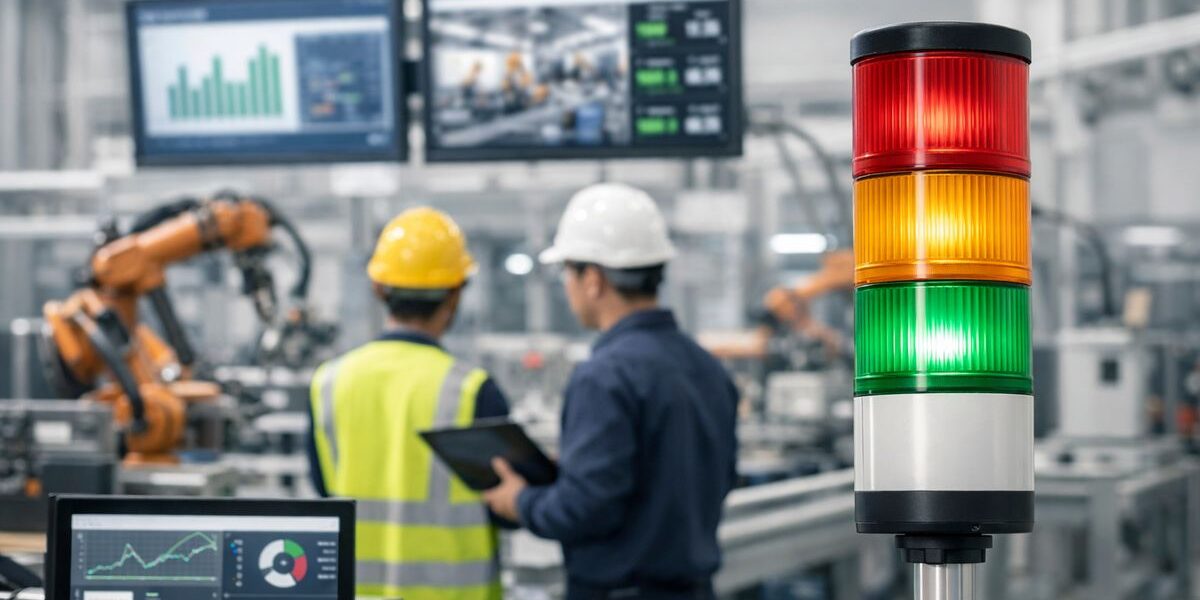
Manufacturing visibility is your ability to see what is happening in production as it happens, not hours later in a report. If that sounds obvious, here’s the catch: plenty of plants still run on delayed updates, whiteboards, and hallway conversations, which means problems stay invisible until output is already off track. The fastest way to change that usually starts with connected ANDON.
What manufacturing visibility actually means on the floor
Manufacturing visibility sounds like a dashboard term, but on the floor it means something much simpler: you can tell what is running, what is blocked, what is waiting on material, what needs attention, and who is responding right now. Not later. Not after someone exports a spreadsheet. Right now.
That distinction matters because visibility is not the same as having data somewhere in the business. Visibility starts at the point where the problem shows up. If a machine stops, a part bin runs empty, or an operator needs support, your system should surface that signal immediately and push it into a response flow.
Why “seeing more data” is not the same as visibility
More data can actually make things worse if it arrives late or without context. A report sent at 4:30 p.m. may show that Line 3 lost 47 minutes to downtime, but that does nothing for the missed output at 10:12 a.m. when the issue could still have been fixed.
Usable visibility is real-time awareness with enough context to act. You need to know what happened, where it happened, how long it has been happening, and who owns the response. A pile of timestamps in a database is data. A live signal that triggers the right action is visibility.
Where manufacturers usually lose sight of problems
Most blind spots come from disconnects between systems, people, and timing. Machines run but do not share status outside local controls. Operators update boards by hand. Supervisors make radio calls. MES, or manufacturing execution systems, track one piece of the story while ERP, or enterprise resource planning systems, hold another.
Picture a Tuesday morning at 10:12. A filler stops on Line 3 because upstream trays did not arrive on time. The stack light turns red. Someone walks over. A supervisor gets pulled in five minutes later. Material handling hears about it after another call. Planning does not know until lunch that output is slipping. That is a visibility problem, even if every system technically has some data.
Why connected ANDON is the starting point
ANDON is a visual alert system that signals when something needs attention. In its simplest form, it might be a light, a board, or a pull cord that tells someone a line has stopped or help is needed.
Connected ANDON takes that same idea and ties it into your systems, workflows, and records. So instead of a red light being just a red light, it becomes a digital event with a timestamp, location, reason, owner, and response path.
Traditional ANDON vs. connected ANDON
Traditional ANDON is local. You see a light on a machine. Maybe you hear a buzzer. Maybe someone pulls a cord. It works, but only if the right person is nearby and knows what to do next.
Connected ANDON is event-driven. The moment an issue happens, alerts can go to a supervisor’s phone, a maintenance queue, a production dashboard, or a messaging tool. Escalation rules can kick in if nobody responds in two minutes. That upgrade matters because visibility that depends on physical proximity does not scale across shifts, departments, or sites.
What connected ANDON tells you in real time
A good connected ANDON setup can surface the signals that actually shape daily performance: machine downtime, quality holds, parts shortages, maintenance calls, safety events, changeover delays, and operator help requests. The value is not just speed. It is speed with context.
Instead of hearing “Line 2 is down,” you see that Line 2 has been waiting seven minutes for a mechanic after a recurring sensor fault during changeover. That is a very different level of awareness.
The All-in-One AI Platform for Orchestrating Business Operations
 Instantly create & manage your process Use AI to save time and move faster Connect your company’s data & business systems
How connected ANDON improves manufacturing visibility
This is where connected ANDON stops being a nice alerting tool and starts becoming the backbone of real manufacturing visibility. It turns scattered signals into a live operating picture.
Faster response to downtime and bottlenecks
The biggest gain is simple: less waiting. Problems get flagged the moment they happen, routed to the right person, and tracked until resolution. That closes the gap between failure and response, which is often where the most avoidable loss sits.
In many plants, the delay is not the repair itself. It is the dead time before somebody notices, confirms ownership, and starts moving. Connected ANDON cuts that dead time hard.
Better production planning and schedule control
Real-time status also helps planning stop guessing. If a line is down, running slow, or stuck in changeover longer than expected, you can adjust labor, resequence work, or reset output expectations while the shift is still recoverable.
That changes the quality of planning conversations. Instead of discovering at the end of the day that a target was missed, you can see risk building as it happens and respond before it turns into a customer problem.
Clearer inventory and material flow signals
Material flow issues often hide in plain sight. A line pauses because a component is short. Work-in-progress stacks up between operations. Finished goods wait because a downstream handoff is late. None of that looks dramatic at first, but it slows everything.
Connected alerts expose those points of friction early. You start seeing where replenishment breaks down, where WIP is piling up, and where internal logistics keep forcing small stoppages that never looked serious in isolation.
Stronger quality and traceability
Traceability simply means you can follow what happened, when it happened, and where it touched the process. Connected ANDON helps by creating a clean event record: issue type, timestamp, response, disposition, and resolution.
That record matters for root-cause analysis, compliance, recalls, and continuous improvement. Instead of relying on memory or handwritten notes, you get an actual chain of events. Honestly, that alone can clean up a lot of low-grade confusion.
Where AI fits once ANDON is connected
AI gets a lot of attention in manufacturing, but AI is only as good as the signals feeding it. If your operation still relies on manual updates and delayed reporting, AI is mostly guessing.
Connected ANDON gives AI something far more useful: timely, structured event data tied to real workflows.
Why AI needs clean event data first
AI works best when inputs are reliable and consistent. That means event types, durations, frequencies, escalation paths, and resolution histories are captured in a way a system can actually learn from.
Think of it like trying to spot traffic patterns. If half your road sensors are offline and the other half only report at the end of the day, predictions will be shaky. The same goes for manufacturing operations.
Practical AI use cases tied to connected ANDON
Once event data is connected and clean, practical AI use cases start to make sense. You can identify recurring stoppages that tend to happen before larger failures. You can spot hidden bottlenecks across shifts. You can rank maintenance needs based on actual disruption patterns, not just calendar intervals.
You can also use those signals to suggest staffing adjustments during chronic changeover windows or flag quality patterns tied to a machine, material lot, or time of day. None of that is science fiction. It is pattern recognition on top of a solid event layer.
What executives should not expect from AI on day one
AI will not walk into a disconnected plant and fix operations by itself. It will not replace response workflows that do not exist. It will not turn vague, inconsistent status notes into perfect insight overnight.
What it can do is help you notice patterns faster and make better decisions once your alerts, ownership, and data flows are already connected. That is a big difference.
What to look for in a connected ANDON setup
If your goal is real visibility, not just another isolated tool, a few design choices matter more than flashy screens.
Real-time integration across your core systems
Connected ANDON should link with the systems already shaping your operation: MES for production execution, ERP for planning and orders, CMMS for maintenance work, SCADA for supervisory control and machine data, quality systems for holds and checks, and messaging tools for alerts.
The point is simple. Signals should not stop at the tower light. A production issue should flow into the systems and teams that need to act on it.
Escalation, ownership, and closed-loop workflows
An alert without ownership is just noise. Good setups assign every event to somebody, define when it escalates, and track when it is resolved. That closed loop is where visibility becomes operational control.
The trick is not raising more alarms. The trick is making sure the right person gets the signal and the issue does not disappear into a shift change.
Multi-site scalability and ease of rollout
If you manage multiple plants, consistency matters. You want similar event definitions, response rules, and reporting across sites, even if each line has local differences.
Ease of rollout matters just as much. If a system needs a six-month cleanup project before anybody can use it, momentum dies. The best setups are configurable enough to fit reality without turning into a consulting marathon.
Common misconceptions about manufacturing visibility
A few objections come up almost every time, and most come from treating visibility as a reporting problem instead of an action problem.
“A dashboard gives you visibility”
A dashboard gives you a summary. That can be useful, but it is not the same as knowing about an issue while the shift is still running. Connected ANDON helps you act during the event, not just review it after.
“This is only for large enterprises”
Smaller manufacturers often see benefits faster because manual workarounds are everywhere. If your operation still runs on verbal updates, spreadsheets, and whiteboards, even one connected alert flow can produce a visible difference almost immediately.
“Operators will see this as surveillance”
Poorly framed systems feel like surveillance. Good ones feel like support. When connected ANDON reduces chasing, guessing, repeat interruptions, and blame-by-memory, operators usually see the point very quickly. The best systems help people get help faster.
A simple way to start
Do not try to light up the whole plant at once. Start with one recurring pain point on one line, maybe changeover delays, material shortages, or frequent operator help calls. Connect the alert, assign ownership, define escalation, and track resolution from start to finish.
That small pilot will tell you a lot. You will see where signals break, where response stalls, and what real manufacturing visibility actually looks like in practice. Try that first. Once that flow works, the rest gets much easier.
The All-in-One AI Platform for Orchestrating Business Operations
Instantly create & manage your process Use AI to save time and move faster Connect your company’s data & business systems
