


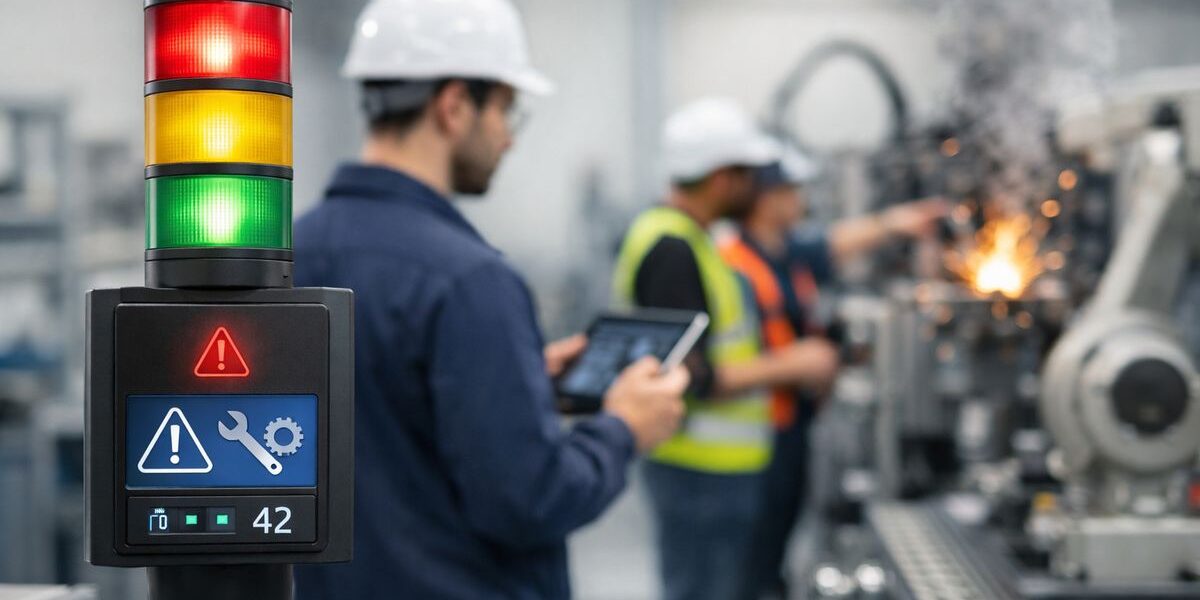
At 2:13 p.m., the filler hiccups, parts start stacking up, and nobody knows who owns the fix. That is how most ANDON problems turn expensive: not with one dramatic breakdown, but with a few unclear minutes that spread across the line. Digital ANDON is simply a real-time alert and response system that makes production issues visible fast, and these are seven factory problems it can fix before they turn into a much bigger mess.
What digital ANDON actually does on the factory floor
Traditional ANDON started with cords, lights, and boards: simple signals that told somebody something was wrong. That idea still works, but digital ANDON upgrades it with connected alerts, live dashboards, automatic escalation rules, and cleaner event data. Instead of hoping the right person sees a flashing light, you can push the issue straight to the right screen, phone, wearable, or team queue.
That matters because speed is only half the value. The other half is consistency. Every stop, call, delay, defect, and response gets captured in a format your supervisors can act on and your IT team can connect to MES, CMMS, ERP, or analytics tools.
1. Hidden downtime that nobody sees until the shift report
Small stops are production’s version of a dripping faucet. One pause here, two minutes there, ten seconds while an operator clears a jam, and suddenly your line has lost real output without ever looking fully down.
Digital ANDON fixes that by surfacing downtime the moment it starts. Instead of discovering the issue in a shift summary, you get a live signal when a machine idles too long, faults out, or falls outside normal cycle time. That shortens the gap between event and response, which is where a lot of lost capacity hides.
Why this problem gets expensive fast
Unnoticed downtime eats away at OEE in the quietest possible way. Labor stays on the clock, schedules get tighter, and your team starts compensating with overtime, faster changeovers, or rushed decisions later in the day.
The worst part is confidence. If your line looks fine from a distance but keeps missing output targets, planning turns into guesswork. You cannot fix what your floor cannot see clearly.
How digital ANDON fixes it
A digital setup can watch machine state in real time and trigger alerts automatically when a stop crosses a threshold. Maybe a cartoner sits idle for 90 seconds. Maybe a press trips the same fault three times in an hour. Instead of waiting for somebody to mention it, the system posts the event, timestamps it, and routes it to maintenance or a supervisor.
That visible escalation changes behavior fast. Issues stop disappearing into memory, and response time gets measurable instead of anecdotal.
2. Quality defects that keep moving down the line
Bad parts rarely stay politely in one place. If a defect gets spotted late, your line keeps feeding the problem forward until scrap, rework, and sorting start piling up like dirty dishes in the sink.
Digital ANDON helps you catch those quality issues at the moment they appear. An operator can flag a suspect part, a vision system can trigger an alert, or a station can call for inspection support before the defect spreads to downstream assembly or final pack-out.
Catch the problem at the source
Stopping or slowing the flow early feels uncomfortable in the moment. But pushing questionable product forward is almost always worse. A five-minute interruption at the source beats two hours of containment at the end of the shift.
That is the core ANDON discipline described by Lean practitioners at Lean Enterprise Institute. Make the abnormal visible, then respond before the problem multiplies.
Tie alerts to quality workflows
Here is where digital tools earn their keep. Instead of a vague call for help, your alert can include a defect code, a digital form, a photo, the station ID, and the containment step already taken. You get traceability without chasing handwritten notes.
That cleaner issue record also makes follow-up easier. A quality lead can review patterns later, compare defect types by shift, and connect the event to corrective action instead of treating every incident like a one-off.
3. Slow response when help is needed right now
One of the most common floor delays has nothing to do with the machine itself. It is the lag between “something is wrong” and “the right person is here.”
Without digital ANDON, that gap gets filled with shouting across the line, radio chatter, hallway searching, or somebody jogging to find a technician. Every minute spent hunting for help is a minute your station is not producing.
Replace shouting, radio traffic, and hallway searching
Manual response methods are familiar, but familiar is not the same as good. If a line lead misses the radio call or maintenance is already tied up elsewhere, the request stalls before it even reaches the right person.
Digital ANDON routes the signal directly to the role that needs it. A maintenance alert can go to a technician’s phone, a quality call can appear on a team dashboard, and a supervisor can see active support requests across the area in one view.
Use escalation rules so requests do not stall
The trick is escalation. If the first person does not acknowledge the call within a set time, the alert moves to the next level automatically. No awkward chasing. No wondering who saw it. No silent failure.
That clear ownership is a big deal. It turns response from an informal favor into a defined process, and defined processes are easier to improve.
The All-in-One AI Platform for Orchestrating Business Operations
 Instantly create & manage your process Use AI to save time and move faster Connect your company’s data & business systems
4. Communication gaps between operators, supervisors, and IT systems
Factory issues often live in separate worlds. The machine controller knows a fault occurred. The MES logs production counts. The supervisor hears about the problem ten minutes later, and your IT systems never get the full story in one place.
Digital ANDON becomes the shared signal everyone can trust. One event, one timestamp, one visible status.
One version of the problem
When alerts live on a central board or dashboard, confusion drops fast. You avoid duplicate reporting, side conversations, and the usual blame loop where each group has a slightly different version of what happened.
That shared visibility matters on busy floors. If your operator says material was missing, maintenance says the machine faulted, and planning says output looked normal for an hour, somebody is working from stale information.
Connect shop floor events to your tech stack
Modern ANDON tools can tie into MES, ERP, CMMS, SCADA, or analytics platforms, which is where the value expands beyond visual management. An alert does not have to die on a whiteboard anymore. It can create a maintenance task, update status in a production system, or feed event data into AI models.
That connected approach lines up with the broader shift toward digital manufacturing described by platforms such as Adobe’s business guide to Andon and other smart factory references. Visibility is useful. Connected visibility is better.
5. Recurring problems that never seem to stay fixed
Some problems show up so often they almost become part of the schedule. The same jam every Tuesday morning. The same missing label roll after changeover. The same feeder fault on second shift.
If that sounds familiar, your issue is not just the event. Your issue is weak memory. Digital ANDON creates structured records that help you spot repeats instead of relying on whoever remembers the last time it happened.
Turn repeated alerts into usable patterns
Timestamps, reason codes, duration, station history, acknowledgment time, and recurrence trends turn random-seeming incidents into something you can actually analyze. You stop saying, “this keeps happening,” and start saying, “this fault occurs 11 times a week after warm-up.”
That is a much better starting point for action. It also gives AI something useful to work with, because predictive systems need clean event history, not vague stories.
Make root-cause work easier, not heavier
Nobody wants more admin wrapped around an existing problem. The point is not to create extra paperwork. The point is to capture useful context while the event is fresh, then make root-cause review simpler later.
That supports classic continuous improvement work, too. Lean organizations have used ANDON for years to expose abnormal conditions early, and digital systems make that learning loop easier to sustain (GBMP overview).
6. Bottlenecks caused by material shortages and line-side supply misses
A line does not need a machine fault to lose time. An empty bin, late replenishment, wrong component, or missed handoff can slow output just as effectively.
Digital ANDON helps your line-side team call out shortages before a station runs dry. That sounds simple, because it is. Simple is good when production is moving fast.
Spot shortages before the line stops
Instead of waiting until the last box is gone, a station can trigger an early warning when material reaches a set threshold. A picker, water spider, or warehouse team gets the signal while production is still running, not after output has already dropped.
That small timing shift can prevent a lot of unnecessary disruption. You preserve flow instead of recovering from a stop.
Improve coordination across departments
Material issues often bounce between production, warehouse, purchasing, and planning, with each area seeing only one slice of the problem. A digital ANDON signal gives each team earlier visibility into the same issue.
That makes recurring shortages easier to separate into categories: replenishment timing, inventory accuracy, supplier delay, or poor line-side presentation. Once the problem has a category, it is much easier to fix.
7. Weak visibility into what is happening across shifts, lines, and plants
At the executive level, disconnected snapshots are the real problem. One report shows yesterday’s downtime. Another shows weekly scrap. A supervisor call mentions a recurring fault, but there is no live operational view tying it all together.
Digital ANDON gives you that view. Not perfect omniscience, just a much cleaner picture of what is happening now and what keeps happening over time.
Move from anecdote to live operational view
Dashboards and digital boards let you compare lines, cells, shifts, or sites without waiting for end-of-day summaries. You can see active issues, response times, top loss categories, and repeat calls while production is still in motion.
That changes the quality of decision-making. Instead of reacting to whoever tells the most convincing story, you can act on shared operational truth.
Build a stronger case for AI and automation
Here is the direct claim: AI projects fail when event data is messy, late, or incomplete. Digital ANDON helps fix that. It creates timely, structured records of downtime, response, defects, and material interruptions, exactly the kind of operational data AI needs to predict failures, recommend actions, or improve scheduling.
If your goal is smarter automation, digital ANDON is not a side project. It is part of the foundation.
What to look for if you want these fixes fast
If speed matters, avoid systems that look impressive in a demo but make operators tap through six screens to report a jam. You want easy floor use, mobile alerts, automatic escalation, integration options, configurable reason codes, and reporting that makes sense without a data scientist translating every chart.
Start smaller than your ambition. Map the top three alert types on one line first, then measure response time and repeat issues for a few weeks. That one test will show you very quickly where your ANDON problems really are, and which fixes are worth scaling next.
The All-in-One AI Platform for Orchestrating Business Operations
Instantly create & manage your process Use AI to save time and move faster Connect your company’s data & business systems
