


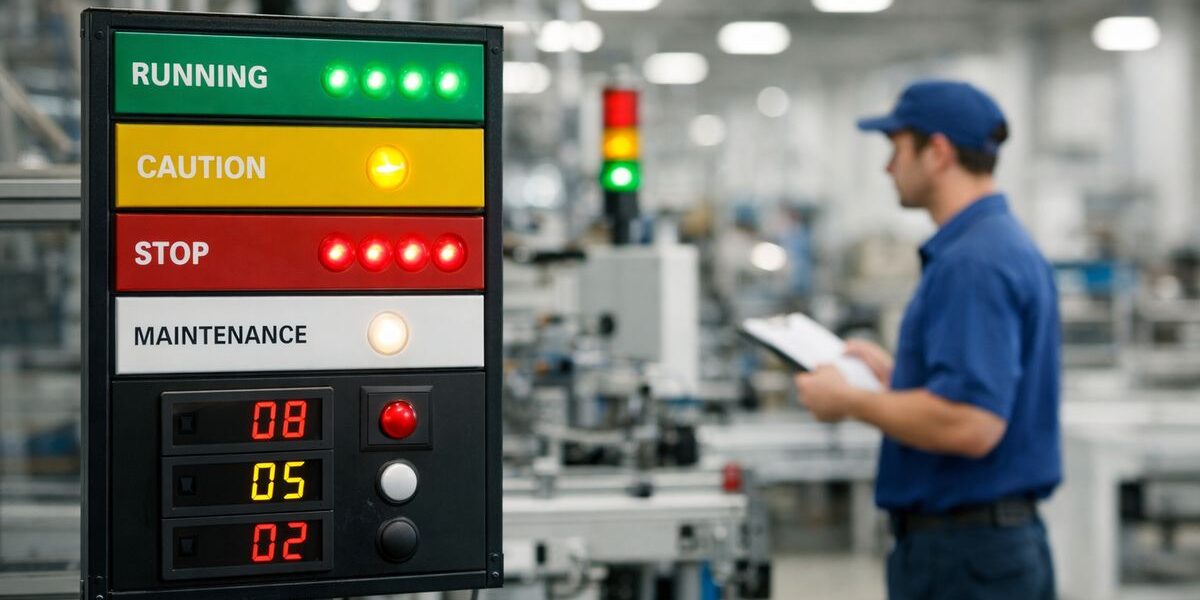
A traditional ANDON board is a factory-floor signaling board that shows when production is running, slowing down, or in trouble. If you’ve ever walked through a plant and seen a red light flashing over a line while somebody hurries over with a radio, you’ve seen the basic idea in action. The problem is that what used to be enough for one line in one building often falls short once your operation gets faster, more connected, and more dependent on data.
What a traditional ANDON board is
At its simplest, a traditional ANDON board is a visual alert system for production. It tells you the status of a machine, station, or line in real time so somebody can respond before a small issue turns into a bigger one. Think of it like a check-engine light for the factory floor, except everyone can see it.
The point is not decoration. The point is speed. If a station jams, runs out of material, hits a quality issue, or needs supervisor support, the ANDON system makes that problem visible immediately. In older setups, that visibility usually comes through stack lights, wall-mounted boards, buzzers, pull cords, or manually updated displays.
Where ANDON comes from
ANDON comes out of the Toyota Production System, the same philosophy that shaped lean manufacturing. The original idea was straightforward: if a problem happens, surface it right away so it can be fixed before defects, delays, or wasted work spread downstream.
That sounds obvious now, but it was a big shift. Instead of hiding problems to keep the line looking busy, ANDON treated problems as signals worth acting on. Visibility became part of quality control, not an embarrassment to cover up.
What “traditional” means in this context
“Traditional” does not mean the concept is outdated. It means the tools are mostly physical, local, and limited in what they communicate. A traditional setup might include a cord an operator pulls, a light tower that changes color, a buzzer that sounds, or a board someone updates by hand.
That matters because ANDON itself is just the method: make problems visible and trigger a response. The traditional ANDON board is one older way of doing that. A digital ANDON system keeps the same purpose but adds software, connectivity, event capture, and shared visibility.
How a traditional ANDON board works on the floor
The flow is usually very simple. A problem happens at a station. Somebody presses a button or pulls a cord. A signal appears, often a colored light or message on a nearby board. A supervisor, team lead, maintenance technician, or quality person notices it and heads over. Then one of two things happens: the issue gets resolved quickly and production keeps moving, or the line stops until the problem is fixed.
That simplicity is exactly why the system lasted so long. Nobody needs to open a laptop or sort through a dashboard just to know a machine needs attention. You look up, see the signal, and act.
In a smaller plant, especially one with short walking distances, that can work surprisingly well. If your line lead can hear the buzzer from 40 feet away and reach the station in under a minute, a basic setup still has value.
Common signals, colors, and alerts
Most traditional systems use colors to show status. Green often means normal operation. Yellow usually signals caution, a minor issue, or a call for support. Red typically means stop, fault, or immediate attention needed.
Some plants add white for material replenishment, blue for quality assistance, or flashing patterns for escalation. Buzzers, horns, and text labels may be added for extra urgency.
The catch is that color standards vary. Red in one area might mean full stop, while red somewhere else means maintenance required but the line is still limping along. That kind of inconsistency creeps in over time, especially across older facilities, and it creates friction right when you need clarity.
The difference between an ANDON board and an ANDON cord
This mix-up happens constantly. The ANDON cord or button is the trigger. It is the thing somebody uses to call for help or flag an issue. The ANDON board is the display surface, the place where that call shows up for others to see.
That distinction matters when you evaluate upgrades. You do not have to abandon the physical trigger just because the display and tracking system gets smarter. In many plants, the cord stays. The board evolves.
Why traditional ANDON boards worked so well for so long
Traditional ANDON boards solved a real problem elegantly. On a stable line, a clear visual signal is often all you need. It keeps the team aligned, reduces shouting across the floor, and makes trouble visible before it gets buried.
There is also something powerful about physical visibility. A light over a station has presence. It is hard to ignore in a way that a buried software notification sometimes is not.
Immediate visual management
A traditional ANDON board works because your brain processes visual warnings fast. Just like a dashboard light in your car, it tells you something is wrong before anybody starts explaining it. You do not need a meeting. You need attention on the problem.
That kind of visual management fit lean operations perfectly. If a line was predictable and the team already knew the usual failure modes, a red light was enough to trigger the right response.
Low training burden and easy adoption
Another reason traditional boards stuck around is that they are easy to learn. New hires, temporary staff, maintenance support, and supervisors can usually understand the system in minutes. Green means go. Red means stop. Yellow means somebody needs to step in.
On a busy floor with shift changes and role changes, that matters. The easier a system is to read, the faster it gets used correctly.
Useful in stable, repeatable environments
Traditional boards still fit operations with repeatable workflows, low product variation, and a compact footprint. If your plant runs the same process all day, in the same sequence, with a small number of predictable interruptions, the board does enough.
That is the key phrase: does enough. For a long time, enough was enough.
The All-in-One AI Platform for Orchestrating Business Operations
 Instantly create & manage your process Use AI to save time and move faster Connect your company’s data & business systems
The catch: where traditional ANDON boards start breaking down
Here’s the thing: the problem is not visual signaling. The problem is disconnected signaling. A traditional ANDON board can tell you that something is wrong, but in many modern factories, that is only the beginning of what you need to know.
Once product mix expands, labor gets tighter, and support teams cover more ground, the old model starts dropping context. And missing context costs time.
Limited information density
A light is fast, but it is thin. Red tells you trouble exists. It does not tell you if the issue is a feeder jam, sensor fault, missing operator, failed inspection, wrong component, or blocked downstream process.
It also does not tell you how long the issue has been active, which work order is affected, whether this has happened twice already today, or what action should happen next. Somebody still has to walk over, ask questions, and piece the story together.
No built-in data logging
This is where the gap becomes expensive. If an alert clears, the signal disappears. Unless somebody logs the event somewhere else, the history vanishes with it.
That means recurring downtime can hide in plain sight. A jam at 2:17 p.m. on Tuesday and another at 2:19 p.m. on Thursday may feel random on the floor, but a connected system would show a pattern immediately. A traditional board usually will not remember anything after the light goes off.
Visibility gaps across large facilities
A board only helps the people who can see or hear it. Once your operation spans multiple cells, long aisles, separate buildings, or multiple shifts, local visibility stops being enough.
Picture a support engineer across the plant in Detroit at 6:40 a.m. A fault starts on Line 4. If the only signal is a tower light above the station, that engineer effectively has no signal at all. The issue exists, but not in a form that reaches the right person.
Manual updates create delay and inconsistency
Some traditional boards rely on manual updates, especially for status displays or production issues that do not come straight from machine controls. That introduces lag, and lag turns a live status board into something much less useful.
The board can end up showing what somebody intended to update, not what is happening right now. In practice, it becomes yesterday’s weather report.
No integration with production, quality, or maintenance systems
For executives looking at AI, this is the real wall. An isolated alert does not feed your MES, ERP, CMMS, quality system, or analytics stack. It signals noise, not structured operational data.
If an alert cannot tie to downtime records, maintenance actions, work orders, scrap events, or operator response times, you cannot do much with it beyond react in the moment. AI cannot learn from a blinking light alone.
Why factories are moving on now
Factories are not moving on from traditional ANDON boards because the idea stopped working. Factories are moving on because the environment changed around it.
Your floor is probably dealing with more variation, less slack, and higher expectations than it did ten years ago. The old signals did not become bad. They became incomplete.
More complexity on the line
Shorter runs, more SKUs, more custom orders, and more frequent changeovers all raise the informational burden of every disruption. A single red light used to point to a small set of likely causes. In a high-mix environment, that same red light could mean ten different things.
The more variation you run, the less useful a bare signal becomes.
Faster response expectations
Minutes matter more now. Customer expectations are tighter. Throughput targets are tighter. Scrap tolerance is tighter. Waiting for somebody to notice a board, interpret it correctly, and physically walk over can be too slow.
The delay is not dramatic. That is what makes it dangerous. Thirty seconds here, two minutes there, repeated across a shift, adds up fast.
Stronger need for traceability and accountability
You need more than awareness. You need a record. What happened, where, when, how often, who responded, and how long resolution took are no longer nice-to-have details.
Without that history, every performance conversation turns into memory versus memory. That is a weak way to run an operation.
AI and analytics need clean event data
This is the turning point for AI in manufacturing. If your goal is predictive maintenance, anomaly detection, smarter staffing, or better scheduling, your systems need structured event data.
A blinking tower light is a signal to humans. AI needs timestamps, fault types, duration, station IDs, response actions, recurrence patterns, and outcomes. No dataset, no learning.
What modern digital ANDON systems do differently
A modern digital ANDON system still does the old job: make problems visible and trigger action. But it also captures the event, routes it intelligently, tracks response, and shares status across the operation.
That shift is bigger than it sounds. The board stops being just a display and becomes part of a response system.
Automated event capture
Instead of relying only on somebody to pull a cord or press a button, digital systems can collect events directly from machines, sensors, and PLCs. Operator input still matters, especially for material shortages or quality concerns, but the system does not depend on memory or perfect timing for every alert.
That reduces missed events and shortens delay between problem and signal.
Richer alerts with context
Modern alerts can include line, station, machine state, fault code, work order, downtime timer, escalation status, and assigned owner. In other words, the alert carries enough detail to make action faster.
That means the first person responding can arrive with context instead of starting from zero.
Escalation to the right person
Traditional ANDON depends on who happens to see the signal. Digital ANDON can route by role, location, skill, or urgency. A maintenance fault can go to maintenance. A material shortage can go to the water spider or line support role. A repeated quality fault can escalate automatically if it is not acknowledged in time.
Screens on the floor still matter, but so do mobile devices, text alerts, email, and wearable notifications. The right person gets the message without waiting for chance.
Centralized visibility across sites
Connected dashboards give plant leadership and support teams a live view across lines, departments, and sites. If a problem starts on second shift or in another building, it is still visible.
That matters operationally, but it also matters culturally. Instead of every issue staying trapped inside one local pocket, the operation can see recurring patterns in one place.
Traditional vs. digital ANDON: the practical differences that matter
The biggest difference is not the hardware. It is the quality of response your system makes possible.
Response time
Traditional ANDON often follows this sequence: somebody notices, somebody walks over, somebody figures out what is wrong, then somebody finds the right support person. Digital ANDON compresses that sequence by routing the event immediately and carrying context with it.
The result is not just faster awareness. It is faster useful action.
Root-cause analysis
With a traditional ANDON board, post-incident analysis often depends on memory, handwritten notes, or a spreadsheet filled out later. Digital systems capture timestamps, fault categories, repeat events, and resolution patterns automatically.
That turns troubleshooting from guesswork into something you can actually search, sort, and trend.
Maintenance and flexibility
Physical boards and hardwired logic take effort to change. If you want new thresholds, different escalation paths, a new station added, or a better display layout, that can mean rewiring, reprogramming, or both.
Software-driven systems are far easier to adapt. Your process changes, your rules change with it.
Scalability
One board can work for one line. Then another board gets added for another line, then another light tower, then another workaround, and eventually your signaling system becomes a patchwork.
Digital ANDON scales more cleanly. You can extend visibility, routing, and reporting without rebuilding the whole structure each time your footprint grows.
What this shift means for AI in manufacturing
Moving beyond a traditional ANDON board is not just a communications upgrade. It is a data foundation.
If your operation wants AI to do anything useful, from predicting stoppages to helping allocate support resources, the system needs clean operational events to learn from.
From signal to dataset
Every call for help, every machine stop, every acknowledgment, and every resolution can become structured data. That changes everything. Instead of only knowing that problems happened, you can analyze when, where, how often, how long, and in what sequence.
A red light becomes a record. A record becomes a pattern.
Better inputs for predictive maintenance
Repeated micro-stops, recurring fault sequences, and worsening response times often show up before major equipment failure. If those signals get logged consistently, predictive maintenance models can flag issues earlier.
Without digital capture, those clues disappear into the background noise of the shift.
Smarter labor and support allocation
Event patterns can show where your staffing model is thin. Maybe maintenance calls spike during changeovers. Maybe one area burns supervisor time because operators need more training. Maybe a certain station consistently waits too long for material support.
That is not abstract analytics. It is a clearer map of where labor gets stuck.
Stronger continuous improvement loops
Continuous improvement works better when losses are visible, ranked, and repeatable. Once ANDON events are logged cleanly, recurring downtime stops being anecdotal. You can see the top offenders by station, shift, fault type, or product family and fix the real constraints first.
Common misconceptions about replacing traditional ANDON boards
A lot of resistance comes from understandable assumptions. Most of them fall apart once you separate the idea of visual signaling from the older technology used to deliver it.
“Digital ANDON is only for huge plants”
Smaller operations often feel the pain of downtime more sharply because there is less buffer and less backup coverage. A five-minute delay in a compact plant can be more disruptive than a longer delay in a large site with deeper support.
Digital ANDON is not about plant size. It is about response quality.
“A physical board is more reliable than software”
A bad software setup can absolutely be fragile. So can a bad physical setup. Reliability depends on design, maintenance, connectivity choices, and fallback planning.
A connected system can still include local stack lights and on-floor displays. You do not lose the immediate visual cue. You add backup notifications, event history, and traceability.
“This means ripping out everything you already have”
Usually, no. Many plants layer digital tools onto existing buttons, lights, PLCs, and displays. The physical trigger stays in place while the event routing, tracking, and reporting get upgraded around it.
That approach is often the smartest one because it preserves what already works.
“More data will just create more noise”
Bad data design creates noise. Good event design creates clarity. The goal is not to capture everything your equipment can possibly emit. The goal is to capture the events that matter, with enough context to act on them.
That is a very different thing.
How to evaluate whether your traditional ANDON setup is holding you back
You do not need a glossy strategy deck to figure this out. A short walk on the floor usually tells the story.
Questions to ask on the floor
Ask simple questions. Can you tell what the issue is without walking over? Can alerts reach the right person automatically? Can you measure acknowledgment time and time to resolution? Can you compare trends by shift, station, or fault type?
If the answer is no to most of those, your traditional setup is probably doing less than you need.
Signs your current system has hit its limit
A few warning signs show up again and again: recurring “unknown” downtime, long walks just to diagnose basic issues, inconsistent escalation, no searchable event history, and separate spreadsheets used later to reconstruct what happened.
Once your team starts building side systems to explain the board, the board has already hit its limit.
Metrics worth watching
Pay attention to downtime duration, acknowledgment time, first-response time, mean time to resolution, repeat fault rate, and the percentage of events captured automatically.
Those metrics reveal something simple: not just that issues happen, but how efficiently your operation responds once they do.
A practical path to modernizing without disrupting the plant
The smartest upgrade path is usually the least dramatic one. Start where the pain is obvious, keep the visual simplicity your floor already understands, and add digital depth behind it.
Start with one line or bottleneck area
Pick the place where missed alerts, slow response, or recurring stoppages already hurt. One bottleneck cell is enough. If that area stops often and support teams lose time figuring out what happened, it is a strong pilot candidate.
A contained test tells you more than a plantwide rollout ever could.
Keep the visual simplicity, add digital depth
The best modern systems do not throw away the at-a-glance signal. You still want the clear local cue, the light, the display, the instant visual flag. But behind that cue, you add context, routing, timers, ownership, and history.
Simple on the surface. Smarter underneath.
Connect ANDON to the systems you already use
Your ANDON events become far more useful once they connect to MES, CMMS, quality workflows, and maintenance processes. Then an alert is not just a warning on a screen. It becomes the start of a trackable action.
That is where communication turns into operational control.
Try one concrete next step
Map one current ANDON event from trigger to resolution. Follow it from the first signal to the final fix, and note every point where time gets lost, context gets lost, or ownership gets fuzzy.
That one exercise usually makes the answer obvious. If your traditional ANDON board tells you that a problem exists but not enough to solve it quickly, you already know why factories are moving on.
The All-in-One AI Platform for Orchestrating Business Operations
Instantly create & manage your process Use AI to save time and move faster Connect your company’s data & business systems
