


You might think scheduling your manufacturing processes is as straightforward as laying out tasks on a timeline. But in reality, you face an array of shifting variables and constraints. When unexpected delays, equipment failure, or rush orders arise, these changes can derail even careful plans and leave you scrambling. Fortunately, production planning with AI offers powerful new ways to handle your scheduling challenges and help your team stay resilient when things don’t go as expected.
By leveraging AI-driven insights, you gain the flexibility to adapt and optimize schedules in near real-time. At the same time, you reduce guesswork, reveal hidden inefficiencies, and build a clear path to meeting deadlines consistently. Below, you’ll discover how to spot the root of your scheduling hurdles, apply practical AI solutions that enhance your workflow, and track the transformations these changes bring.
Recognize common scheduling challenges
Producing the right parts or products at the right time involves juggling multiple considerations: material availability, machine capacity, labor shifts, quality checks, and ever-evolving customer demands. If you manually manage these factors, the entire process can feel like a puzzle with far too many moving pieces. Bottlenecks tend to appear where you least expect them, and you end up reacting instead of anticipating.
Perhaps you rely on spreadsheets or legacy software that can’t keep up with last-minute updates. If a critical propeller blade casting batch is delayed by a few hours or a key supplier shipment runs late, your manual scheduling system may not show the ripple effects until it’s too late. That’s typically when you scramble, often expediting new processes to make up lost time, rushing raw materials to the right lines, and dispatching overtime shifts to handle the overflow.
When you can’t see the big picture, you may overcommit resources or misallocate workforce hours, and the costly overtime you intended to avoid creeps in. At the same time, haphazard planning leaves employees guessing about what needs to be done first or next. Identifying these fundamental scheduling weak spots requires a careful look at how information moves through your system and how fast you respond to disruptions.
The hidden cost of poor planning
Inconsistent scheduling leads to more than just delays. You could see a gradual dip in worker morale if individuals feel uncertain about their tasks from week to week. Productivity might decrease when operators have to pause production repeatedly to clarify instructions or search for missing components. Add to that the potential quality issues that come from rushed work, and you’ve got a formula that harms your bottom line.
When you step back and gather data on how often production times slip, or how frequently you pivot tasks mid-shift, you start to see the real toll inefficient scheduling can take. This is precisely where a well-designed AI solution can step in and turn the tide in your favor.
Understand AI’s role in production
On the surface, artificial intelligence might sound like a buzzword typically reserved for tech companies. Yet, in the world of manufacturing, AI quickly proves its value by untangling the scheduling complexity you face every day. AI-enabled systems rely on machine learning algorithms that analyze data from all relevant sources: line utilization rates, past production cycles, worker availability, and even real-time sensor data from your machines.
The power of AI lies in how it learns from your unique production environment over time. It doesn’t just push out a static schedule at the start of the week. Instead, it recommends adjustments on the fly, factoring in unexpected events—like machine downtime or a sudden spike in demand—and recalibrates your timetable accordingly. This dynamic approach means you spend less time firefighting and more time proactively planning ahead.
Key benefits of an AI-driven approach
- Predictive insights: AI can forecast when your machinery might need maintenance or how long specific tasks could take, helping you get ahead of potential delays.
- Real-time updates: If a supplier shipment is late or a production line idles, your system automatically alerts you and suggests rerouting tasks.
- Resource optimization: You reduce wasted labor hours by matching crew availability with real-time capacity.
- Enhanced accuracy: Algorithms crunch large datasets to uncover trends, so you’re no longer relying solely on gut instincts or historical habit.
Over time, these capabilities train your team to rely on data-based scheduling rather than guesswork, which can significantly diminish penalties, excess inventory, and idle production lines.
Explore an interactive scheduling interface
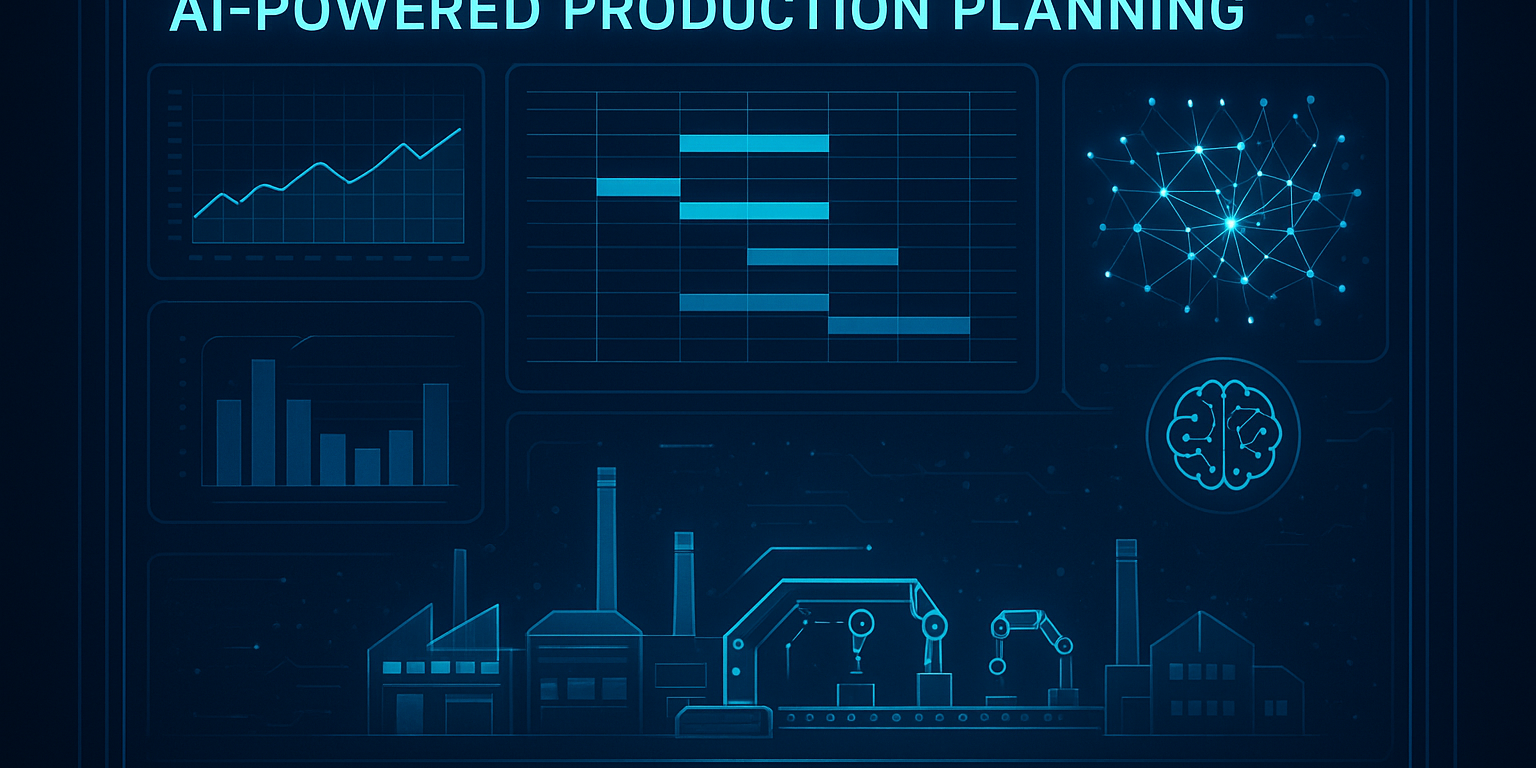
One of the most significant advantages of production planning with AI is the user-friendly platform that bridges high-level analytics with day-to-day operations. Instead of asking your frontline managers to decipher complex algorithms, you rely on an intuitive dashboard or interface that displays tasks, timelines, and capacity in visually clear blocks or color-coded segments.
An interactive smart scheduling interface allows you to drag, drop, and adjust tasks as needed with immediate feedback from the underlying AI engine. Imagine you see a conflict between two job orders fighting for the same machine. By shifting one order to an alternative machine or timeslot, you see in real time how that decision impacts overall throughput and deadlines.
Why interface design matters
An AI solution is only as effective as the humans who use it. When your interactive scheduling interface provides a clear, uncluttered view of your entire production pipeline, employees can rapidly spot trouble areas. They also gain the confidence to experiment with different scheduling options without fear of irreversibly disrupting workflows.
Moreover, adopting a visually appealing and intuitive tool encourages broader acceptance in your organization. Supervisors and operators who might have struggled with complicated spreadsheets can now embrace an interface that offers guided suggestions from AI. That simplicity goes a long way toward reducing repetitive data entry and building trust in the new system.
If you’re exploring options, you might look into smart scheduling software that integrates AI algorithms with an approachable dashboard. This type of tool typically comes with ready-made modules for forecasting, reporting, and collaboration, so you can centralize all scheduling tasks in one place.
The All-in-One AI Platform for Orchestrating Business Operations
 Instantly create & manage your process Use AI to save time and move faster Connect your company’s data & business systems
Implement AI-driven solutions effectively
You may be wondering how to apply these AI-driven solutions in real-life workflows. It helps to start small, targeting specific areas where poor scheduling has the largest impact. Many manufacturers first pilot AI scheduling on their most constrained line, or on a subset of tasks where delays are frequent. This way, you can measure and compare performance before expanding AI usage across the entire site.
During implementation, communication is key. Your team, especially line supervisors and machine operators, should understand why an algorithm might shift a task or combine orders. Clarifying the rationale behind these changes builds trust and helps people see AI as a collaboration tool rather than a topper-level directive they must follow blindly.
Steps to integrate AI into your process
- Identify your biggest pain points. Pinpoint a line or area where scheduling issues most commonly arise.
- Collect accurate, up-to-date data. Your AI system is only as strong as the information it analyzes.
- Train relevant team members. Show them how to read the interface, interpret AI suggestions, and provide feedback on results.
- Set clear metrics. Define success criteria, such as reductions in overtime hours or improved on-time delivery rates, to gauge AI’s impact.
- Expand gradually. Once you see measurable gains, integrate AI planning into more processes and lines.
A thorough rollout ensures that everyone stays on the same page, and it prevents confusion or resistance that can arise from sudden changes in daily routines.
Measure the impact on operations
Once you begin using AI-powered production planning, you’ll want to examine the results closely. Collecting and analyzing performance data helps you confirm how well the system is doing and pinpoint where you might fine-tune further. Typically, you’ll see improvements in:
• Lead time reduction, even for complex orders with short turnaround windows.
• Lower overtime and fewer last-minute schedule changes.
• Better machine utilization, with fewer idle hours or overlapping tasks.
• Reduced scrap or rework, thanks to more balanced workloads and fewer rushed jobs.
You’ll also want to track your on-time delivery rate, a vital metric that reveals whether your production process can keep pace with customer expectations. Over time, capturing these metrics helps you paint a clear picture of return on investment. The proof is in consistent results—less guesswork, a steadier production flow, and reduced friction when responding to sudden changes.
Demonstrating advanced productivity gains
Suppose your plant manufactures components for the automotive industry, and late deliveries were once a frequent headache. After a few months of leveraging AI-driven scheduling, you might measure a 15% increase in on-time shipments, a 10% decrease in overtime costs, and a marked improvement in employee satisfaction reported on internal surveys. Those numbers tell a story of enhanced workflow efficiency and a more stable environment for everyone involved.
This kind of feedback loop is invaluable. Not only does it justify your initial investment, but it also gives you the data you need to expand AI usage to other departments or production lines. Over the long term, you can integrate AI-generated schedules with inventory management systems, maintenance programs, and even enterprise resource planning (ERP) tools, strengthening your entire manufacturing ecosystem.
Plan your next steps carefully
While production planning with AI opens up significant opportunities for efficiency and savings, you’ll want to evaluate your infrastructure before going all-in. If you lack reliable data collection processes, or if your current software systems are fragmented, it may take extra effort to ensure AI can access consistent, accurate information. Still, those hurdles aren’t insurmountable. Careful planning and robust data management protocols can set the stage for a smooth AI transition across your facility.
Think about assembling a cross-functional team to oversee the process. Include IT professionals, line managers, and data analysts who can drive both the technical implementation and day-to-day usage. This joint approach ensures the system stays flexible enough to adapt to each department’s needs while maintaining overall consistency and quality control.
Practical ways to keep momentum
- Start an AI readiness audit: Identify where your data is stored, how clean it is, and what gaps you might need to fill.
- Engage leadership: Gain buy-in from senior management by showing how AI-based scheduling aligns with overarching business goals.
- Create feedback channels: Encourage production-floor employees to share observations on system recommendations so you can address any unexpected issues.
- Provide ongoing training: As your AI scheduling tool evolves with new features, continual skill-building keeps everyone up to speed.
Following these steps positions you well for scaling AI-driven production planning even further. Ultimately, your goal is to let the AI system handle the granular scheduling details while your people concentrate on strategic improvements and creative problem-solving.
Conclusion
In today’s fast-paced manufacturing environment, production planning with AI provides you with much-needed agility. You pull together data from multiple systems and trust real-time analysis rather than guesswork. As you embrace an interactive scheduling interface, communication flows more smoothly, unexpected changes become manageable, and you can keep complex operations on track with less stress.
By implementing AI across your facility, you gain control over every stage of production. Whether you’re tracking a single work cell or an entire plant, you have a system that continually learns from each shift and each order. Over time, those incremental improvements compound, resulting in more consistent delivery times, cost savings, and a happier workforce.
Now is the time to assess your current scheduling setup, identify your biggest pain points, and explore the AI solutions that can tackle them. As you do, remember that rolling out new technology is as much a people process as a digital one. By fostering an environment of collaboration and transparency, you’ll see your scheduling hurdles shrink and your production output thrive. And that’s the ultimate goal: stable, efficient, and future-ready operations that position you at the forefront of modern manufacturing.
The All-in-One AI Platform for Orchestrating Business Operations
Instantly create & manage your process Use AI to save time and move faster Connect your company’s data & business systems
