


Proven Business Best Practices, Processes, Tools and Templates for Innovation Management

Innovation management is the process through which a business systematically develops a new product, service, process, or business model. While organizations come up with new innovations all the time ranging from different ways to package and ship goods to the development of new technologies that enable customers to shop in more seamless ways, the manner in which they manage innovation can vary greatly depending on the industry and organization. In fact, innovation management itself can take many forms, and can have vastly different impact in terms of scope and value for the business.
The purpose of innovation management is to provide greater value – either to a customer, a key stakeholder or a business. When a business succeeds at producing a valuable innovation, it can be rewarded by greater efficiencies throughout the organization, additional sales, industry recognition, and greater customer loyalty. When innovation goes wrong, businesses can lose millions of dollars and the customer experience can be irreparably harmed.
Leading Innovation
If you are a leader in charge of innovation within your organization, you’re likely asking yourself how best to manage the process of innovation in a way that ensures the greatest return on investment, all without putting the business at risk. The process of innovation management is complex, and it is made up of many parts.
Whether you are creating an opportunity portfolio, developing a business case, tracking products and services through the stage gate process, or engaging internal teams and external partners in the innovation process, leading innovation requires a structured yet flexible approach.
No matter what stage of the innovation management process you are facing at this time, a number of proven innovation processes, tools and templates exists to help guide your decision-making as you work to develop innovative solutions within your organization and for customers.
Five Phases of Innovation Management
Innovation management tends to be separated out into five key phases:
- Exploration
- Definition
- Testing & Learning
- Building a Business Case
- Implementation
In the Exploration phase, we look to identify core problems that the business is trying to solve. In the Definition phase, we uncover the best ways to prototype and develop ideas for innovations which may help to solve the problems identified in the Exploration phase. In the Testing & Learning phase, we get feedback on our initial concepts and ideas by talking to internal stakeholders and customers. In the Building a Business Case phase, we ensure your investment in innovation will see strong returns which will drive actual business growth. And finally, in the Implementation phase, the goal is to develop and implement the idea into a tangible solution that delivers real value.
What follows is an exploration of the top innovation management tools and templates we have identified that fit within each of these five phases. Some of these tools and templates are also available for download as either a PPT or an Excel from page should you wish to use them as is, or adapt them to your organization:
1. EXPLORATION
True innovation should always start with the customer in mind. Empathizing with your target customer is the best way to identify opportunities to help better serve them and solve their problems. Without developing deep customer insight, you might create a product that misses the mark and doesn’t meet an important enough need or solve a big enough problem.
The Explore phase includes three primary steps:
- Identify the problem
- Get customer insight
- Identify jobs to be done
Follow the steps below or use the individual tools in any order to help you better think through your idea. The goal is to gain new insights and information to generate ideas or further build out your initial idea. If you already have an idea, it’s usually helpful to write it up before starting the Exploration phase by filling out a Concept Development Template.

1.1 Identify the Problem
The first step in any innovation activity is to define the problem you are trying to solve. Innovation without purpose is a luxury, and you will rarely have the opportunity to tinker around with new and innovative approaches to doing business unless there is a clearly defined problem to solve.
The spark for innovation usually occurs when you recognize a problem exists or there could be a better way to do something. Consider using one or more of the templates below to get clear on your “target customer” and what their primary issues or problems are that you can potentially solve. Sometimes it’s helpful to complete one of these templates and then go back and edit it after you gain more information about the problem and customers during other steps of the innovation process. Iteration is good!
SCAMPER Template
SCAMPER is an acronym that provides a structured way of assisting teams and individuals to think out of the box and enhance their knowledge around a specific topic or idea. The SCAMPER Template provides a structure for putting together these ideas in one place using certain prompts to help generate more creative ideas.

Six Thinking Hats Template
You may also think about using the Six Thinking Hats Template to consider different ways of identifying a business opportunity or customer problem. Each hat provides a unique lens with which to listen and think about a new or existing idea.

1.2 Get Customer Insight
Once you have defined a business problem you want to solve, the next step is to start working to empathize with your target customer. What is it that they want to accomplish, and what are their key pain points? Uncovering their key needs or problems will be essential as you determine the best path forward on your innovation journey.
Getting “insight” is integral to obtaining a better understanding of your target customer’s problems and needs. The goal is to find specific pain points, motivations, issues, problems, desires, or anything else that will help clarify your focus. There are many ways to get insight, from doing internet research to conducting interviews.
Customer Problem Statement Template
The Customer Problem Statement Template helps you to put yourself in the customers shoes and consider the characteristics they have and the barriers they face.

Customer Empathy Map Template
The Customer Empathy Map Template helps you think about the different things that a customer might say, feel, think and do while simultaneously forcing you to think about their “pain” and opportunities to “gain” something of value.

Painstorming Template
Another great way to think about customer pain points and problems is to conduct an exercise called “Painstorming”. Use the Painstorming Template below to help develop a better understanding of your customer and their needs.

1.3 Identify Jobs to be Done
Exploring customers’ “Jobs to be Done” is a way to identify and understand their most important needs and problems. The underlying principle of the concept is that people buy products and services to get a “job” done, and the most successful products help customers get their jobs done faster, more easily or less expensively. When a company understands in detail what a functional job is, it is more likely to be able to create solutions to help the customer get a job done better than the competition.
List & Prioritize Your Customers’ Jobs to Be Done
After conducting interviews or other market research, it becomes possible to uncover the primary “jobs” your customers do today and want to do in the future. The biggest opportunities usually come from the most important jobs that are the most difficult or require a lot of effort to accomplish. Questions to consider that can help reveal your customers’ jobs to be done include:
- What are your customers’ processes?
- What outcome are they seeking to create or realize?
- What workarounds are they doing when the current process doesn’t meet their needs?
- What keeps them up at night?
- What are their primary complaints, wishes, and desires?
- How do they currently meet their needs, and what is working or not working for them?
Use the template below to list and create a relative score for each of your customers’ most important jobs to be done.
Jobs to be Done Template
The Jobs to be Done Template allows you to prioritize your customer’s biggest activities by importance and difficulty:
Jobs to Be Done Map
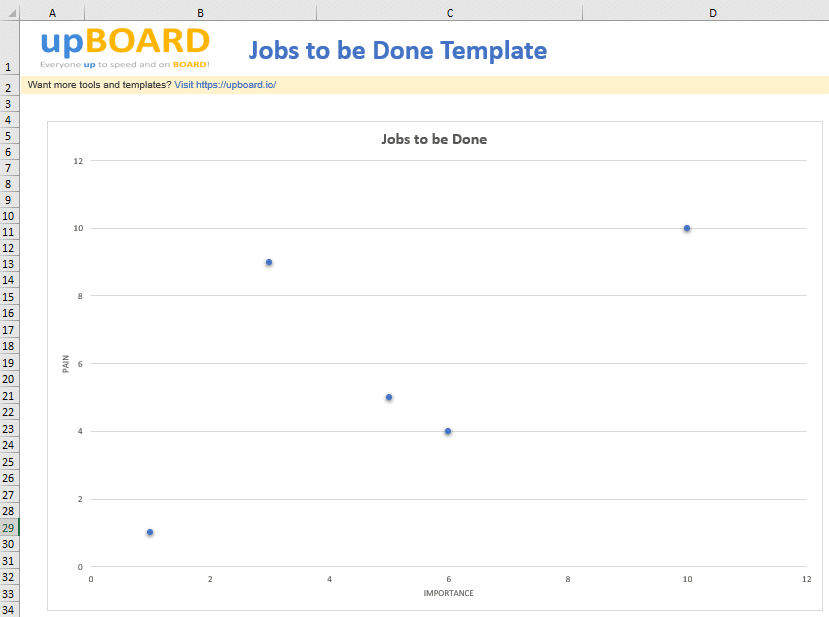
After completing the Jobs to be Done Prioritization scoring, you can chart your prioritized portfolio of jobs using a map like the one shown below. Review the jobs in the top right quadrant that are the highest in importance and pain to the customer. Explore how you might support these jobs as part of your idea.
2. DEFINITION
Once you have a sense of the issues, problems, and needs of your target “customer,” it becomes possible to further define your idea. Different ideas should be communicated differently. Product ideas are typically best illustrated using drawings. Services, customer experiences, and new business processes are usually best communicated using storyboards, wireframes or process diagrams.
It’s also valuable to explore the business model that will support the idea. Use the tools below if helpful, or just draw your idea, find photos on the internet, or use other software tools to depict your idea.
Concept Development Template
Sometimes you might start with a pre-existing idea as noted above, but if not, as you start to think about the idea you want to bring into the world, the best place to start is with the Concept Development Template. The Concept Development Template below has been built into both PPT and Excel based on your preferences:
Prototype Your Idea
Once you have outlined the high-level features of your product or service using the Concept Development Template, you are in a place to think about prototyping your idea. Bring your ideas to life with a visual depiction and description of key attributes and features using one of the templates below:


Explore the Business Model
Explore the various dimensions of the business model for your idea including your idea’s “WOW” factor and other differentiators.
Business Model Template
The Business Model Template is a tool for developing a new business model or clarifying the elements of an existing business model. It is a “canvas” or chart that describes a firm’s value proposition, infrastructure, partnerships, value proposition, customers, finances and other strategic and operational dimensions of the business.
The Business Model Template lays out ten building blocks for any business, whether a for-profit company or nonprofit organization. The different dimensions of business model design include:
- Customer Segments: The different types of customers that a company targets to build a successful business model
- Unfair Advantage: The one thing you will do that can’t be copied and differentiates the product, service or business
- Unique Value Proposition: The single compelling message that says why you’re different and worthy of customers’ attention
- Solution: The top 2-3 features or elements of the overall solution
- Problem: The core problem or job to be done that the solution addresses
- Key Metrics: The most important activities that will be measured to indicate success
- The “WOW!”: The one insanely cool feature that every customer and review will rave about!
- Channels: How to reach customers, including internal channels (store fronts), partner channels (distributors), or a combination
- Cost Structure: The primary costs of doing business
- Revenue Streams: The primary way of making money
When using the business model template, iterate on your answers based on your continuous research and learning.

Review Competition
Assessing the competition is key to understanding what is already being done around your proposed area of innovation and what might help you differentiate your idea.
To successfully assess the competition, review the competitive environment including specific organizations and products, services or features that compete with your concept.
When developing a new product or service, it’s important to understand the competition so you can make sure what you’re creating is different from what exists. If you’re creating a new business process or customer experience, competition in the traditional sense may not be as relevant.
In either case, usually there are “alternatives” that customers currently use or could use instead of what you’re offering. In its broadest sense, consider what competition exists for your idea and explore the competition’s current role, threat to your idea, and strengths that exist that you might learn from or apply in some way to your own ideas.
Competitive Analysis Template
A basic Competitive Analysis Template includes a list of key competitors, an assessment of their threat to your business, their core strengths, and how you are or will create competitive differentiation compared to them.

3. TESTING & LEARNING
Businesses that move fast and learn from their mistakes are those that stay ahead of the competition. Those who are able to test their ideas quickly and iterate on those ideas are likely to be the most successful in the long run.
With this in mind, consider how you can test your ideas more efficiently. Once you have an idea, how do you know if it’s any good? The best way to make your idea better is to share it with others for instant feedback, especially potential customers. When you get input or learn something new, go back to your original idea and update it. It’s all about iterating so you make your idea better with every piece of feedback.
It’s also important to identify your biggest assumptions and hypotheses, and then test them through research and discussions with customers, partners, colleagues, and others. Doing this helps surface additional issues and identify specific gaps or risks that need to be addressed later in your business case and plan.
Test Your Ideas
Identify & test key assumptions and hypotheses that underlie your idea, the business model and your approach to implementing it.
Because “innovation” involves creating something new, there is always some level of uncertainty built into the process. The best way to manage this uncertainty is to identify the biggest assumptions underlying the idea, and then do what’s needed to validate them. Different assumptions exist for different types of ideas and can relate to the market, customer needs, suppliers, partners, technology, user adoption, and a myriad of other things. Use the tools below to identify the biggest assumptions that underlie your idea, and then go out and test them through conducting internet research, talking to customers, talking to experts, conducting a mini-pilot of your idea, or anything else that will help you validate (or invalidate!) your current thinking.
Concept Testing Template
The Concept Testing Template prompts users to ask specific questions around the assumptions and hypotheses that they would like to test, and then provides an opportunity to identify how those hypotheses will be tested.

Concept Screening Template
The Concept Screening Template allows users to screen multiple concepts alongside one another to better understand how specific ideas stack up against one another:

Learn & Iterate
Whatever you choose to do in order to test your idea, it’s important to document what you learn. Just as important, you should look at the strategic and tactical implications of what you’ve discovered.
When you learn something, you typically either challenge an explicit or implicit assumption or validate a hypothesis about your idea, so it’s essential to link learning to specific improvements you can make. Use the template below to capture the biggest things you’ve learned and list what you believe are the most important implications for your idea, your business model, or how you need to approach implementation. Update your idea based on what you’ve learned.
Build Learn Measure Feedback Loop Template
The Build-Measure-Learn Feedback Loop Template helps translate potentially risky ideas or strategies that top management is not completely certain about into beneficial knowledge that can be used to promote progress in the organization. More specifically, this knowledge can be applied to idea and product development as well as general business strategy.

Identify Gaps & Risks
Look at the specific gaps in knowledge, technology, or resources that exist, and any other business risks.
When doing anything new, there are always risks. That’s why “risk taking” and overcoming fear of “failure” is so important for innovation. One way to increase the chances of success from the beginning involves identifying the biggest gaps and risks that exist, and coming up with a plan to address these. Use the template below to identify and list the biggest gaps and risks related to your idea. Where possible, identify ways to bridge gaps and mitigate risks.
Key Knowledge Gaps Template
Create a table like the one shown below to list your top knowledge gaps related to the idea. What else must be obtained or learned to provider a greater degree of confidence and likelihood of success?
After that, list the biggest risks involved in implementing the idea. What could be the biggest barriers or stumbling blocks?

4. BUILDING A BUSINESS CASE
Innovations should not be pursued without a solid business case in place for why that innovation is necessary. Unless there is a plan in place to ensure the innovation will support future business growth, it will likely not lead to sustainable growth. After you’ve tested your concept or idea, make sure you build a business case which will stand up to questioning.
SWOT Analysis Template
Explore and highlight the key Strengths, Weaknesses, Opportunities, and Threats that exist for the idea.
SWOT Analysis is a strategic thinking tool that helps reveal the strengths, weaknesses, opportunities, and threats related to an idea or business strategy. Considering all of your work so far, compete the SWOT analysis. Consider the strengths that make your idea truly different, the remaining gaps and risks that represent weaknesses or threats, and the biggest opportunities for the idea. Don’t get too detailed. The goal is to provide a top line summary of the key points for each element of the SWOT.

Scope Opportunity
Outline the overall risk profile, revenue generation or cost savings opportunity, and financials of the idea.
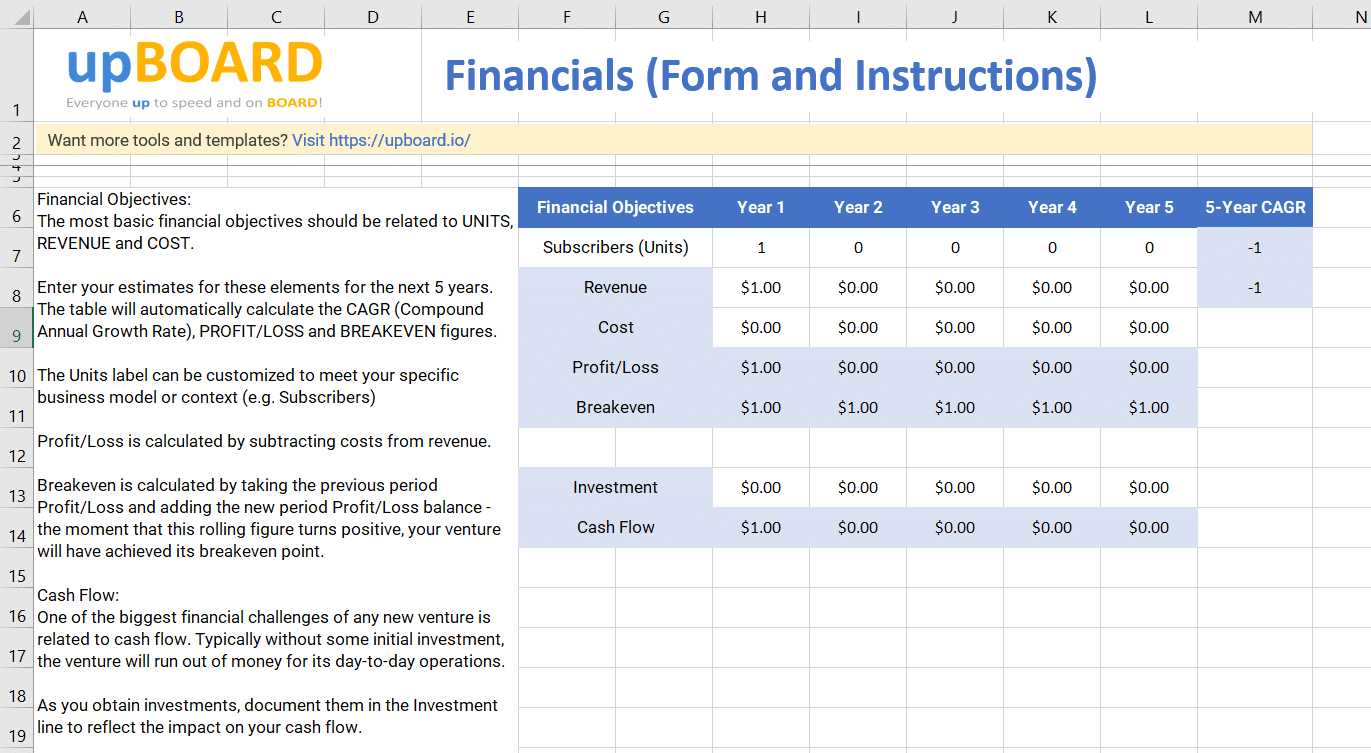
Good ideas turn into great “innovations” when they add value to the world. Outlining how much money it may cost to implement your idea and the potential return on investment is an important aspect of building the business case. Even if you don’t have all the detailed information, it’s important to estimate the investment and returns, and list any assumptions being made in the process.
Financial Return Template
List the primary sources of revenue or cost savings from your idea over time. This is the “return” you expect to achieve from implementing the idea. Note your biggest assumptions behind these numbers below.
Then, list the primary costs required to implement your idea and achieve the financial return outlined above. This is the “investment” you believe is required to implement the idea. Note your biggest assumptions behind these numbers below.
Opportunity Risk Assessment Template
To gain a sense of the relative opportunity versus risk for your idea, it’s often helpful to score your idea using certain criteria. Based upon your work to date, enter scores in the tables below to assess what you see as the relative overall opportunity and risk associated with implementing your idea.
One of the best examples of opportunity risk assessment is portfolio management. Portfolio Management is an indispensable management process that provides a high-level perspective of how aligned the organization’s projects are with its strategic objectives. It enables managers to not only track implementation of current projects, but also anticipate the necessary resources and likelihood of success of proposed projects, identifying potential barriers and risks prior to new project selection.
You can check out the tool we’ve created to help with opportunity risk assessment in portfolio management here.

Define Action Plan
Identify specific milestones and actions to advance the idea to the next level.
Now that you’ve explored customer needs, defined and tested your idea, and scoped out the opportunity, it’s time to list the specific things that need to be done next. Is your idea really for full implementation? Do you need to do another round of testing with customers? Do you need to build out a more complete and robust working prototype? Whatever your answer, list the top action items needed to advanced your idea to its next stage.
An Action Item List is a simple tool for tracking tasks, owners of tasks, and the time frame that tasks need to be completed during a project. You can see the template we’ve created to help you develop your own action item list here.

5. IMPLEMENTATION
In the context of building a business or developing a strategy for innovation management, implementation is the process of acting off of the back of your previously made assumptions and executing a plan or policy so that a specific product, process or service becomes a reality. To implement a plan properly, it’s important that the business is aligned and that managers clearly communicate goals and expectations to those throughout the wider organization.
Innovation Horizons Template
Part of the process of aligning expectations comes through horizon planning. The Innovation Horizons Model, also called the three horizons model, is a framework that organizations can use to identify areas for innovation and improvement without losing sight of current performance. This model is useful for driving innovation while preventing the type of organizational stagnation seen in many mature companies.
The Innovation Horizons Model Template can be used to outline the different innovation priorities you have over time, the products and services to be explored within each of those horizons, and the details related to business model and strategic approach to each horizon.

Innovation Roadmap Template
An Innovation Roadmap is a visual depiction of the steps to be taken to achieve a strategic goal driven by innovation. As a strategic tool, and Innovation Roadmap lays out the specific actions that should be implemented over time to create new products, services, or business models.
The Innovation Roadmap Template is a tool which can be used to help you outline your top innovation priorities across a timeline.

CONCLUSION
Innovation management is a complex topic. Almost all businesses are looking for new ways to streamline the process of effectively managing innovation within their organizations, and chances are there is a lot more that could be done to streamline the innovation process within your business.
Whether you run an innovation department, R&D lab, or HR department focused on creating a culture of innovation, upBOARD’s Innovation Management Software Platform gives you a scalable solution for driving innovation.
6. OTHER TOOLS AND TEMPLATES
Technology Life Cycle Model Template
The Technology Life Cycle outlines the life cycle through which a product moves from the research and development phase to the the financial return during its “vital life”. The Technology Life Cycle Model Template provides you with insight into the effects of customer needs, core technologies and outside forces on the lifespan of the technology.

S-Curve Mapping Template
S-Curve Mapping is the process used to identify the different phases of evolution of a product, service, or business process to identify innovation opportunities for competitive advantage. S-curve maps plot product or industry performance along the axes of time and performance. The model can be used to determine how mature and established an organization is within the industry or how well-developed the industry is itself.
The S-Curve Mapping Template provides you with a framework for identifying key products, services or offerings that fall into each phase of evolution.
